
(Solomon Victor, Vijaya M. Nayak, Raveen Rajasingh, “Evolution of the Ventricles,” Texas Heart Institute Journal, Vol.26(3):168-75 (1999), internal citations removed.)
A Hearty Introduction:
Before we get going, here are some exciting
heart facts to start your day with: In case your momma never told
you, hearts have 2 types of chambers: atria and ventricles. Atria
are where blood enters the heart and ventricles pump the blood out of the
heart. Hearts take in oxygen poor blood, pump it through the pulmonary circuit (lungs/gills) where it gets oxygenated,
and then they pump it out to the rest of the body.
There are many many small veins (take blood to the heart) and arteries (carry it away) which connect the heart to the
pulmonary circuit and keep it all running right. Blood pressure has to be
carefully balanced in all tubes so that flow pressure is maintained and
blood keeps moving, but not so fast as to explode certain areas or
capillaries. One might say this careful and complex hydrostatic wiring
might be easily selectable in an evolutionary scenario, but there’s no getting around the fact
that there’s a very complicated and highly balanced network of biological fluid mechanics going on inside
a heart than most artificial heart engineers probably care to think about.
Given all this, there are 3 basic ways to make a heart found in animals:
a 2 chambered heart, a 3 chambered heart, and a 4 chambered
heart. Fish have 2 chambers, one atrium and one ventricle. Amphibians and reptiles
have 3 chambers: 2 atria and a ventricle. Crocodiles are the one reptilian exception, as they have 4 chambers (2 atria, 2 ventricles).
Birds and mammals have 4 chambers (2 atria and 2 ventricles).
Differences between the hearts:
The fish heart (figure 1a) is much different than the amphibian/reptile/bird/mammal heart (figures 1b and c). Hearts are very complex–they’re not just a bunch of random arteries and veins connecting tissue. Fish hearts simply draw in deoxygenated blood in a single atrium, and pump it out through a ventricle. This system is termed “single circulation”, as blood enters the heart, gets
pumped through the gills and out to the body, Blood pressure is low for oxygenated blood leaving the gills.
3 and 4 chambered hearts have a pulmonary circuit (pathways taking blood from heart to lung
and back to heart) that is very complex and must be set up such that blood can travel from the heart
to become oxygenated in the lungs and then be properly pumped back the heart and out to the body. The 3
(and 4) chambered heart has “double circulation” (figure 1b and c) and is quite different
from “single circulation” (figure 1a) of fishes.
“Double circulation” has an interior circuit within the heart–blood enters the heart, leaves the heart and
gets oxygenated, enters the heart again, and then gets pumped out to the
body. Because “Double circulation” allows oxygenated blood to be pumped back
into the heart before going out to the body, it pumps blood with much more
pressure and much more vigorously than “single circulation”.
Figure 1: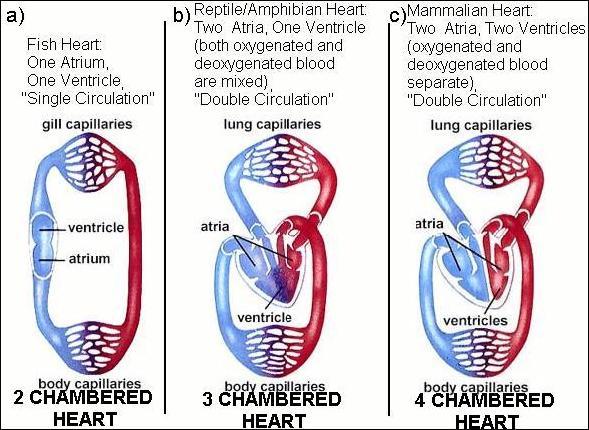
The Above diagram adapted from “http://gened.emc.maricopa.edu/bio/bio181/BIOBK/BioBookcircSYS.html#Vertebrate
Vascular Systems which was said to be adapted from http://www.biosci.uga.edu/almanac/bio_104/notes/may_7.html
and bears a striking resemblance to the diagrams from Campbell’s “Biology”
4th edition pg. 822.
Though the 4 chambered heart has 2 atrium-ventricle pairs, both pairs do not do the same thing. There are 4 steps
involved with blood entering the heart: 1) oxygen poor blood enters the
first atrium. 2) oxygen poor blood is fed to the first ventricle, which
pumps it out to the pulmonary circuit (lungs) where it is enriched in
oxygen. 3) Oxygen rich blood just leaving the lungs is pumped back into
the second atria. 4) Oxygen rich blood is then fed to the second
ventricle, which pumps the oxygen rich blood out of the heart and back
into the body for usage.
The 4 chambered heart differs from the 3 chambered heart in that it keeps
oxygenated blood completely separate from de-oxygnated blood, because there is one ventricle for deoxgynated blood
and one for oxygenated blood. In the 3 chambered heart, a single
ventricle pumps both out of the heart, and there is some mixing between
fresh and old blood. The 2 ventricle-4 chamber heart prevents mixing
allows the blood leaving the heart to have far more oxygen than it would
otherwise. This is good for enhancing the more fast paced lifestyle that
birds and mammals tend to have, giving an advantage to having a 4 chambered heart.
Problems with evolving the hearts:
Getting a heart, period: Evolving a 2 chambered heart in the first
place is very difficult because the circulatory system is irreducibly
complex. At least 3 subsystems are necessary: 1) an organ for enriching
the hemophlegm (blood) with oxygen
(lungs/gills), 2) a complex network of closed tubes to carry the
energy-rich blood to the
body (veins and arteries), and 3) a pumping mechanism (heart) to
transport energy-rich fluid throughout the body. One common way an
evolutionist might try to get around problems associated with irreducible
complexity might be to imagine scenarios where some or all of the
subsystems could originate in a freestanding manner, functional on their
own. However in this case what good is a closed tube network without a
pumping mechanism to transport fluid, and what good is a pump without the
fluid or the tubing? Oxygen exchange occurs in many organisms through the
skin without a chordate-like circulatory system, but what is the advantage
for such an organism to randomly mutate itself a single oxygen exchange
organ (the lungs/gills)? Even so, once a single oxygen exchange organ was
in place, it would need the very transport network provided by the heart,
veins and arteries. Scenarios attempting the circulatory system in a step
by step manner would fail and not take into account the overall complexity
of the system.
Even if the subsystems of the circulatory system could be
evolved on their own, evolving a freestanding 2 chambered heart on its own
would be very difficult, even if it didn’t need other components of the
circulatory
system to be useful. A human heart is an 11 ounce pumping machine the
size of a human fist which beats over 2 billion times and pumps over
100 million gallons of blood over the course of the average
human lifetime. It is primarily a shell with a carefully
balanced interior network of holes and valves which keep fluid constantly
flowing in, out, and in the right direction everywhere in between. A
large number of fluid-directing parts as well as a very strong
and properly and complexly shaped pumping muscle are
necessary for it to function. The positioning of the parts of a heart
are a good example of specified complexity.
For this reason, the heart, as well as the entire circulatory system, are
unevolvable in a step by step manner.
Getting a 3 chambered
heart from a 2 chambered heart: Given a 2 chambered heart, experts do
not know when, how, or in
what lineage the alleged transition from the 2 chamber fish heart to the 3
chambered amphibian heart took place, mainly because this is a very
difficult transition to even imagine. A 3 chambered heart has “double
circulation” and is
irreducibly complex with respect to “double
circulation”. 2 chambered hearts of fish have “single circulation” and
the basic design is very different from a 3 chambered heart.
A vastly oversimplified explanation of the evolution of the
heart might be to say that by simply duplicating the some or all
of the chambers of a 2
chambered heart, one could easily evolve a functional 3 or 4 chambered
heart. Of course the way the evolutionary story goes, fish turned into
amphibians which turned into reptiles which became mammals and birds, so
the heart is said to have evolved from 2 –> 3 –> 4 chambers. A
direct 2 –> 4 chamber transition is never thought to have taken place
and would have even more difficulties than a 2 –> 3 chamber transition,
so we will focus on the 2 –> 3 chamber transition.
However, in reality the changes that would need to take place for this
transition are far more
than merely the duplication of one or more chambers. It could not happen
in a step-by-step manner where intermediates are functional.
The 2 chamber heart –> 3 chamber heart transition requires much more than
the duplication of an atrium, because the interior circuit causing the
“double circulation” of the 3 chambered heart must also be created.
Duplicating the atrium without a closed circulatory network for “double
circulation” would cause the heart to suck nothing but interstitial fluid
out of the body. “Double circulation” only works when there is a loop
feeding from a ventricle back to the heart, and back to a ventricle.
Thus, both the loop and the new atrium are necessary for a 3 chambered
heart to function. And though the loop (interior circuit) sounds simple,
it really must be a complex tube network with valves in the right
places to keep fluid flowing properly.
Single circulation hearts
pump blood directly through the gas exchange organ and out to the body
(figure 1a).
Double circulation pumps blood to the lung/gills through an “interior
circuit” loop and then back to the heart before going out to the body
(figure 1b and c).
And if this new loop doesn’t connect with the gas exchange organ, then the
new loop is functionless and useless. The easiest way to make this
transition
happen is probably to have the vein leaving the gas exchange organ
feedback to become an artery feeding back into the heart. Of course this
means the new vein-artery simultaneously needs
the proper valves so it can function like an actual part of the heart
itself. Probably of most importance is the fact that
there is now no
vein leaving the heart and pumping blood back out to the body. In other
words, to create this interior circuit of double circulation, a new
vein must be created and blood flow out of the heart completely
rewired to the rest of the body.
Even if gas exchange organ
could be bypassed (making it a less complex, though functionless and
not selectively advantageous circuit), the
main problem with going from
single circulation to double circulation is that somehow this new
circuit has to wire itself to the lungs. Either way, the vein leaving
the heart must somehow also become an artery fed back into
the heart through a new functional
atrium and then a new vein must be created so that blood leaving the heart
still gets out to the rest of the body through the circulatory network.
Finally, the heart muscle has to adapt to all of these changes, especially
such that beating can occur to pump through the new atrium and associated
fluid pressure changes.
In other words 4 primary changes are needed to go from single to double
circulation:
transport through new
atrium is functional
leaving the heart into an artery at the other end such that it is fed
back into the heart.
leaves the heart and goes out to the rest of the body (the creation of a
new vein and rewiring).
additional atrium
and fluid pressure changes associated with the rewiring.
If any of these steps are missing, double circulation won’t work.
And this says
nothing about the many valves and other smaller veins and arteries
associated with double circulation which characterize true hearts as well
changes needed in the pumping mechanism of the heart muscle to accommodate
a completely new atrium and fluid-pressure balance.
The transition from 2 to
3 chambers requires a change from single to double circulation which
involves at least 4 major simultaneous changes including the
complete rewiring of how blood leaves the heart to the rest of the body.
Many more minor simultaneous changes associated with mechanics of
proper fluid transport would also be necessary. It not possible for
double circulation system to evolve from
a single circulation heart system in a Darwinian step-by-step manner
because too many changes are necessary,
making the 3 chambered heart unevolvable from a 2 chambered heart.
Getting a 4 chambered heart: With respect to hearts with “double
circulation”, the 4 chamber mammalian heart probably isn’t irreducibly
complex. Going from 3 to 4 chambers really doesn’t look all that
complicated (of course they’re still very different and this is totally
oversimplified, but I’m only talking about basic organ design).
Basically, the
single ventricle in the 3-chambered heart is split into 2 chambers in the
4 chambered heart, making 2 ventricles instead of one. A “double
circulation” heart could work with 3 chambers–and it does in reptiles and
amphibians.
The human heart has 2 atrium-ventricle pairs, which beat in
succession something like pistons in a car. Only one ventricle is really
needed to pump the blood. But just like an 8 cylinder engine put out a
lot more horsepower than a 4 cylinder, so does a 4 chamber (2 pairs) heart
have a much more power to supply the body with energy and oxygen-rich
blood than a 3 chamber (1 ventricle) heart. There is a huge advantage to
having a 4 chamber heart. Taking away the additional
capillary complexities
associated with suddenly having a second ventricle, one might be able to
argue that
the 3 to 4 chambered heart transition isn’t difficult to imagine,
relatively speaking, as all
one has to do is note the strong advantage of separating oxygenated and
de-oxygenated blood and then divide the ventricle in half. Of course the
key word here is “imagine”.
Irreducible complexity is a real phenomena,
and it can be analyzed, and so in some cases it might not exist, and in
the case of the 4-chambered heart case it probably doesn’t. Though the 4
chambered heart may not be
irreducibly complex with respect to “double circulation”, it might still
be the result of intelligent design and not evolution, and irreducible
complexity doesn’t have to exist in all instances for it to exist in some.
Overall, regardless of chambers, the heart has had much design put into
it. And the complex double-circulatory heart bears strong marks of
intelligent design.
Getting a bird heart: Finally, the evolutionary origin of
the bird heart-lung system is puzzling for the dino-bird hypothesis
because “no lung in any other vertebrate species is known which in any way
approaches the avian system.” (Denton (1998), pg 361). Molecular
biologist Michael Denton had the following to say about the evolutionary
origin of the bird-heart-lung system:
Just how such a different respiratory system could have evolved gradually from the standard vertebrate design without some sort of direction is, again, very difficult to
envisage, especially bearing in mind that the maintenance of respiratory function is
absolutely vital to the life of the organism. Moreover, the unique function and form of
the avian lung necessitates a number of additional unique adaptations during avian
development. As H. R. Dunker, one of the world’s authorities in this field, explains,
because first, the avian lung is fixed rigidly to the body wall and cannot therefore
expand in volume and, second, because the small diameter of the lung capillaries and
the resulting high surface tension of any liquid within them, the avian lung cannot be
inflated out of a collapsed state as happens in all other vertebrates after birth. In
birds, aeration of the lung must occur gradually and starts three to four days before
hatching with a filling of the main bronchi, air sacs, and parabronchi with air. Only
after the main air ducts are already filled with air does the final development of the
lung, and particularly the growth of the air capillary network, take place. The air
capillaries are never collapsed as are the alveoli of other vertebrate species; rather, as
they grow into the lung tissue, the parabronchi are from the beginning open tubes
filled with either air or fluid (Denton (1998), 361)
Denton goes on to say that, “The avian lung brings us very close to answering Darwin’s challenge: ‘If it
could be demonstrated that any complex organ existed, which could not possibly have been
formed by numerous, successive, slight modifications, my theory would absolutely break
down.’
One respiratory physiology expert, John Ruben, critiquing this evolutionary scenario noted that,
“a transition from a crocodilian to a bird lung would be impossible, because the transitional animal would have a
life-threatening hernia or hole in its diaphragm … It seems clear that a bird’s radically different system of
breathing, in which air is continuously drawn through its lungs, could not have evolved from the
hepatic-piston system we see in this theropod dinosaur.” (Gibbons, 1997 B, pg. 1230)
Plus, we’re
also dealing with convergent evolution here. The 4 chamber system had to
have evolved twice (and also in crocodiles), if it evolved at all, because
mammals and birds are allegedly from very different reptilian stock. It
isn’t just a neat case of common ancestry being clear cut by
characteristics.
There are many other animals with hearts–some
worms have like 5 or 6 hearts. These heats all probably evolved
independently however. So, there is not a nice neat Darwinian tree with
respect to hearts. Common design better explains this, because odds are
low you would come up with a similar structure through chance evolution
alone.
Summary and conclusion:
Fish: 2 chambers, Amphibians and reptiles: 3 chambers, Mammals and birds:
4 chambers. 3 and 4 chambered hearts are similar because they both have
an interior circuit or “double circulation”. This is very different from
the 2 chambered heart which has “single circulation”. Going from a 2 to a
3 chambered heart requires A LOT more than the mere duplication of a
chamber, but a COMPLETE reworking of the veins and arteries surrounding
the heart, interior valves of the heart, and the creation of this interior
circuit which can properly interact with the lungs. Plus I have it on
good authority that evolutionists don’t know how the 2 to 3 chamber
transition took place. Going from 3 to 4 might be more possible in a
remote theoretical sense, though there are surely many less important
complications. Going from 2 to 4 requires a vast more change than mere
duplication of atria and ventricles. It might be
remotely possible to go from a 3 chambered heart to a 4 chambered heart
but it is not likely that a 2 chambered heart could
evolve into a 3 or 4 chambered heart.
References Cited:
Campbell’s Biology 4th edition pg. 822.
Solomon Victor, Vijaya M. Nayak, Raveen Rajasingh, “Evolution of the Ventricles,” Texas Heart Institute Journal, Vol.26(3):168-75 (1999),
Michael Denton, Nature’s Destiny (1998), p. 361
Ann Gibbons, “Lung Fossils Suggest Dinos Breathed in Cold Blood,” Science, Vol. 278, 14 November 1997, p. 1230.