
[Completed September, 2004; Posted January, 2005]
Preface:
Steven Stanley’s The New Evolutionary Timetable Timetable: Fossils, Genes, and the Origin of Species [Basic Books, 1981] (herein referred to as “TNET”) is a popular-level book which develops, explains, and defends Stanley’s punctuational model of evolution.[1] Stanley has been very influential in formulating the punctuational model of evolution, and he is currently a professor in the Morton K. Blaustein Department of Earth and Planetary Sciences at John Hopkins University. Stanley does not believe that the punctuational view is the only possible model for how evolutionary change takes place, but he believes it is a compelling model which yields insight into evolutionary history.
Stanley has made significant contributions to evolutionary
biology, particularly with regards to elaborating the punctuational model of
evolutionary change. TNET is important to understand because it provides
insight into the nature of the fossil record, the punctuational model of
evolutionary biology, and Stanley’s own views on rates of evolutionary change
and the mechanisms by which species can originate.
I should note off-the-bat that I am a skeptic of Darwinian evolution. I am an ID proponent and I am affiliated with the IDEA Center, a relatively small intelligent design organization which helps promote
investigation, discussion, and debate about intelligent design theory on
college and high school campuses.[2]
My purpose here, however, is neither to critique nor to affirm Dr. Stanley’s work, nor is my goal to
make any kind of argument whatsoever, be it for or against evolution. My
purpose is simply to summarize Stanley’s views as presented in TNET for those
interested in understanding his work. If readers disagree with what is written here, they should try to keep in mind that if I have accurately summarized Stanley’s views in TNET, then they likely disagree with him, not me. My goal is essentially to attempt to
provide something constructive for “all sides” of this never-ending debate, so
that people can better understand Steven Stanley. I hope that all who read this will gain a better understanding of evolutionary biology, the punctuated equilibria model of evolutionary change, and specifically, Dr. Stanley’s views.
This is loosely a chapter-by-chapter summary and
review. I have skipped around a bit and combined similar sections out of the book. I have not discussed every aspect of the book, because my primary
purpose is not to give every detail of Stanley’s discussion, but to help
readers understand his views about rates of evolution and the origin of
species. Overall, I hope to accurately summarize the story told in Steven Stanley’s The New Evolutionary Timetable.
Introduction
The first chapter of TNET contains descriptions of various terms
encountered throughout the book. Evolution is an unfolding, which might occur
rapidly, or gradually. Later in the book Stanley explicitly defines the
gradualistic view of evolution, essentially calling it a slow and continuous,
species-to-species transition which connect genera or other higher taxa. (pg.
75) Stanley immediately critiques gradualism, as traditionally embodied in
the famous story of the allegedly slow, gradual evolution of the horse. (pgs.
1-3) Stanley contends that the horse’s evolution is actually not so gradual.
Because of this, their origin is not well-documented by fossil evidence. (pg.
3) This rapid evolution is often followed by long periods of stasis, which he says is a common pattern for many of the species in the traditional story of the origin of the horse.
Stanley believes that Darwin, in The Origin of Species, diagrammed
the tree of life as if branches diverged very gradually. (pg. 114) At the
core of Darwin’s argument is the notion that species arise through gradual
divergence. (pg. 115) Stanley repeatedly notes that Darwin’s gradualistic views
were heavily influenced by his view that the fossil record was generally too
imperfect to record gradual change. Stanley criticizes Darwin’s metaphor of
the fossil record as imperfect book, where the gradual changes were rarely
recorded. This metaphor is improper because the fossil record actually says evolution
proceeds by fits and starts. (pg. 7-8) Darwin believed that evolution closely
follows changing environmental conditions but Stanley counters that species do
not tightly track their surroundings. (pg. 11)
In Stanley’s view, natural selection does occur, but it is
really a combination of two processes: one random process and one nonrandom
process. (pg. 11) The random component is basically comprised of the processes
which create variability: reshuffling of genes in a population via random
mating, plus random mutations and other genetic mechanisms.[3]
The nonrandom aspect of evolution is natural selection where organisms with
certain traits tend to survive better than others with different traits. One
final force affecting species is genetic drift, where small populations might
undergo changes which are neutral with respect to environmental adaptation but
nonetheless spread throughout that population.
Though there are many definitions of the term “species,” Stanley essentially would recognize a species by looking for a reproductively isolated population of interbreeding organisms. (pg.
8) Stanley firmly believes that species change little throughout most of their
history. A chronospecies is a segment of a population in time which undergoes a
small amount of evolution during a span of time such that the individuals during the span can be recognized as
members of that same species. (pg. 14) Stanley’s view of species arising
quickly but then remaining generally static stands in contrast with Darwin’s view of the origin of species, where a population slowly morphs, via natural
selection, into something else over exceedingly long periods of time.
One of Stanley’s main themes in the early chapters is that Darwin taught us how changes can occur, not how species actually form. The fact that
chronospecies can be identified reveals that many species change little during their history. Nonetheless, Stanley believes a
chronospecies can exhibit significant variability during its overall
history—probably more than is found in a living population at any given time. Stanley also notes that one of Darwin’s aims in The Origin of Species was to assure the
reader that he meant to use no teleology to explain how species arose. (pg. 14)
Darwin’s scheme was totally mechanistic—to an extent which surprised even Darwin! (pg. 14)
A final concept Stanley introduces is that of plenitude.
Plenitude is derived from the Victorian “scala naturae” which held that the
world was supposed to be full of life, in a gapless series filling the niches
of the environment. Early evolutionists found the idea of plenitude easy to swallow
because they liked the idea of species climbing some imaginary ladder of
complexity. More on plenitude will come later.
A History of Darwin and his theory
Chapters 2, and 3 in TNET deal mainly with the history of how Darwin developed and his theory of evolution. The story is fascinating, but it is has been told many times by
many other authors.[4]
Darwin was heavily influenced by Charles Lyell, a lawyer and geologist who
used arguments to ultimately convince many of his peers and antecessors that
uniformitarian principles were the best way to understand geological history. (pg.
18) This view stood in contrast with the catastrophists of Lyell’s day.
In a dramatic encounter, Darwin experienced Lyell’s
principles in action during an earthquake in the Chilean town of Valdivia. As the Beagle sailed north along the South American coast, Darwin saw recently-upraised beds of muscles which were “putrid” because they had just
died after being thrust out of the tidal zone during the quake. While
observing a seaside cliff, Darwin saw a pattern of muscle beds going upwards,
and he realized this pattern might have been produced by many similarly small
upthrusts. Darwin was intrigued by the view that the Earth is a slowly changing
dynamic system and this influenced his view of life’s history as changing
gradually and slowly. (pg. 19-20)
Darwin borrowed another idea from Lyell—the notion that the
fossil record is imperfect. Ironically, Lyell believed life had changed little
over Earth’s history, and cited the imperfection of the fossil record in support
of this claim. Yet it was this very claim of an imperfect fossil record which
led Darwin to his view of slow, gradual change.
Though the fossil record played a role in forming Darwin’s beliefs about extinction, Stanley notes that many of Darwin’s ideas about
evolution were ultimately based upon studies of living organisms. Stanley insightfully divides Darwin’s ideas into two categories:
1) The concept of evolution (i.e. that life had simply changed over time with descent).
2) The mechanisms or processes he envisioned as causing that evolution (i.e. natural
selection). (pg. 27)
Darwin’s voyage on the Beagle led him to think mostly about
the first category: that species had changed. Stanley notes that the voyage
revealed variation among organisms, and that Darwin did observe the natural
struggle for survival which later influenced his ideas about natural selection.
(pg. 27) But it was not until Darwin came home and read T. R. Malthus’ paper
on population growth that he fully began to develop his idea of natural
selection. Thus, Darwin first recognized that evolution had occurred, and
later came up with a way to explain how it had happened.
According Stanley’s research, natural selection was born in
the mind of Darwin on September 28, 1838, despite the fact that Darwin had believed in the historical concept of evolution for more than a year, though lacking
an explanation. (pg. 43) Darwin soon also conceived the concept of sexual
selection, which produces structures that can increase fecundity, or increase ones
chances of finding a mate. The peacock’s plumage or hummingbird’s
ornamentation are oft-cited as examples of such.
Explaining the origin of such beauty in mechanistic terms
rather than as the expression of divine creativity meant that Darwin was
invoking a form of argument different from those of his contemporaries. Some of Darwin’s arguments were explicitly dysteleological. Stanley notes that Darwin questioned why a creator would create very different species to fill similar niches in
different parts of the world (pg. 27), why a single body plan would be used for
species filling habitats changing greatly over time (pg. 29), or why various
vertebrates would develop similarly early on and then diverge as they approached
their adult form. (pg. 38) Perhaps most striking were Darwin’s arguments
involving so-called “vestigial” organs, such as the pelvis of the whale or legs
on some snake species. (pg. 38) Indeed, in a later chapter, Stanley also writes
that Darwin complained that a Creator would never create parasites and worms
which feed off the destruction of other creatures. Stanley believes this natural
evil caused Christianity to shrink back from challenging the claims of biology.[5]
(pg. 179)
Stanley makes two interesting observations about The Origin
of Species:
is the transformation of species labeled “evolution.” (pg. 46)
is the phrase “survival of the fittest” to be found. (pg. 46)
Stanley here sets the stage here for his later argument as he
quotes Darwin saying that natural selection requires slow, infinitesimally
small modifications, but Darwin concedes that evolution might work differently
if organisms could undergo more radical, sudden changes. Stanley acknowledges
that Darwin did not know about modern genetics nor did Darwin consider what types
of changes might be possible in small populations. But Stanley is going to put
forward the view that great and sudden modifications can take place in small
populations, often by mutations in regulatory genes.
Darwin thus failed to appreciate that geographical isolation
of small populations might allow for rapid evolutionary change. Darwin also thought that variation was rare, and change could only occur in small, slow steps.
Stanley has a different view as he believes that species are loosely packed
into the environment, such that quite a bit of variation can be tolerated.
Because there is this latent variation, small and isolated populations might trap
some of it, permitting rapid emplacement of new traits and divergence into new
species. (pg. 53) In Stanley’s view, natural election does operate, but in a manner that is
much less constrained than how Darwin imagined. (pg. 53)
Stanley speculates that it took Darwin 21 years to publish Origin because Darwin first wanted to establish a reputation as a scientist before
putting forth challenging ideas. In 1849, Darwin wrote that he was only writing
in a speculatory manner. (pg. 59) Yet Darwin was very good at swaying
skeptics, of which he had many, partly because he was very sensitive to
criticism. When criticized, Darwin would emphasize where he and his critics
shared common ground, rather than where they differed.[6]
Darwin sought specifically to convince three prominent
British scientists: Charles Lyell, Joseph Hooker, and Thomas Henry Huxley. Though
Lyell was always skeptical, he encouraged Darwin to publish. Hooker eventually
accepted evolution (pg. 57), and Huxley became a staunch supporter. Yet Stanley believes Huxley questioned whether or not gradualism was correct and thought there
may have been more rapid steps in evolution. Despite these differences, when Darwin retreated from public debate after publication of Origin, Huxley became one
of his most ardent proponents.
Stanley states that the strongest opposition to Darwin was religious, claiming that even Lyell may have objected to Darwin for religious
reasons. This was probably because, in the minds of many, Darwin’s work demoted
the status of humans from God’s special creation to the level of lower mammals.
(pg. 60) Stanley summarizes the reaction to Origin saying that most natural
scientists contemporary with Darwin were impressed, and many accepted the historical concept of
evolution while remaining skeptical that natural selection was its mechanism.
(pg. 60)
Darwin’s Theory after Darwin
Chapter 4 of TNET discusses the history of Darwin’s theory subsequent to Darwin. Evolutionists after Darwin exerted much energy trying
to elucidate the shape of the tree of life, because they accepted that
evolution had generally taken place. But in the 1880’s, Darwin’s ideas were
again questioned when Kelvin argued that the Earth was so hot that it could not have
been more than about 75 million years old–an age of the Earth which was younger
than what many had expected as necessary to accommodate Darwin’s account of evolutionary history.[7]
Although essentially nothing was known about population genetics and mutation
rates at this time, Kelvin’s ideas had the effect of casting doubt upon gradualistic
evolution. It was not until the discovery of radioactive heating in the early
1900’s that a source for the Earth’s heat was identified, allowing the mainstream view of the age of
the Earth to increase, and apparently increasing the confidence of biologists
in gradualism.
Another obstacle for Darwin’s mechanism of natural selection
was explaining the origin of variation. Darwin’s contemporaries believed in a
vague notion called “blending inheritance” where the traits of parents would
somehow be blended in a non-discrete manner into their offspring. Under this
model, any new adaptation would eventually get diluted out by being mixed during
inheritance with other structures. (pg. 62) This was a severe source of doubt
towards Darwin’s theory early on, even for Darwin himself. It was not until the
turn of the 20th century that geneticists began to accept Mendelian
genetics, where traits were inherited as discrete entities (i.e. alleles) such
that an allele could persist for generations. Only then did biologists
find a renewal of confidence that natural selection could allow for permanent
biological changes in species.
Darwin’s mechanisms for gradual evolution by natural
selection were again questioned in the early 1900’s with the advent of the
macromutation. (pg. 66) If mutations could cause great phenotypic changes,
then gradual selection wasn’t so important for there was no longer any need for gradual
accumulation of small beneficial mutations. (pg. 66) Macromutations were viewed
as a panacea for evolution. Stanley notes that macromutationists caused quite a
stir and many of this period even adopted Lamarckianism.
In the 1920’s and ‘30’s, the “Modern Synthesis” of evolutionary
biology was born, and biologists came back to a gradualistic view of evolution
by natural selection. (pg. 67) Macromutations fell out of favor as geneticists
learned that small changes in hereditary molecules (i.e. what we now know to be
DNA) indeed really could cause miniscule phenotypic changes. This made it
possible for evolution to be explained by the occasional small and beneficial
mutation, leaving less of a need to invoke macromutations.
In the 1950’s, Theodosius Dobzhansky observed small
changes in fruit flies, producing traits which he could then select for in the
laboratory. This meant evolution could be studied in the laboratory, elevating
it from a historical and conjectural field to a more rigorous experimental one.
(pg. 68) The growth of evolutionary biology as a scientific field was also
aided by the development of the mathematics of population genetics.
Sewall Wright made key mathematical findings which aided population genetics. Stanley believes Wright’s work supports the important concept that small populations are more widely subject to chance changes in gene frequencies while large populations are not good at fixing such changes. (pg. 68, 69) Essentially, Wright’s
findings explain the common intuition that when dealing with smaller numbers,
things become more unpredictable. (pg. 68-69) When a mutation arises in a
smaller population that is isolated from the larger population, it has a better
chance of becoming fixed into more individuals. Dobzhansky applied these ideas
under the context of Darwin’s gradual changes, where a sub-population with a
favorable mutation slowly spreads its mutation into the larger population over
long periods of time. Yet the possibility of rapid speciation was not considered by Dobzhansky.
Stanley believes that evolution will proceed more slowly in
large populations because it is difficult to fix a new trait over a large
geographical range. (pg. 70) Rapid evolution is most likely in small isolated populations
which have well-mixed breeding, perhaps even inbreeding. These populations
will likely occupy a restricted habitat where there might be novel and strong selection
pressure. (pg. 70) This can permit unique scenarios for evolutionary change. Stanley notes that there was little room for dissent under
the guards of the Modern Synthesis as many who proposed rapid evolution were
ignored or ostracized.
Ernst Mayr had envisioned something like a punctuationist
model in 1942 when he proposed that some living genera of birds evolved rapidly
out of small, peripheral populations diverging from the original population. (pg.
77) Mayr believed this allowed him to better explain the sudden appearance of new
morphology. (pg. 77) Of important note is Stanley’s observation that if a
transition is rapid and the population small and localized, we would not
expect to find fossil evidence of the transformational event. (pg. 77) Stanley thus believes this model best accounts for the sudden appearance of many species
in the fossil record. This also implies that the lack of gradual transitions
is not simply the result of an imperfect record, because most species typically change
very little throughout their history. Mayr’s ideas were apparently generally ignored by geneticists who saw evolution
progressing extremely gradually. (pg. 78)
In the 1970’s, Eldredge and Gould revived Mayr’s ideas. Stanley believes that polarization of viewpoints and misunderstandings have marked the
field since that time. Gradualists misunderstood the punctuational view in
that they thought it denied that gradual evolution ever occurs within
established species. Similarly, Stanley believes punctuationists like Gould and Eldredge have wrongly assumed that
the gradualistic model taught that change was never rapidly divergent. Stanley proposes that there should be two different models, the “gradualistic model” and
the “punctuational model,” which need not be mutually exclusive. According to Stanley, both models talk about different, but real, modes of evolution.
Exploring the Fossil Record
In chapter 5 of TNET, Stanley turns to the fossil record to explain life’s
history because it can provide direct evidence of large-scale evolutionary change.
(pg. 72) The fossil record can allows us to test gradualism, but Stanley believes the verdict is against gradualism,
and he give numerous examples to support this contention.
According to Stanley, there are numerous examples of species
which remain unchanged for long periods of time. The best tests of the two
models come from recent fossils because here we have more complete fossil
records to work with, including some collections leading all the way up to living
representatives. Such lineages are claimed to vindicate stasis as the common
mode of existence for species. Examples of living fossils which exhibit stasis
include:
–
Ice Age beetles being almost identical to modern ones (pg. 79)
–
Bowfin fish since the Cretaceous (pg. 83)
–
Lungfish (pg. 84)
–
Sturgeon fishes (pg. 84)
–
Garpikes (pg. 84)
–
Snapping turtles (pg. 84)
–
Alligators (pg. 84)
–
Tapirs (pg. 84)
–
Aardvarks (pg. 84)
A similar pattern is found in extinct mammals from the Bighorn Basin in Wyoming, which evolved very little during their duration. (pg. 85-86) Recent
mammals such as the wooly mammoth and wooly rhino show a similar pattern, in
that after arising, they evolved little. (pg. 98) Another conundrum for
gradualism comes from Stanley’s observation that the Pleistocene period shows that
during a relatively short period, at least fifteen new genera of mammals appeared in Europe.
Stanley characterizes the origin of mammals as an adaptive
radiation, which is basically the rapid divergence of many species from a
common ancestor. (pg. 86) During adaptive radiations, species quickly explore
available niches. (pg. 95) The advantage of invoking adaptive radiation is
that biologists are no longer required to conjecture unrecorded periods of
evolution or claim that the fossil record is simply incomplete. (pg. 89, 90)
The mammalian radiation at the beginning of the Cenozoic was
made possible by the sudden extinction of the dinosaurs which opened up various
niches. Stanley notes Mesozoic mammals were small and rodentlike (no
bigger than a house cat) yet in about a twelve million year period, most of the
living orders of mammals had come into existence. (pg. 91, 92) Among the orders
which appeared rapidly were those which include bears lions, wolves, bears, horses,
rhinos, deer, pigs, antelopes, sheep, whales, and bats. Stanley sees one of the
greatest challenges posed to gradualism coming from the origin of bats and
whales, which he says evolved from terrestrial mammals in a time-period less than twelve
million years. (pg. 93, 96)
In Stanley’s view, the greatest adaptive radiation was the
Cambrian explosion. (pg. 86) Darwin knew about the relatively sudden appearance
of the Cambrian fauna but proposed that the record testifying to their
gradual evolution came lie in sediments which were inaccessible. (pg. 87) Stanley believes that the Cambrian explosion is a real phenomenon, but also discusses various trace fossils which have been discovered in late Pre-Cambrian sediments.
Nonetheless, the Pre-Cambrian life lies only in the strata just below the
Cambrian, implying there was rapid evolution. (pg. 89) Stanley claims that
gradualism cannot explain the relatively rapid origin of these groups, which
thus requires punctuational evolution. (pg. 90)
Stanley notes that similar evidence comes from the origin of
angiosperms, where many species also appear suddenly. Like the Cambrian fauna, Darwin also knew about the sudden appearance of angiosperms and was perplexed by it. (pg. 90) Stanley believes that the fossil record shows a progressional increase in
complexity of plants with respect to leaves and pollen, but concludes that this
evolution was fairly rapid—it took place in about ten million years. (pg. 91) Stanley believes this too challenges Darwin’s gradualism.
To test the gradualistic vs. punctuational models, Stanley asks if there is enough time
for the gradualistic model to account for the origin of bats or whales.
According to the fossil record, a small rodentlike mammal transformed into a
bat, and also to a whale in about ten to twelve million years. If we don’t
invoke rapid branching, then we must rely upon gradual transformation. However,
chronospecies of Cenozoic mammals typically exist for more than a million years
before they exhibit enough change to be considered a new species. This only
gives about ten to fifteen chronospecies with which to go from a rodent
to a bat, and a rodent to a whale. Because differences between successive chronospecies
typically only slight, there is simply not enough time in the fossil record to
allow for this change under the gradualistic model. (pg. 93-94) Stanley thus believes this implies that the punctuational model must be invoked to account for the origin of bats and whales.
To account for the fossil data, the gradualist is forced to
assert very rapid evolution within established species. This means that the
chronospecies must have been of very short duration. But, just as in the
Cambrian and angiosperm situations, there is no evidence that chronospecies
have undergone rapid change. (pg. 94) A problem faced by the gradualist is thus to explain why an established species would undergo rapid change, and why the mere
presence of open ecological niches would cause an entire established species to
abandon its habitat for a new mode of existence? (pg. 94) We would not expect
an entire desertion of what worked just fine before. (pg. 94) Stanley proposes that under the punctuational model, this rapid diversification occurs by
the sprouting off of new species from already established species, where the
original species can continue on in its old mode of existence. (pg. 94) The
availability of ecological niches can drive this rapid branching process, and
this is what has happened during adaptive radiations. Stanley refers to this
solution as "quantum speciation." (pg. 96)
Thus, Stanley proposes a solution to the origin of whales by postulating that
there was never a single species which gradually morphed from one form into the
next until it eventually turned from a rodent into a whale. Rather, very small
segments of the chronospecies would branch off and "sprout" into
something new, while the rest of the original population of the chronospecies
would continue to do its original thing (figure 1):
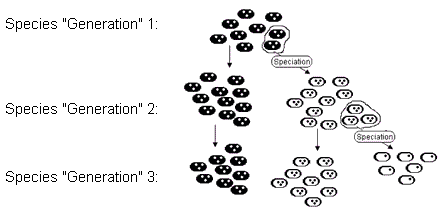 Figure 1. This illustrates Stanley’s view of how species “bud” from one-another. Pictured are three “generations” of species (where a generation is the time it takes for a species go bud off another species). During Generation 1, species  “buds off” through a speciation event into species  . Then, after generation 2, species buds off into species  . In the end, populations representing all three species exist, though all are descended from the original population of . The point is that the gradualist model predicts that a species completely morphs into something else, such that representatives of the original population will cease to exist because they were “selected out.” Stanley sees evolutionary change differently. He believes that one segment of a population can undergo speciation (i.e. allopatric speciation) and turn into something else, and meanwhile the original segment of the population continues to do its own thing unchanged. In this way, over time, a single population can produce multiple descendant species while that original species itself may not even cease to exist. |
Similarly, to solve the problem of the origin of so many new
genera during the Pleistocene, Stanley notes that there is only enough time for
three or four successive chronospecies, which might produce a new genus. Under
the punctuational model, Stanley believes new genera might arise after one or two speciation events. (pg. 99) Stanley speculates that some genera, such as polar bears, are
sufficiently similar to other species (i.e. the brown bear) that they might
have formed in just one speciation event. Thus, we have no choice but to
invoke the rapid speciation of populations which were too small to leave a
record of their evolution. (pg. 99)
The record of elephants provides another example of a punctuational pattern. Each modern elephant genus appears rapidly
from its ancestral genus Primelphas, and then undergoes little change
for thousands of generations. (pg. 100) This clearly shows the punctuational
pattern.
Another confirmation of the punctuationist model comes from
formanifera, which are tiny one-celled marine creatures that live in seafloor sediments.
Stanley notes that the average Cenozoic bottom-dwelling foram species exists for about twenty million
years and undergoes very little change. (pg. 100) The fact that thirty families
of forams appeared in the first 30 million years of the Cenozoic is significant
because it points against the possibility that they arose due to the transformation
of already-existing species. (pg. 101) Bivalve mollusks also exhibit a punctuational
pattern for their origin.
Stanley notes that he is by no means
the first paleontologist to uncover evidence that conflicts with gradualism. Some
paleontologists from Darwin’s era uncovered paleontological data conflicting with gradualism, but they were generally ignored. T.H. Huxley believed the origin of every class must have been much older than its first appearance in the fossil record
and postulated hypothetical lands which hosted long, but undocumented
periods of evolution. (pg. 103) Darwin again assuaged these doubts by
appealing to the incompleteness of the fossil record, but Stanley writes that eventually
scientists forgot that Darwin’s views about the incompleteness of the fossil
record were not based on solid evidence of widespread gaps, but merely upon deduction
from his gradualistic model. (pg. 106) This unfortunately led to circular reasoning
with regards to the incompleteness of the fossil record (pg. 106)
Stanley’s makes an argument that if we see a pattern
which doesn’t fit one model, then we must abandon it in favor of another
model. The data shows that gradualism isn’t what happened, so we must accept
that most change occurred in small populations permitting the punctuational pattern. (pg. 109) Darwin could not
have proposed this because it would have meant the evolution he proposed occurred
exactly where we would be least likely to observe it. Such an idea, even if
correct, would have been difficult to test and thus unlikely to gain the favor
of many scientists. (pg. 110)
Rapid Species Formation
In 1970, Ernst Mayr predicted
that evolution would one day rely heavily upon the changes in regulatory genes.
(pg. 108) Stanley believes that changes in regulatory genes, which guide the development of an
organism, are key to the punctuational model.
Today, Stanley believes the punctuational model is more
reasonable because today we have living examples of species that have formed rapidly.
In fact, Stanley states that contrary to what Darwin believed, only a small
percentage of genera formed via gradualistic transformation of an entire species.
(pg. 114) Gradual evolution might still occasionally happen if two conditions
are met:
1) Natural
selection is consistent throughout the species range for long periods of time.
(pg. 132)
2) Similar ranges of variability
are widespread throughout the population.
For some types of changes, like changes in body size, this
sort of gradual evolution may be possible. According to Cope’s Rule, species
tend to get bigger with time, for there seems to be a more-universal selection
pressure allowing larger animals to better find food, to fight off predators, and to outcompete
others vying to mate. (pg. 133) Occasionally, Stanley speculates that changes
related to reproduction might also find more ubiquitous selection pressure.
This could be able to account for large-scale sexual selection for certain
visually attractive traits, such as the male peacock’s tail. (pg. 133) However,
for many other traits, this second criterion seems difficult to meet,
particularly for unusual genetic changes, which might play a large role in the
origin of species. (pg. 132)
To place confidence in the punctuational model of evolution,
Stanley seeks examples of speciation which meet two criteria:
1) It must have occurred rapidly (i.e. in less than a few thousand years or at most a
few tens of thousands of years). (pg. 111)
2) It must have achieved significant morphological change (such as change leading
to the formation of a new genus). (pg. 111)
”Quantum speciation” or “quantum evolution” represent the
notion that there has been rapid evolution in a small population. (pg. 115) Quantum
speciation had previously been given little attention because it was associated
with Goldschmidt’s “hopeful monsters,” judged to be an untenable hypothesis by biologists. (pg. 135) Quantum speciation events take place in special environments, which may be difficult to identify because they are short-lived or become obscured if the
species becomes widely dispersed from the local environment where it
originated. Thus, a third necessity for finding such an example of quantum
speciation may be that the species has not yet escaped from their place of origin.
(pg. 111)
The first example Stanley gives is that of African cichlid fishes in
Lake Nabugabo in Uganda. This small lake was separated from nearby Lake Victoria within the past four-thousand years, and contains five species of cichlids
which are unique to the lake. Each species is similar to its parent species in
Lake Victoria, typically differing in coloration and other minor traits. (pg.
111) (Changes in male coloration can be key to establishing reproductive
isolation because this is how cichlids typically identify members of their own
species for breeding.) Thus, here we find an example which meets criteria
1—rapid speciation—in that reproductive isolation may have been achieved
quickly. It may not meet criteria 2, but it does show that a reproductively
isolated population – a species – can be formed rapidly. (pg. 111)
Stanley’s second example comes from Hawaiian moths of the
genus Hedylepta. Species in this genus feed on many plants—ranging from
grasses, to lilies, palms, legumes, and banana plants. Yet bananas did not
arrive in Hawaii until about 1000 years ago when brought by the
Polynesians. Stanley believes multiple speciation events must have occurred leading to reproductively isolated populations of moths which feed exclusively on the banana plants in the mountain forests. Again, effective reproductive isolation has been established
with these moths, and thus they are a species. A well-known example Stanley discusses is the peppered moth, which is said to have undergone a rapid coloration
change. However, this was not significant enough morphological change to
constitute even a speciation event. (pg. 130) These examples seem to meet
criteria one (rapid change). But what about criteria two—significant
morphological change?
Stanley finds evidence for rapid significant morphological
change from analysis of fishes and birds. In the Death Valley region of California, “desert pupfishes” populate recently produced ponds which are isolated from
other ponds. Some of these recently produced ponds contain unique species of
pupfishes, one of which has reduced pelvic fins and does not resemble other
pupfishes. Honeycreeper birds on the Hawaiian Islands arose from an ancestral
population of finches and today display widely diverse beak shapes. (pg.
115-116) There are honeycreepers with parrot-like beaks, long curved beaks,
nondescript beaks, and feed on a variety of different food sources. Some of these
species are endemic to the big island of Hawaii, identified as only 750,000
years old. Stanley believes these could be examples of the rapid origin of
significant morphological change.
A final example comes from Lake Victoria in Africa which contains cichlid species with many different types of feeding apparati. From
these cichlids, Stanley finds an ideal test between the gradualist and punctuational
models. The many cichlid species in Lake Victoria are said to have descended
from a riverine species which entered the lake sometime after it formed. The gradualist model would predict that the riverine species, once in the lake, would have slowly morphed into another species, such that examples the original riverine species ceased to exist because they were slowly selected out over time. Yet the riverine species persists in Lake Victoria.
Furthermore, Stanley notes that the average fresh-water fish
chronospecies takes several million years to evolve into a new chronospecies.
Yet there are 170 unique species of cichlids in the relatively young lake. Gradualism
cannot account for this high species diversity. But under the punctuationist
scheme, this is easily explained because the segments of the riverine species
population which entered the lake rapidly “budded off” into other species. (pg.
119; see also figure 1.) These cichlid species illustrate how adaptive
radiations can take place when there is ecological opportunity and environmental
niches can be filled.[8]
Ecological opportunity is thus important to quantum speciation.
Adaptive radiations typically take place in environments
with clear boundaries (like lakes or islands), such that their inhabitants are geographically
isolated from other species. Yet geographical isolation does not care about the
scale of spatial separation. (pg. 122) All that matters is that there is some physical
separation. Speciation events often include passage through a population
bottleneck. Stanley believes that population bottlenecks do not represent the
transformation of an entire species, but rather represent a small localized
segment of a larger population which is rapidly transformed.
But what about the origin of all the variation which permits
rapid speciation? Stanley attempts to account for this by recounting the story
of the artificial introduction of Bairdiella (a small fish) into the Salton Sea in the early 1950’s. Bairdiella was the only fish species in this lake when it
was introduced. After its introduction, members of subsequent generations often
had abnormalities and deformities. But once the population filled the lake and
food resources became scarce, the odd diversity disappeared. This illustrates
stabilizing selection where competition tends to weed out abnormalities. (pg.
121) However, the presence of that diversity in the absence of competition
illustrates that much variation might be available when there is less
competition. This, Stanley believes, reveals that much unseen potential
variability exists even during normal environmental conditions. (pg. 121) Some
habitats with relaxed selection may not weed out that variability such that new
changes can occur. (pg. 122)
Stanley also looks to the fossil record to support these
views. When the Himalayas were formed about 10 million years ago, an adaptive
radiation of hydrobioid snails took place due to the creation of a large
habitat. A similar scenario occurred when marsupials invaded Australia. Again, the availability of ecological opportunity yielded an adaptive radiation among
marsupials. Stanley calls these geographically isolated events “insular
adaptive radiations.” (pg. 126) Yet because they often occur in permanently
isolated environments, many such insular radiations go unrecorded because their
products eventually go extinct, leaving no descendants. Yet Stanley believes
that quantum speciation is going on constantly, sometimes as insular radiation
and sometimes simply as non-isolated local events. (pg. 126)
To provide an account for the origin of variation in the
first place, Stanley contends that small genetic changes can indeed cause great
morphological changes. Stanley attributes the origin of this variation to changes
in regulatory genes, which are those which switch on-and-off structural genes.
Structural genes are those that form the proteins which form physical
structures in the cell, and which mediate biochemical reactions. (pg. 127) By
manipulating structural genes, Stanley believes small changes in regulatory genes might have large effects on morphology.
Chromosomal mutations or rearrangements might also play a
role in quantum evolution, especially if the operation of a regulatory gene is
affected by its position on a chromosome relative to other genes it could
potentially control. (pg. 131) The fact that many closely related species or
genera differ in chromosomal structure, indicates that chromosomal
rearrangements could cause evolution. This must take place in small
populations because parents with different chromosomal arrangements usually do
not produce successful offspring. (pg. 131) For new chromosomal arrangements to
spread, an organism must be in close proximity to other individuals with the
same chromosomal structure. Inbreeding in a small population would best
facilitate such a scenario.
These types of mutations might change the sequence of
development or the rate at which structures grow. (pg. 131) Stanley’s primary
example given of the power of changes in regulatory genes comes from the
axolotl, and amphibian which has arrested development due to a mutation which
prevents production of hormones controlling development. Yet injection of the
missing hormones causes the amphibians to mature fully and become land-dwelling
“adults.” Stanley believes that a single mutation in to this developmentally
important hormone could have caused the origin of this species.[9]
A second example comes from the giant panda, which has
enlarged and strengthened teeth and jaws, but a reduced size in genitalia and the
pelvic area. Stanley claims that simple changes in growth gradients in a bear
could result in these characteristics. Given the sparse fossil record of giant
pandas, Stanley imagines that they may have arisen in a local bamboo forest
high in the Himalayas in a relatively short period of geological time.
A final hypothetical example discussed by Stanley where
regulatory genes might have played a large role in evolution comes from snails.
Stanley first notes that a common objection to the idea that rapid
evolutionary change is possible in small populations is that it facially appears
unlikely that an individual with many new traits could find a mate. (pg. 133) Stanley claims first-off that this objection comes primarily from biologists (and not
paleontologists) who misunderstand the vastness of geological time. He
believes that snails can help overcome this objection.
During their development, snail bodies undergo “torsion” such that their bodies are twisted so the anus lies above the head. (pg. 133) This torsion occurs by the differential development of two muscles in juvenile snails. In some species
the process takes only a few minutes (pg. 133) Stanley claims that the new
morphology caused by torsion could evolve rapidly. He finds evidence for this
from the fact that when snails have lost torsion, they have often not lost it
altogether, but to varying degrees. Thus “detorsion’ has evolved by in
progressive steps. But because torsion itself is not found developed in
varying degrees, he believes it must have arisen in a single mutational step. (pg.
134)
Stanley seeks to find out if this sort of mutation would have been possible in the ten million years preceding the Cambrian Explosion. In the Pre-Cambrian
“pre-snail” (i.e. snail-like organism with no torsion) population, it is
conceivable that each year there could be as many as a
hundred-thousand-trillion broods of “presnails.” With such numbers, it is easy
to imagine that some snails would have the single mutation required for
torsion, if such a single mutation exists. But what about the odds that two members with the correct mutation would find one-another? Stanley says that this is possible through inbreeding. If a female had a mutation in her gonad tissue such that many of
her offspring had this particular mutation, then again, chances are high that some
of her own offspring would find one-another and reproduce, producing more
offspring with the single “torsion” mutation. If some of these siblings
happened to experience geographic isolation from the rest of the population,
reproductive isolation could be established. (pg. 134) Thus, Stanley concludes
that torsion could arise rapidly, because with a high-fecundity type of
organisms like snails, the odds are good of getting a single mutation fixed in less
than ten-million years.
One implication of Stanley’s argument is that fixation of
new traits might require inbreeding. This is especially true when the new
trait is recessive and members in a large species carrying genes for that trait
would be unlikely to ever meet and breed. A small local population would thus
be necessary to allow for the trait to be readily expressed and allow natural
selection to take effect.
One difficulty Stanley identifies is pinpointing the exact moment in when a speciation event takes place. Stanley suggests that the
definitive moment of speciation is when a population can no longer interbreed
with its parent population. This moment, however, is difficult to identify. Reproductive
isolation might not always make a good marker, for the rapid evolutionary
changes which typically mark speciation may occur in a population which is
already reproductively isolated, or one which is not completely reproductively
isolated. Stanley isn’t worried about this too much, for it is difficult to
identify the exact moment of speciation, even if it ultimately takes place. (pg. 132) Finally, it is difficult to
give general answers about when exactly speciation occurs because modes of
reproductive isolation may differ from species to species, depending upon the
lifestyle, habitat, behavior, and mobility of a type of organism.
One final important note is that many of the examples Stanley gives for rapid speciation represent small populations which could easily be environmentally
threatened. Such populations are of great value to the study of biology,
however because of their small size, they are often not widely recognized as
important examples of biodiversity. Environmental protection is vital for these sensitive species which could hold keys to understanding the punctuational mode of evolution. Stanley doesn’t view all organisms as connected in a web, and he isn’t sure that removal
of one species will always affect other species. But he believes environmental
protection is still necessary because of aesthetic sensibilities, the sanctity
of life, and potential scientific or educational value. (pg. 197)
The Punctuationism and Humanity
Stanley discusses human origins because he believes
that although gradualism has dominated this field, a punctuational pattern best explains human origins.[10]
Traditionally, anthropologists and paleontologists have reconstructed human evolution
as an ape gradually becoming human. (pg. 138) This gradualistic scheme has
dominated thinking in evolutionary biology since it was first promoted by
Darwin and Huxley, where one species gradually morphed from an ape species into
humans. This is referred to as the “single-species hypothesis” where humans become
the greatest achievement of evolution. (pg. 164) Stanley seeks to have that
view overturned with regards to human origins.
One way to test between the punctuational and gradualistic models
is to look at the branching patterns. A branching pattern is required under
the punctuational model, but it is does not constitute proof of the model. The
decisive question is if the hominid species leading to humans evolved
via quantum speciation with rapid divergence, or gradual transformation. Stanley finds validation for the punctuational model from the fact that many hominid
species are long-lived. He believes our genus evolved from
asutralopithecines in just a few million years, but yet most hominid species
live up to one-million years. Stanley provides a summary of various hominid
species which have existed in the past 4 million years:[11]
Australopithecus africanus is the species Stanley believes was the direct ancestor of the genus Homo. This “slender”
australopithecine species lived at least from 3 to 2 million years ago (Ma),
and perhaps as late as 1.6 Ma. Humans have an average brain size of about 1300
cubic centimeters (cc) while Australopithecus africanus has an average
brain size of about 500 cc. Stanley does note that brain size of an individual
is not necessarily a reliable indicator of intelligence, because brain size
within a species can vary greatly without corresponding to intelligence. Nonetheless, the differences between humans and australopithecines is great enough to show a significant intellectual change. (pg.
145) Other differences between humans and australopithecines include height (humans
are about a foot taller), forehead size (ours is taller and more vertical), and the fact that we have a chin, reduced orbits, jaws, and teeth, and we have upper limbs with higher dexterity.
Australopithecus afarensis is also a slender
Australopithecine, but older than A. africanus. A. afaraensis left footprints about 3 Ma that seem to imply a mode of locomotion similar to modern humans. Stanley thinks it is very similar to A. africanus such that they could be united as a single species. A third type of australopithecine Stanley mentions are the
robust form, but he does not believe their line led to humans. (pg. 151)
Stanley recounts that Homo erectus
appears about 1.6 Ma and lived until at least 200,000 year ago. Stanley believes erectus is closely related to Homo sapiens.[12]
Stanley notes that Homo erectus has jaws, teeth, and braincase which
are of a size between that of humans and the australopithecines. Brain volume in
Homo erectus ranged from 800 cc to 1300 cc, with the upper limit within the
range of average variation in our own species. However, because they lacked
the high forehead it can be inferred that modern humans are more intelligent. (pg.
146) H. erectus had an upright posture differing little from modern humans and probably used fire and various stone tools.
When introducing Homo habilis, Stanley notes is controversial because some paleontologists do not believe it exists. (pg.
148) Its specimens are dated between 1.8 and 1.6 Ma. Stanley questions if habilis
should be in the genus “’Homo’” because “in many aspects of skull shape and
size, habilis seems like the australopithecines. (pg. 148) It seems to
also have used crude stone tools.
Neanderthals, Stanley believes, had unique features not
found in earlier populations nor in modern humans. This makes it difficult to determine whether or not they were our ancestors. Neanderthals lasted at most 100,000
years and had brains slightly larger than those of modern humans. They also had a
stockier build than modern humans with heavier limbs, and were thus probably physically stronger. Stanley also notes some relatively small differences in
skull shape, chin shape, and pelvis shape. Culturally, they made knives and
other sophisticated stone tools. As for their classification, many researchers
have called them a member of our own species but Stanley believes these
interpretations may have been colored by biases from gradualism or a desire not
to have another species in Homo with a larger brain size than modern
humans.
As for our own species, Homo sapiens, Stanley believes we are even more specialized than Neanderthals with regards to our sharp
chin, weak brow, and highly vaulted forehead. We also have culture more highly
developed than other members of Homo.
Stanley uses habilis as a springboard for talking
about how the origin of the genus Homo works best under the
punctuationist model. Because some australopithecines may have existed as late
as 1.6 – 2.0 Ma and Homo erectus definitely lived by 1.6 Ma, Stanley infers that there is simply not enough time allowed in the fossil record for a gradualist model to accommodate Australopithecus africanus turning into Homo
habilis and then turning into Homo erectus.
But how did Homo sapiens arise? Gradualists who
believe in the single species hypothesis believe that Neanderthals were members
of Homo sapiens. As noted, Stanley believes this classification may be improper, and has been the result of a fear that a hominid species other than our own might claim the title of the largest brain. Stanley also believes that skeletal differences
between Neanderthals and Homo sapiens are not insignificant, and that
in other taxa of mammals, such differences would warrant the creation
of a new species. Finally, our cultures appear to be quite different. Stanley states the Neanderthal culture did not go much beyond making particular types of
stone tools. But the advanced artistic culture of Homo sapiens rapidly arose
all around Europe between about forty thousand and thirty-five thousand years
ago. Thus, he believes Neanderthals should be called “Homo neanderthalensis,” a species distinct from our own.
The punctuational model should be invoked to explain the origin of Neanderthals and Homo sapiens. According to Stanley, Neanderthals appear about 100,000 years ago and disappear perhaps just a bit later than modern humans appear. Stanley says that Neanderthals could not have transformed into modern humans so quickly. (pg. 153) Neanderthals had existed for at least 65,000 years with basically no change, and then suddenly Homo sapiens appears. Stanley claims this could only
have happened if a small population of Neanderthals had undergone a quantum
speciation event. (pg. 153)
Apart from paleontological timescales, Stanley also attempts
to account for the origin of many of our traits in a punctuationist manner. He
believes many human traits can be explained through the retardation of
development, called “neoteny.” (pg. 156) Firstly, Stanley believes that many
of our modern human features resemble those of newborn apes: our generally hairless bodies, our soft hands, and our enlarged, high-vaulted braincases. Stanley believes the result of these traits is that our newborns are more helpless and must be cared for and trained, causing more social interaction, ultimately resulting in a more elaborate
culture. Stanley believes that a neotenous pattern of development could also
explain the origin of upright posture. Stanley prefers this mode of change
because he believes that neotenous changes in the developmental program might take place with only a few mutations, making rapid morphological change more likely.
Interpretation of phylogeny can be very different under the
gradualist vs. punctuationist model. Stanley notes that due to the gradualist
model, fossils are placed in a phylogeny based upon the assumption that each
population is a bit closer to becoming a human. (pg. 151) Because of the rapid
morphological changes permitted under the punctuational model, such assumptions
can be thrown out. Speciation does not mandate that a new species follow an
evolutionary trajectory of previous species because during quantum speciation,
changes may be the function of accidental selection pressures in the local
environment or random mutational events. (pg. 151) There is thus no
progression towards one form (like Homo sapiens). (pg. 151)
Punctuational evolution is not phased by evolutionary reversals
such as the fact Homo sapiens has a brow which is less robust than that
of Homo erectus, despite the fact that Homo erectus is more heavily
browed than the australopithecines. (pg. 151) Because of the ease with which
species can change the direction of evolution under the punctuational model, Stanley argues that the fact that Australopithecus africanus is specialized does
not disqualify it from being a direct ancestor of habilis or the genus
Homo. Thus, he would argue that the punctuationist model can easily account
for the differences between africanus and Homo. The fact that the
two slender australopithecine[13]
species change very little over hundreds of thousands of years makes it
improbable that a gradualist model can account for the origin of Homo.
Looking at this pattern from a broader perspective, Stanley believes that hominids have not really evolved any faster than many other mammalian
taxa. It is thus a false interpretation to search for the “missing link” because
the notion that two species must be connected by species of intermediate form
is not a requirement under the punctuational model. (pg. 155) This is
validated by the presence of evolutionary reversals. Evolution does not necessarily
move only in one direction. (pg. 155)
As far as our own cultural evolution goes, Stanley believes that
the culture of modern humans appeared very rapidly in Europe about 35-40
thousand years ago. Modern theories of social evolution, which focus more on the interaction of groups might do better to draw upon ideas from punctuational models of evolution rather than gradualistic models. (pg. 205) One analogy can be drawn from the fact that species normally tend to resist change, a trait often found in large governments or corporations. Yet new kinds of social structures may arise under small localized conditions, such as the United States during the American Revolutionary
period. (pg. 205)
Finally, Stanley believes that humans are not evolving much
anymore. Medical advances have allowed many who in the past were not allowed to
breed to do so. But since modern humans arose in Western Europe, he says there
has been essentially no skeletal evolution. Furthermore, he observes that
humanity tends to reject mutants – whether natural mutants or potentially
engineered ones – and this could retard future evolution. Stanley believes
that if major adaptive genetic changes occur during speciation, then speciation
probably won’t occur within modern humans unless we escape Earth and colonize
other planets. Or, more glibly, if nuclear war were to decimate much of
humanity, then the subsequent populations might also cause a new race to come
about.
More Social Commentary
In some of the final chapters, Stanley discusses his take on creationism. By creationists, Stanley seems to mean almost entirely young Earth creationists who argue their position based primarily off of the Bible.[14]
He indicates he would prefer that creationism just be ignored, but because of
its influence upon education, it cannot be. (pg. 177) Yet, Stanley takes a
broad view of divine creation arguing that it represents, on one end of the
spectrum, a 6-day Genesis account (where the rock record is the result of
Noah’s flood), and on the other, progressive creation where species are created
over long periods of time. Either way, Stanley sees these views as
incompatible with science because they are both subject to the will of God,
which cannot be studied by scientific methods.
Stanley observes that evolutionists represent a wide range
of religious viewpoints, whereas creationists are primarily composed
of Christians. Some evolutionists are Christians while others practice other
religions, or they are agnostics or atheists. Stanley writes that T.H. Huxley
coined the term “agnostic” which means having no knowledge with regards to the
existence of God. (pg. 167) As far as science is concerned, Stanley writes
that agnosticism is the only acceptable position regarding the existence of
God. According to Stanley, atheism is just as inappropriate as a scientific
conclusion as is theism. (pg. 167) Stanley then juxtaposes scientific knowledge
and religious knowledge where observations and measurement are the stuff of
scientific knowledge and revelation and faith are the basis for religious
knowledge. Because of these differences in knowledge, Stanley believes that religion
and science occupy separate domains. (pg. 167)
Another difference between religion and science is the standard
of proof. In science, things never reach absolute proof. One only achieves
degrees of support through the data. Stanley characterizes creationist
opposition to evolution as if it merely asks the question, “has evolution been
proven?” Stanley answers that most evolutionists would argue that it evolution
is a real phenomenon, but absolute proof in science is impossible. (pg. 169) Stanley believes that most nonfundamentalist biologists are evolutionists, because evolution
has not been disproved. Stanley finds 2 ways a theory can be disproved:
1) Discovery
of direct evidence opposing the theory
2) Refutation
of its corollaries or predictions (pg. 171)
With regards to evolution, Stanley believes that evolution
makes many predictions, but no prediction of evolution has been refuted to the
degree that it has lost general support. (pg. 171) Stanley then lists some of
the ways evolution might have been disproved:
–
Discovery of a fossil population of horses in Pre-Cambrian rocks
–
Any “topsy-turvy sequence of fossils”
–
A biogeographical inconsistency (Stanley proposes as kangaroos found in California identical to those in Australia)
Stanley believes that evolution has also solved new problems,
such as the fact that some odd geographical distributions were resolved in light
of plate tectonics. Stanley claims that essentially the existence of any of transitional
forms would refute a creation account. He offers Archaeopteryx and ammonoids as
such examples, claiming the evolution of nautiloids into ammonoids is recorded
in the fossil record, particularly with regards to the position of the tube in
their shell.
Stanley believes that his views will make some creationists happy
because the punctuational model teaches that some species appear suddenly in
the fossil record, and then change slowly. Yet Stanley turns this observation into
fortune for evolutionists, for he believes that punctuationism gives
evolutionists the ability to counter creationist arguments. Creationists, Stanley believes, argued against gradualism, and now that punctuationists can explain why
gradualism is not the best way to explain evolutionary change, they have an
answer for why the fossil record does not validate gradualism. Stanley also asks if the acceptance of punctuational model would throw the whole theory
into doubt. He believes this will not happen because although evolutionists debate
the patterns and the mechanisms of evolution, they agree that evolution
happened. (pg. 166)
Stanley believes that creationism is religion, and not science,
in part because of its religious homogeneity and lack of a presence outside of
the United States. He resists public debates with creationists because it
turns science into something more like a popularity test. This poses a problem
for evolutionists, because presenting the case for evolution cannot be done in
a few minutes, but might require an entire a college course. (pg. 177) Stanley concludes this chapter predicting that genetics and embryology will continue to
show how quantum speciation is possible, strengthening the punctuational model.
(pg. 179)
Another danger Stanley perceives to science is that of
teleology and orthogenesis—the view that humans are the pinnacle of
evolutionary change, and that we were destined to exist through an evolutionary
process. Orthogenesis is inappropriate for science because even the Modern
Synthesis implied that variation was random, and environmentally-caused
selection pressures are impossible to predict. Evolution is thus neither
progressive nor regressive.
Stanley believes that the punctuational view only increases
the random nature of evolution because it is essentially impossible to predict the
direction that speciation will take a species. (pg. 181) Speciation is like experimentation
where populations experience temporary chance factors as they probe out the
environment to see what works. (pg. 181) Evolutionary trends are possible, where species will over time tend to go in one direction. Yet this is most likely the result of
the ability to undergo speciation. Two factors control the ability of a species to undergo speciation:
1) Long-lived
species tend to “bud off” more descendant species.
2) “Differential
fecundity” (i.e. fecundity in terms of the ability of a species to undergo
speciation and produce new species)
Thus, according to Stanley, just like how individuals in a
population which leave the most descendants tend to dominate the future
population, so do species which tend to speciate off the most new species, tend to
dominate the biota of the future. This is called “species selection.” Because
natural selection within a species does not necessarily affect what goes on
when new species are produced, and because speciation is highly unpredictable, microevolution is essentially decoupled from macroevolution. Furthermore, traditionally important questions like “What drove humans down from the trees?” may become less important under the punctuational view, for major changes can happen in the absence of long-term environmental trends. (pg. 186) In other words, Stanley might say that long-standing environmental pressures did not drive them out of the trees, it just happened as a part of an unpredictable event during speciation.
Species selection can be influenced by environmental trends,
but macroevolutionary trends in a direction are most likely to occur simply
because a particular type of species tends to be long-lived, or happens to rapidly bud
off descendant species. When higher taxa go extinct, it is probably because
the species within that taxa tend to not have the qualities enabling them to
succeed in species selection. It is possible that species need not be
long-lived to be successful. For example, cichlids may have many species purely
due to their virtue of having the ability to speciate rapidly (i.e. their populations can quickly establish reproductive isolation). Some plant species
also exhibit this quality, due to their ability to easily achieve reproductive
isolation due to pollination mechanisms. Thus, macroevolution takes place in
response to environmental changes only to the extent that species within a taxa
find a way to become long-lived and leave many descendant species.
Extinction also plays a role in macroevolution. Extinction
has little to do with microevolution because natural selection takes place when
some members of a population reproduce better than others, whereas extinction
is when all members of a population fail to reproduce. At this point, Stanley believes that emergent properties arise making macroevolution irreducible to microevolution.
(pg. 184-185) Yet, mass extinction does allow the environment to have large
effects upon macroevolution, as environmental changes will often select out
many types of species.
Many fauna today lack “plenitude,” or the full range of possible diversity. Though we have large mammals today, such as the elephant, rhino, and hippo, in the not-so-distant-past many more species of large mammals existed. Similarly, before the ice age, there were many more species of shelled mollusks in the Caribbean than there are today. Some extinctions can occur simply because one predator hunts
its prey to death, at least in a local region. Predation can eliminate many
members of an otherwise very-successful species, thus preventing that otherwise
successful species from monopolizing the habitat. Yet when that predator
is removed, that successful prey-species can take-over. Ironically, predation
can actually allow for higher species diversity by keeping some species in
check, allowing more room for others.
Darwin didn’t recognize that predation
can allow for an increase in species diversity. Darwin thought that there was
always this fierce competition in nature for resources, and did not realize
that it is possible for many species to coexist. Stanley believes that when
predation keeps population numbers of many species in check, competition
for living space is not a major environmental factor affecting the success of
a species. However, Stanley does believe that this competition might
have been a factor in the Pre-Cambrian environment before there were
multicellular species, and there likely were not widespread predators floating
around keeping the algae and bacteria in check. Plenitude was possible in this
environment where the ecospace was saturated with all the primitive
autotrophs it could handle. Stanley believes that widespread bacterial mat
stromatolite fossils from the PreCambrian indicates that plenitude existed in this environment. Once consumers (i.e. predators) arose, stromatolites began to decline. Stanley thus finds it remarkable that for much
of Earth’s history, plenitude may have reigned, even though today he believes
it does not.
Interestingly, Stanley provides a rationale for why the
existence of plenitude caused it to take so long for multicellular creatures to
arise. With plenitude, the ecosystems were saturated with organisms, and it
was difficult for reproductive isolation (and thus speciation) to occur. New breeds of consumers could not arise without the possibility of speciation. Stanley envisions that occasional speciation events may have eventually created the
multicellular creatures which started eating the one-celled world of algae and
bacteria. Stanley believes that under the punctuational model, it was
“inevitable” that the origin of animals would be followed by an adaptive
radiation.
Stanley also interprets the origin of sexual reproduction
under a punctuational model. Sexual reproduction entails genetic
recombination, and this can allow for large phenotypic changes. The punctuational model might explain the prevalence of sex, because it fundamentally allows for more speciation. (pg. 198) Without sex, the only way to get genetic diversity is to allow for the slow accumulation of mutations, thus slowing diversification. Stanley believes this is why today, sexual creatures are more prolific – they simply
are better able to produce the variability which aids speciation. Thus, when
the environment changes, asexually reproducing creatures are subject to
extinction if they can’t produce the variability which will allow them to
survive. Stanley says that perhaps the only highly successful asexual
creature is the bdelloid rotifer, which requires very little
diversification to avoid extinction because they can hibernate in
the absence of hospitable environmental conditions.
Conclusion
I hope this summary accurately represents Stanley’s views.
I realize that there are many differing views of the fossil record out there,
from ID proponents to creationists, and even within the evolutionist
community. Whatever you believe, my only hope is that you will learn something
about Dr. Steven Stanley’s own views and about the punctuational model of evolution
by reading this summary. I also hope that if you disagree with anything written
here, it is Stanley’s own views with which you disagree with and not any
misrepresentations of his views which have unintentionally crept into this
summary. I thank you for reading and I hope that you find this summary useful, as it was enjoyable and educational for me to write. I also appreciate comments, suggestions, or any form of constructive criticism which you can send to me at casey@ideacenter.org.
[1]
Other authors have often referred to the theory as “punctuated equilibrium” or
“punctuated equilibria” however because Stanley refers to it as the
“punctuational model,” the “punctuational view,” or “punctuationalism,” those
phrases will be used primarily in this book review.
[2]
Please feel free to send any feedback, comments, or criticisms as I appreciate
such and take them seriously. The author may be contacted at casey@ideacenter.org.
[3]
Of course many have argued that in a broader sense, these random processes are
overall statistically predictable such that over time they are not truly
random. Nonetheless, Stanley here describes them as random.
[4]
The first four chapters of TNET tell a fascinating history of evolutionary
theory. But all histories must be read in the context of their historian. I do not mean to question Stanley’s account, but readers should keep in mind that the history given by Stanley is rooted in his own viewpoint as an evolutionist
paleontologist who often questions the importance of the gradualistic model.
[5]
Evaluating the strength of these dysteleological arguments is beyond the scope
of this summary.
[6]
From what Stanley says, it seems to me that Darwin showed a great measure of
respect to those who dissented from his theory and did not resort to accusations or namecalling.
[7]
Stanley himself doesn’t mention the precise age Kelvin actually proposed for the
age of the Earth, but I mention it here for clarity.
[8]
Stanley also attempts to give an interesting morphological rationale for why
rapid diversification took place in cichlids. Many of the species are
separated by feeding habits. Studies of cichlids have shown that the rear
portion of their jaw is decoupled from the front, making it possible for these
fishes allow their front teeth to become specialized for one form of feeding,
and their back teeth specialized for grinding the food brought in by the front
teeth. Thus, many different forms of feeding can be easily imagined from the
cichlid jaw makeup.
[9]
It should be noted that Stanley’s book was written when regulatory genes were
just beginning to be understood, and that it is likely that if he were to write
the book today, he would have had a much more extensive discussion on this
subject.
[10]
It should be noted, again, that Stanley wrote in 1981 and some ideas about
human evolution have changed since that time.
[11]
Stanley actually discusses some earlier fossils as well, such as
Aegyptopithecus, a 30 million year old primate with apelike teeth, a relatively
large brain volume compared to other contemporary fossils, leading Stanley to
think it could have been an early ancestor of the apes and ‘the smartest animal
in its Oligocene world.” (pg. 140) Stanley then recounts that the
dryopithecine apes lived in the latter Oligocene, and these did give rise to
modern apes. Ramapithecus lived in Africa and Eurasia from 14-8 Ma
(million years ago), and had teeth more similar to modern forms. (It should be
noted that it is no longer generally believed that Ramapithecus was a
direct ancestor to modern humans, or the australopithecines.
[12]
Homo erectus is also known as Pithecanthropus.
[13]
By the slender australopithecines, Stanley means Australopithecus afarensis and Australopithecus africanus, which are commonly referred to as “gracile.”
[14]
As Stanley’s book was written in 1981, young-Earth creationism was far and away
almost the only form of creationism which had been popularized at the time.