
|
Introduction:
One of the foundational tenets of the IDEA Philosophy is to value dialogue, discussion, and exchange with those who are critical of intelligent design. We at the IDEA Center were pleased to see that the Union Tribune covered intelligent design. However, we were saddened that they chose to only interview scientists who were anti-ID, and that the article did not seek dialogue, discussion, and exchange with scientists or organizations holding pro-ID viewpoints.
We were also saddened and concerned that many of the statements about intelligent design in the article were highly inaccurate. Thus, we have composed this response with the purpose of helping to correct much of the misinformation about intelligent design in “Intelligent Discussion” by Scott Lafee (Union Tribune, June 8, 2005). Additionally, the IDEA Center is sponsoring a series of Intelligent Design Video Nights at the Chula Vista Public Library, where the public will have an opportunity to freely view 3 intelligent design videos. This will help correct some of the misinformation in the article about intelligent design theory.
The grey boxes contain quotes from “Intelligent Discussion,”
followed by commentary and documentation correcting the various
inaccurate statements. This response is a collective effort contributed to by various IDEA Center staff.
Quick Navigation:
Response to comments by…
Commentary and Response:
Response to Comments by Scott LaFee:
| “The new challenge comes from proponents of "intelligent design," which argues that there are things in the world – namely, life – that defy scientific explanation and can only be attributed to the handiwork of an unidentified, supernatural creator.” (Scott LaFee, Union Tribune Staff Science Reporter) |
Response: Unfortunately this statement is not an accurate description of the actual nature of intelligent design theory and how it works.
I. This states that
intelligent design argues simply that “there are things in the world – namely,
life – that defy scientific explanation.” This is an inaccurate
characterization for two reasons:
Intelligent
design theory does not simply argue that aspects of life are unevolvable and is
not purely an argument against naturalistic processes.
The theoretical way we infer design is expounded in detail
in The Design Inference (Cambridge
University Press, 1998) by William Dembski. An essay by William Dembksi lays
out in detail how we can understand the products of intelligent design by
examining how designers work:
of intelligent causation. The principal characteristic of intelligent causation
is directed contingency, or what we call choice. Whenever an intelligent cause
acts, it chooses from a range of competing possibilities. This is true not just
of humans, but of animals as well as extra-terrestrial intelligences. A rat
navigating a maze must choose whether to go right or left at various points in
the maze. When SETI (Search for Extra-Terrestrial Intelligence) researchers
attempt to discover intelligence in the extra-terrestrial radio transmissions
they are monitoring, they assume an extra-terrestrial intelligence could have
chosen any number of possible radio transmissions, and then attempt to match
the transmissions they observe with certain patterns as opposed to others
(patterns that presumably are markers of intelligence). Whenever a human being
utters meaningful speech, a choice is made from a range of possible
sound-combinations that might have been uttered. Intelligent causation always
entails discrimination, choosing certain things, ruling out others. Given this
characterization of intelligent causes, the crucial question is how to
recognize their operation. Intelligent causes act by making a choice.
“CSI is a reliable indicator of design because its recognition coincides with
how we recognize intelligent causation generally. In general, to recognize
intelligent causation we must establish that one from a range of competing
possibilities was actualized, determine which possibilities were excluded, and
then specify the possibility that was actualized. What’s more, the competing
possibilities that were excluded must be live possibilities, sufficiently
numerous so that specifying the possibility that was actualized cannot be
attributed to chance. In terms of probability, this means that the possibility
that was specified is highly improbable. In terms of complexity, this means
that the possibility that was specified is highly complex. All the elements in
the general scheme for recognizing intelligent causation (i.e.,
Actualization-Exclusion-Specification) find their counterpart in complex
specified information-CSI. CSI pinpoints what we need to be looking for when we
detect design.”[1]
Thus, when one reads the actual primary literature of
intelligent design proponents, it is quickly and easily clear that intelligent
design theory is not simply based upon a critique of other scientific
hypotheses, but intelligent design theory puts forth its own positive
predictions by which we can infer intelligent design. Above, Dembski notes that
intelligent agents can choose from one of many competing possibilities. If the
choice made is unlikely to occur and sufficiently complex, then we can
attribute that choice to design. This comes from our understanding of how
intelligent agents operate–not from a negative argument against Neo-Darwinism.
Thus, intelligent design theory is not based purely upon a
negative critique of Neo-Darwinism. Indeed,
below are discussed 4 positive predictions of intelligent design theory, based
upon our observations of how intelligent agents operate:
| Table 1. Ways Designers Act When Designing (Observations): Intelligent agents … |
“Experience teaches that information-rich systems … invariably result from intelligent causes, not naturalistic ones. … Finding the best explanation, however, requires invoking causes that have the power to produce the effect in question. When it comes to information, we know of only one such cause. For this reason, the biology of the information age now requires a new science of design.”[2] “Agents can arrange matter with distant goals in mind. In their use of language, they routinely ‘find’ highly isolated and improbable functional sequences amid vast spaces of combinatorial possibilities.”[3] “Indeed, in all cases where we know the causal origin of ‘high information content,’ experience has shown that intelligent design played a causal role.” [4] |
“Intelligent design provides a sufficient causal explanation for the origin of large amounts of information, since we have considerable experience of intelligent agents generating informational configurations of matter.”[5] |
“An intelligent cause may reuse or redeploy the same module in different systems, without there necessarily being any material or physical connection between those systems. Even more simply, intelligent causes can generate identical patterns independently: We do so, for instance, every time we sign a bank check or credit card slip”[6] |
These observations can then be converted into predictions about what we should find if an object was designed:
| Table 2. Predictions of Design (Hypothesis): |
(1) High information content machine-like irreducibly complex structures will be found. (2) Forms will be found in the fossil record that appear suddenly and without any precursors. (3) Genes and functional parts will be re-used in different unrelated organisms. (4) The genetic code will NOT contain much discarded genetic baggage code or functionless “junk DNA”. |
These predictions can then be put to the test by observing the scientific data:
Table 3. Examining the Evidence (Experiment and Conclusion): | ||
(1) Biochemical complexity / Laws of the Universe. | High information content machine-like irreducibly complex structures are commonly found. The bacterial flagellum is a prime example. Specified complexity found in the laws of the universe may be another. | |
(2) Fossil Record | Biological complexity (i.e. new species) tend to appear in the fossil record suddenly and without any similar precursors. The Cambrian explosion is a prime example. | |
(3) Distribution of Molecular and Morphological Characteristics | Similar parts found in different organisms. Many genes and functional parts not distributed in a manner predicted by ancestry, and are often found in clearly unrelated organisms. The "root" of the tree of life is a prime example. | |
(4) DNA Biochemical and Biological Functionality | Increased knowledge of genetics has created a strong trend towards functionality for “junk-DNA.” Examples include recently discovered functionality in some pseudogenes, microRNAs, introns, LINE and ALU elements. Examples of DNA of unknown function persist, but discovery of function may be expected (or lack of current function still explainable under a design paradigm). | |
In this manner, intelligent design clearly makes a
positive argument for intelligent design, as it observes how intelligent agents
act when designing (Table 1) in order to make predictions about what we should
find if an intelligent agent had been at work (Table 2) , and then goes out and
tests those predictions to see if they are met (Table 3)!
It is not simply a critique of Neo-Darwinism.
B)
Intelligent
design does not argue that characteristics of life “defy
scientific explanation” because intelligent design itself puts
forth a scientific explanation.
Intelligent design simply argues that Neo-Darwinism is the wrong
scientific explanation for the origin of many aspects of life—it does not argue
that there is no “scientific explanation.”
In contrast, intelligent design theory argues
that there IS a scientific explanation: intelligent design.
2.
The
second problem with the first statement above is that it states that
intelligent design appeals to a “supernatural creator.”
Again, this is an inaccurate statement about intelligent design theory.
Many critics of intelligent design (including your article
on ID) have inaccurately stated that intelligent design is an argument for the
existence of God, or that it posits an explicitly supernatural creator. The
reasons why critics misconstrue intelligent design in this fashion are apparent and
twofold:
unscientific because the scientific method cannot detect the supernatural
cannot be taught in public schools since the U.S. Supreme Court declared in
1987 that teaching a "supernatural creator" is religion, and
unconstitutional.[7]
By calling intelligent design as an appeal
to the supernatural, the public has been misled into thinking that intelligent
design is both unscientific and unconstitutional to teach. Thankfully, the reality of intelligent design theory is much different from how it was portrayed in the article.
In reality, intelligent design cannot tell you if the
designer was natural, supernatural, cosmic, alien, humanoid, God-like, or
anything. Many intelligent design
proponents have beliefs about the identity of the designer, but these beliefs
do not stem from intelligent design theory.
For example, I personally am a Christian and I believe the
identity of the designer is the God of the Bible. However, I do not derive this
belief from intelligent design theory.
Indeed, science can only study natural objects, and cannot
make statements about the supernatural. IF it is correct to state
that intelligent design theory appeals to a specifically supernatural creator,
then intelligent design would not be scientific. However, the claim that
intelligent design theory proposes a supernatural designer, or that it
specifically appeals to God, is a mischaracterization of intelligent design
theory, and the article is not correct.
The Actual Arguments of Leading ID Proponents
An extensive look at the actual writings and arguments of
those in the ID research community reveals that intelligent design is not an
appeal to the supernatural, nor is it trying to "prove" the existence
of God. The consensus of ID proponents is intelligent design theory does not
allow one to identify the designer as natural or supernatural, because to do so
would go beyond the limits of scientific inquiry.
Here are some excerpts from ID literature making it clear
that ID is not an appeal to God or the supernatural:
“Intelligent design is modest
in what it attributes to the designing intelligence responsible for the
specified complexity in nature. For instance, design theorists recognize that
the nature, moral character and purposes of this intelligence lie beyond the
competence of science and must be left to religion and philosophy.”[8]
“If science is based upon
experience, then science tells us the message encoded in DNA must have
originated from an intelligent cause. But what kind of intelligent agent
was it? On its own, science cannot answer this question; it must leave it to religion
and philosophy. But that should not prevent science from acknowledging
evidences for an intelligent cause origin wherever they may exist. This is no
different, really, than if we discovered life did result from natural causes. We
still would not know, from science, if the natural cause was all that was
involved, or if the ultimate explanation was beyond nature, and using the
natural cause.”[9]
“Surely the intelligent design
explanation has unanswered questions of its own. But unanswered questions, which
exist on both sides, are an essential part of healthy science; they define the
areas of needed research. Questions often expose hidden errors that have
impeded the progress of science. For example, the place of intelligent design
in science has been troubling for more than a century. That is because on the
whole, scientists from within Western culture failed to distinguish between
intelligence, which can be recognized by uniform sensory experience, and the
supernatural, which cannot. Today we recognize that appeals to intelligent
design may be considered in science, as illustrated by current NASA search for
extraterrestrial intelligence (SETI). Archaeology has pioneered the development
of methods for distinguishing the effects of natural and intelligent causes. We
should recognize, however, that if we go further, and conclude that the
intelligence responsible for biological origins is outside the universe
(supernatural) or within it, we do so without the help of science.“[10]
“The idea that life had an intelligent source is hardly unique to
Christian fundamentalism. Advocates of design have included not only Christians
and other religious theists, but pantheists, Greek and Enlightenment
philosophers and now include many modern scientists who describe themselves as
religiously agnostic. Moreover, the concept of design implies absolutely
nothing about beliefs and normally associated with Christian fundamentalism,
such as a young earth, a global flood, or even the existence of the Christian
God. All it implies is that life had an intelligent source.”[11]
“The most important difference [between modern intelligent design theory
and Paley’s arguments] is that [intelligent design] is limited to design
itself; I strongly emphasize that it is not an argument for the existence of a
benevolent God, as Paley’s was. I hasten to add that I myself do believe in a
benevolent God, and I recognize that philosophy and theology may be able to
extend the argument. But a scientific argument for design in biology does
not reach that far. This while I argue for design, the question of the
identity of the designer is left open. Possible candidates for the role of
designer include: the God of Christianity; an angel–fallen or not; Plato’s
demi-urge; some mystical new age force; space aliens from Alpha Centauri; time
travelers; or some utterly unknown intelligent being. Of course, some of these
possibilities may seem more plausible than others based on information from
fields other than science. Nonetheless, as regards the identity of the designer,
modern ID theory happily echoes Isaac Newton’s phrase >hypothesis non fingo.[12]
“Although intelligent design
fits comfortably with a belief in God, it doesn’t require it, because the
scientific theory doesn’t tell you who the designer is. While most people –
including myself – will think the designer is God, some people might think that
the designer was a space alien or something odd like that.”[13]
“One of the worries about intelligent design is that it will jettison much
of what is accepted in science, and that an “ID-based curriculum” will look
very different from current science curricula. Although intelligent design has
radical implications for science, I submit that it does not have nearly as
radical implications for science education. First off, intelligent design is
not a form of anti-evolutionism. Intelligent design does not claim that
living things came together suddenly in their present form through the efforts
of a supernatural creator. Intelligent design is not and never will be a
doctrine of creation.”[14]
“The conclusion that something was designed can be made quite
independently of knowledge of the designer. As a matter of procedure, the
design must first be apprehended before there can be any further question about
the designer. The inference to design can be held with all the firmness that is
possible in this world, without knowing anything about the designer.”[15]
“The most obvious difference is
that scientific creationism has prior religious commitments whereas intelligent
design does not. … Intelligent design … has no prior religious commitments
and interprets the data of science on generally accepted scientific principles.
In particular, intelligent design does not depend on the biblical account of
creation.”[16]
“Intelligent design begins with
data that scientists observe in the laboratory and nature, identifies in them
patterns known to signal intelligent causes and thereby ascertains whether a
phenomenon was designed. For design theorists, the conclusion of design
constitutes an inference from data, not a deduction from religious
authority.”[17]
“ID is not an interventionist
theory. Its only commitment is that the design in the world be empirically
detectable. All the design could therefore have emerged through a cosmic
evolutionary process that started with the Big Bang. What’s more, the designer
need not be a deity. It could be an extraterrestrial or a telic process
inherent in the universe. ID has no doctrine of creation. Scott and Branch at
best could argue that many of the ID proponents are religious believers in a
deity, but that has no bearing on the content of the theory. As for being
“vague” about what happened and when, that is utterly misleading. ID claims
that many naturalistic evolutionary scenarios (like the origin of life) are
unsupported by evidence and that we simply do not know the answer at this time
to what happened. This is not a matter of being vague but rather of not
pretending to knowledge that we don’t have.“[18]
In each of these quotes, it seems
clear that intelligent design proponents are stating that intelligent design
theory tells us nothing about the nature of the designer, and cannot determine
if the designer was natural or supernatural. If intelligent design is truly a
scientific discipline, then this makes perfect sense, for there are limits on
what science can tell us, and science is not capable of studying the evidence
to tell us if the designer was supernatural or natural.
Intelligent design theory begins and ends with observations of the natural
world. It begins with observations of intelligent agents in the natural world,
in order to quantify the sort of information they tend to emplace into their
designed objects. It ends with observations as we study natural objects to
determine if they contain that information which we know is a tell-tale sign
that an intelligent agent played a hand in the origin of that object. True to
the scientific method, throughout the entire process of testing for intelligent
design, we are making observations of the observable natural world.
Science, and thus intelligent design theory, can only
discover what is found in the observable realm. We cannot access the
supernatural. Thus intelligent design proponents make it clear that all their
theory can do is tell if a natural object bears the hallmarks of having been
designed–it cannot tell you anything about the designer, much less that it was
a supernatural deity. If some supernatural agent took action in the natural
world, we might be able to detect that action, but not detect whether the actor
was supernatural or otherwise.
Science can indeed tell us if aspects of biology were designed, but it turns
out to be silent on the question on the nature of the designer.
Understanding the Identity of the Designer:
The scientific theory of intelligent design cannot identify
the designer, but only detects the past occurrence of intelligent design in the
natural world. Intelligent design theory cannot name the designer because it
works off the assumption that all intelligent agents would generally create
certain types of informational patterns when they act. While we can detect that
type of information in the natural world to infer intelligent design, finding
that type of information does not give us any information about the nature or
identity of the designer. All we can infer is that the object we are studying
was designed. Consider the following diagram:
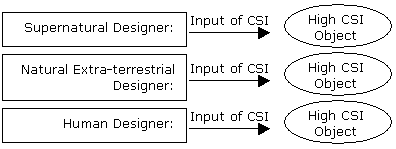
In this diagram, many types of intelligent agents could produce identical
objects with high levels of complex and specified information (CSI).
Intelligent design theory can only find the object containing high levels of
CSI and works backwards to detect if an intelligent was at work. While it can
detect that the object was designed, it cannot discriminate what kind of
designer designed the object, nor determine any specific properties about the
designer, other than that it was an intelligent agent. All intelligent design
theory can infer is that the object was designed. Intelligent design, as a
scientific theory cannot identify the identity of the designer.
Not identifying the designer is not a cop-out nor does it stem from an unwillingness
to be honest about motivations. It results solely from the pure empirical
limitations of scientific investigation. As William Dembski notes:
“[The] only commitment [of
intelligent design theory] is that the design in the world be empirically
detectable…This is not a matter of being vague but rather of not pretending to
[have] knowledge that we don’t have.” (See footnote [18])
The scientific method and empirical data are presently
incapable of helping to understand the identity of the designer. Thus, the
scientific theory of intelligent design simply cannot identity the designer
because it is not a question which can be addressed through the methods of
science. At this point, this question of the identity of the designer cannot be answered thruogh intelligent design theory.
The fact that the identity of the designer is a religious question does not
negate the purely scientific methods through which we can infer merely that an
object was indeed designed. Indeed, when we find the type of information we
know tends to be produced by intelligent agents, we have a valid scientific
rationale for inferring intelligent design.
Thus, intelligent design proponents themselves readily admit
that they may believe the designer is God. However, this belief does not derive
from intelligent design theory. To call
intelligent design an appeal to a “supernatural creator” is to inaccurately describe intellignt design theory.
| “In more than 20 states, proposals supporting intelligent design are being considered, most notably by the Kansas State Board of Education, which may decide this month whether to include intelligent design lessons in its new science curriculum standards and encourage school teachersy to more aggressively challenge the precepts of Darwinism.” (Scott LaFee, Union Tribune Staff Science Reporter) |
Response: This is another inaccurate statement because the Kansas State Board of
Education is not considering introducing intelligent design into the
curriculum. All they are considering is
whether criticism of Neo-Darwinism should be taught.
They are not considering teaching another
alternative explanation like intelligent design.
Documentation on what is actually being considered by the
Kansas State Board of Education can be found at http://www.evolutionnews.org/index.php?p=465&more=1&c=1&tb=1&pb=1 where an article by Seattle Pacific University political science professor John
West explains the actual nature of what is being considered by the Kansas State
Board of Education. In contrast to what
your article contained, the actual draft being considered by the Kansas Science
standards contains the following statement:
“the Science Curriculum Standards do not include the theory
of Intelligent Design. While the testimony presented at the science hearings
included both advocates and critics of the theory of Intelligent Design, we do
not include it in these curriculum standards. The Board does not take a
position on this topic.”
For more direct documentation demonstrating why the Kansas State Board of Education (“Board”) is not currently considering mandating intelligent design in the curriculum, also visit the Board’s latest working version of the science standards here, which contains the above-quoted disclaimer that the Board is not considering mandating intelligent design in the curriculum.
Response to Comments by Phil Unitt:
| “‘Intelligent design’ is science only if it’s a story that can be tested by observation and experimentation. Is there any observation we can make or experiment we can do whose results would be one way if ‘intelligent design’ is true, another way if it is false?” (Phil Unitt, ornithologist, San Diego Natural History Museum)) |
Response: Dr. Unitt is correct to state that scientific ideas can be tested by “observation and experimentation” and subject to being proven false. At this point, Dr. Unitt’s lack of familiarity with intelligent design
theory, or the wrings of intelligent design proponents becomes eminently clear, as intelligent design proponents have devised many ways of testing their ideas.
Intelligent design is based upon the methods of science, and not upon faith. Leading intelligent design theorist William Dembski writes:
data that scientists observe in the laboratory and nature, identifies in them
patterns known to signal intelligent causes and thereby ascertains whether a
phenomenon was designed. For design theorists, the conclusion of design
constitutes an inference from data, not a deduction from religious authority.”[19]
“Natural causes are too stupid
to keep pace with intelligent causes. Intelligent design theory provides a
rigorous scientific demonstration of this long-standing intuition. Let me
stress, the complexity-specification criterion is not a principle that comes to
us demanding our unexamined acceptance–it is not an article of faith. Rather
it is the outcome of a careful and sustained argument about the precise
interrelationships between necessity, chance and design.”[20]
Intelligent design thus uses the scientific method to detect
design. The following is a description of the scientific method (which
correlates with Dr. Unitt’s description of the scientific method):

Detecting design using the scientific method:
i. Observation:
The ways that intelligent agents act can be observed in the natural world and
described. When intelligent agents act, it is observed that they produce high
levels of "complex-specified information" (CSI). CSI is basically a
scenario which is unlikely to happen (making it complex), and conforms to a
pattern (making it specified). Language and machines are good examples of
things with much CSI. From our understanding of the world, high levels of CSI are
always the product of intelligent design.
ii. Hypothesis:
If an object in the natural world was designed, then we should be able to
examine that object and find the same high levels of CSI in the natural world
as we find in human-designed objects.
iii. Experiment:
We can examine biological structures to test if high CSI exists. When we look
at natural objects in biology, we find many machine-like structures which are
specified, because they have a particular arrangement of parts which is
necessary for them to function, and complex because they have an unlikely
arrangement of many interacting parts. These biological machines are
"irreducibly complex," for any change in the nature or arrangement of
these parts would destroy their function. Irreducibly complex structures cannot
be built up through an alternative theory, such as Darwinian evolution, because
Darwinian evolution requires that a biological structure be functional along
every small-step of its evolution. "Reverse engineering" of these
structures shows that they cease to function if changed even slightly.
iv. Conclusion:
Because they exhibit high levels of CSI, a quality known to be produced only by
intelligent design, and because there is no other known mechanism to explain
the origin of these "irreducibly complex" biological structures, we
conclude that they were intelligently designed.
The writings of ID proponents show that intelligent design theory uses observations
and tests to validate its claims. Incidentally, Dr. Unitt did not mention Dembski’s
work, CSI, irreducible complexity, or the many biological-data-based arguments
made by intelligent design proponents about intelligent design.
Also, regarding testability of
intelligent design, a number of testable predictions made by intelligent design
proponents are outlined in detail in Tables 1-3 above.
“In any case, even if God – or someone claiming to be God – were to emerge in a puff of smoke on the floor of the Senate and claim to have created the universe, that story would not be science unless there were some independent means of testing that claim through observation and experimentation.” (Phil Unitt, ornithologist, San Diego Natural History Museum) |
Response: Of course Dr. Unitt’s statements
here are completely correct. The question is, what relevance does it have to
intelligent design theory? Such criticisms have no application to intelligent design theory for the following reasons:
1)
Intelligent
design theory is not claiming that “God” or any other designer in particular
created the universe
2)
Intelligent
design is not basing its claims off of any religious authority or scriptural
test. This is explained by William
Dembski:
“Intelligent design begins with data that scientists
observe in the laboratory and nature, identifies in them patterns known to
signal intelligent causes and thereby ascertains whether a phenomenon was
designed. For design theorists, the conclusion of design constitutes an
inference from data, not a deduction from religious authority.”[21]
Thus, intelligent design is very simple. Here is a basic
schematic of how it works:
Intelligent design theory simply observes intelligent agents
in nature and observes that when they act, they tend to design objects with
property X. If we can then go out into nature and test to see if objects
contain property X, we can construct a testable, repeatable, independent mode
of detecting design.
In fact, this type of reasoning is already employed with the
Search for Extra-Terrestrial Intelligence (SETI) Project. Popularized in the movie
Contact based upon the novel by Carl Sagan, SETI employs arrays of
radiotelescopes to scan the skies for electromagnetic signals with an
extraterrestrial intelligent origin. The
challenge posed to SETI researchers is to discriminate between radiosignals
actually sent by intelligent agents, and those of a purely natural origin.
This is ID reasoning in action: SETI must
detect designed radiosignals amongst naturally occurring interstellar signals.
ID uses similar logic to detect design in biology.
The theory is essentially a
competing explanation for the origin of biological information.
As Richard Dawkins observes, every cell “contains a digitally coded database larger, in information content, than all
30 volumes of the Encyclopaedia Britannica put together.”[22] By observing that intelligent agents tend to produce tremendous amounts of encoded
information, ID theorists look at the cell and find places where design is the best explanation.
Response to Comments by Christopher Wills:
“Intelligent design is not science, because it only goes partway through this process and leaves out the most important part. Advocates of intelligent design have observed the world, and have proposed the hypothesis that some vast intelligence must have created it because the world (or at least some portion of it) is too complicated to have arisen through natural processes. This is their hypothesis, and it is in principle testable. For example, one could look for messages or other evidence for the existence of a vast intelligence (see Carl Sagan’s novel "Contact" for a fictional example). […] But the intelligent designers have proposed no such experiments. Their hypothesis is therefore not subject to modification, much less eventual abandonment. As a consequence, intelligent design and its parent belief, creationism, are not science.” (Christopher Wills, professor of biology, UCSD) |
Response: Firstly, a semantic correction. Dr. Wills refers to intelligent design proponents as “intelligent designers.” While intelligent design proponents are humans, and thus are “intelligent designers” the correct way to refer to a proponent of an intelligent design is not to call them an “intelligent designer.” In intelligent design theory, “intelligent designers” are those who do the designing of the objects being studied. To refer to scientists who are accepting of intelligent design theory, it might be clearer for him to use terminology such as “intelligent design proponents” or even acceptable terms of endearment like “IDists.”
Dr. Wills makes an interesting
concession here because he concedes that intelligent design is “in principle”
falsifiable. He writes “it is in
principle testable.” Thus, Wills contradicts
Phil Unitt’s claim that intelligent design is not even in principle subject to
testability. In fact, Wills even
mentions the SETI Project as an example of intelligent design reasoning
in-action. Thus, Wills makes very important concessions which go towards
intelligent design being possible to be a legitimate scientific
hypothesis.
However, for Wills, it has not been practically put to the
test. Thus, for Wills, intelligent
design is not science because it isn’t testable, it isn’t science because it
simply hasn’t been tested. Thus, Wills
makes the following allegations: “the intelligent designers have proposed no
such experiments. Their hypothesis is therefore not subject to modification,
much less eventual abandonment.”
Again, this demonstrates a complete lack of familiarity with
the primary writings and literature of intelligent design proponents.
Intelligent design has been tested.
Indeed, in a recent article, “The origin of
biological information and the higher taxonomic categories,"[23] by
Stephen C. Meyer proposes that intelligent design might be detected if we found
one can study the paleontological record to test if the phyla were designed in
the Cambrian explosion. Indeed, others
have done computer calculation studies to test the degree to which irreducible
complexity exists in protein-protein bonds, which may have a large bearing on
whether or not these structures were designed.[24]
This paper, by a leading design theorist
Michael Behe, gives indirect support to the notion that protein-protein
interactions exhibit intelligent design.
Clearly ID proponents have indeed tested their ideas against
the data. This means that contrary to Dr. Wills’ allegations, intelligent
design passes his second criteria for being science: that it has been subjected
to actual tests!
“Or, in the case of evolution, one could search for sudden discontinuities in the history of life, in which a new structure or function has arisen without any previous history and no relationship to structures or functions in other related organisms. (Such new structures have not yet been found, by the way.)” (Christopher Wills, professor of biology, UCSD) |
Response: Dr. Wills is correct to claim that
evolution is testable. However, his
claim that there are no “sudden discontinuities in the history of life” or that
there are no “new structure or function [that] has arisen without any previous
history and no relationship to structures or functions in other related
organisms” are pure bluffs. The fossil
record tells a tale where there are many new structures which appear in a
“discontinuous” manner which betrays a simple evolutionary explanation.
Consider the following statements from prominent biologists who were not
bluffing about the nature of the fossil record:
“No wonder paleontologists shied
away from evolution for so long. It never seemed to happen. Assiduous
collecting up cliff faces yields … a rate too slow to account for all the
prodigious change that has occurred in evolutionary history. When we do see the
introduction of evolutionary novelty, it usually shows up with a bang, and
often with no firm evidence that the fossils did not evolve elsewhere!”[25]
In 1997, vertebrate paleontologist Robert Carroll wrote:
“Fossils would be expected to
show a continuous progression of slightly different forms linking all species
and all major groups with one another in a nearly unbroken spectrum. In fact,
most well-preserved fossils are as readily classified in a relatively small
number of major groups…"[26]
In 1999, reviewing a book in Nature, Oxford zoologist Mark Pagel stated:
“Palaeobiologists flocked to these
scientific visions of a world in a constant state of flux and admixture. But
instead of finding the slow, smooth and progressive changes Lyell and Darwin
had expected, they saw in the fossil records rapid bursts of change, new
species appearing seemingly out of nowhere and then remaining unchanged for
millions of years-patterns hauntingly reminiscent of creation.”[27]
Finally, in 2001, evolutionary biologist Ernst Mayr wrote:
“Wherever we look at the living
biota … discontinuities are overwhelmingly frequent…The discontinuities are
even more striking in the fossil record. New species usually appear in the
fossil record suddenly, not connected with their ancestors by a series of
intermediates."[28]
These quotes are not listed to imply that there are never any fossils in the fossil record which could be called transitionalish, or which might be interpreted as transitional forms. However, these are here to rebut Dr. Wills bold bluff that there are no “sudden discontinuities in the history of life.” Given that it appears Dr. Wills boldly proclaimed the presence of “sudden discontinuities in the history of life” as a test of evolution, it would seem that evolution has failed this test upon many occasions in the fossil record.
While many evolutionary biologists have attempted to invoke
“punctuated equilibrium” as an explanation for the abrupt and discontinuous
appearance of biological novelty in the fossil record, consider this analysis
of the implausibility of such an explanation by biologist Michael Denton:
“[M]ajor discontinuities simply
could not, unless we are to believe in miracles, have been crossed in
geologically short periods of time through one or two transitional species
occupying restricted geographical areas. Surely such transitions must have
involved long lineages including many collateral lines of hundreds or probably
thousands of transitional species.[29]
Specifically, regarding one major event in the history of
life, it appears that it occurs in a highly discontinuous manner lacking
transitional forms:
time scale is but a blink of an eye. The Cambrian explosion denoting the almost
simultaneous emergence of nearly all the extant phyla of the Kingdom Animalia
within the time span of 6-10 million years can’t possibly be explained by
mutational divergence of individual gene functions."[30]
As one biology textbook writes:
“Most of the animal phyla that
are represented in the fossil record first appear, ‘fully formed’ and
identifiable as to their phylum in the Cambrian some 550 million years
ago…The fossil record is therefore of no help with respect to the origin and
early diversification of the various animal phyla…"[31]
In the words of the famous evolutionary biologist Richard
Dawkins, the Cambrian Explosion
fossils are “Already in a very advanced state of evolution the very
first time they appear. It is though
they were just planted there, without any evolutionary history.”[32]
Thus, according to this evidence, there clearly are “sudden
discontinuities in the history of life, in which a new structure or function
has arisen without any previous history and no relationship to structures or
functions in other related organisms.” By his own standards, evolution seems to fail the test put forth by
Christopher Wills with respect to the origin of the major body plans of animals
as they appear in the Cambrian Explosion.
Response to Comments by Exequiel Ezcurra:
“(Intelligent design) postulates the existence of a hypothetical and abstract entity, lacking any physical concrete presence, unobservable and impossible to experiment with in order to explain biological structures and processes whose origin can be perfectly explained by the simple rules of natural selection.” (Exequiel Ezcurra, director of scientific research, San Diego Natural History Museum) |
Response: This
is an odd characterization of intelligent design theory, because most
intelligent design theorists do not cast the theory in terms of its predicting
an “entity” and don’t even talk that much about the nature or identity of the
designer. As William Dembski writes:
“Intelligent design is modest
in what it attributes to the designing intelligence responsible for the
specified complexity in nature. For instance, design theorists recognize that
the nature, moral character and purposes of this intelligence lie beyond the
competence of science and must be left to religion and philosophy.”[8]
Rather than studying the designing agents, intelligent design theorists focus on studying the observable natural
systems themselves to see if they bear the hallmarks of systems which were
designed. Dr. Ezcurra’s characterization of intelligent design theory thus
stands in stark contrast to the descriptions put forth by actual proponents of
intelligent design, who write as follows:
of intelligent design is straightforward and easily intelligible: namely, there
exist natural systems that cannot be adequately explained in terms of
undirected natural causes and that exhibit features which in any other
circumstances we would attribute to intelligence.”[33]
Thus, intelligent
design is based upon positive predictions based upon the types of “features
which in any other circumstance we would attribute to intelligence.”
It does not postulate any “entities” but
rather studies systems to see if those systems “exhibit clear hallmarks of
[having been designed by] intelligence.”[34]
Additionally, if
there were any need for evidence of a designer, intelligent design theory
itself provides it. As noted,
intelligent design theory studies how intelligent agents operate to figure out
what kind of properties are typically found in objects they design. When those
same types of properties are found in objects in nature, we have a rational
argument for inferring that some intelligence designed those objects.
“It is based on the acceptance of the existence of a completely unnecessary conjecture – that of a supernatural "intelligent designer" – and violates one of the most basic principles of scientific philosophy, the principle of parsimony, which states that natural effects should be explained through natural causes and that unnecessary hypotheses should be discarded when trying to understand the way the natural world works.” (Exequiel Ezcurra, director of scientific research, San Diego Natural History Museum) |
Response:
Here, Dr. Ezcurra again
mischaracterizes intelligent design as an appeal to the “supernatural.’
Dr. Ezcurra is correct to state that science
cannot study the supernatural. However, if an object bears properties which
seem to be like those which we find in objects we observe are created by
intelligent agents, then the most parsimonious explanation is that such an
object was designed. Thus, as Stephen C. Meyer writes:
teaches that information-rich systems … invariably result from intelligent
causes, not naturalistic ones. … Finding the best explanation, however,
requires invoking causes that have the power to produce the effect in question.
When it comes to information, we know of only one such cause. For this reason,
the biology of the information age now requires a new science of design.” [35]
“Agents
can arrange matter with distant goals in mind. In their use of language, they
routinely ‘find’ highly isolated and improbable functional sequences amid vast
spaces of combinatorial possibilities.”[36]
“Indeed,
in all cases where we know the causal origin of ‘high information content,’
experience has shown that intelligent design played a causal role."[37]
If Meyer’s observations are correct, then intelligent design is the
most parsimonious explanation for instances of “language” and code, and
complexity, and isolated sequences with highly specified information content,
such our genetic code. This inference
is strengthened when it is observed that current undirected hypotheses of
biological origins, such as Neo-Darwinism, are incapable of explaining the
origin of such biological complexity.
Response to Comments by Evan Snyder:
“If proponents of intelligent design (ID) wish their hypothesis to be treated as a science, then they must be prepared to generate experiments that will prove ID incorrect and teach their students how to disprove ID. If an "intelligent designer" is equated with "God," then, if they are true scientists, they must now spend their time trying to disprove the existence of God. I am not sure if the proponents of ID are prepared to go down that route – training a classroom of students to design experiments that rule out the existence of God.” (Dr. Evan Snyder, neurologist and director of the Stem Cells and Regeneration Program at The Burnham Institute) |
Response: Again, Dr. Snyder makes the mistake that intelligent design proponents are
arguing for the existence of “God.” As noted previously, intelligent design
theory does not identify the existence of the designer.
Additionally, Dr.
Snyder implies that intelligent design theorists are afraid of falsifying their
hypotheses because it will damage their faith.
Rather, there are clear-cut examples of Darwinists who see evidence for
intelligent design but reject it for their own anti-theological reasons. Consider this statement by Richard Dawkins
regarding the aforementioned explanation for the Cambrian explosion:
schools of thought agree that the only alternative explanation of the sudden
appearance of so many complex animal types in the Cambrian era is divine
creation, and both would reject this alternative.”[38]
While intelligent
design is not an argument for “divine creation,” the same reaction can be seen
from Darwinists regarding intelligent design. Intelligent design theory
threatens to overturn Darwinism, which is what Dawkins notes “made it possible
to be an intellectually fulfilled atheist.”[39] While many scientists indeed are theists, this gives some scientists strong philosophical reasons for opposing intelligent design theory. William Dembski notes that it is a fear of
losing support for Darwinism which causes Darwinists like Dr. Snyder to
improperly mischaracterize intelligent design as simply an appeal to God:
are critics of intelligent design so quick to conflate it with theology[?] … I
submit that the preoccupation by critics of intelligent design with theology
results not from intelligent design being inherently theological. Instead, it
results from critics having built their own theology (or anti-theology, as the
case may be) on a foundation of Darwinism.
Intelligent design challenges that foundation, so critics reflexively
assume that intelligent design must be inherently theological or have a
theological agenda. Freud, if it were
not for his own virulent Darwinism, would have instantly seen this as a
projection. Critics of intelligent
design resort to a classic defense mechanism: they project onto intelligent
design the very thing that intelligent design unmasks in their own views,
namely, that Darwinism, especially as it has been taken up by today’s
intellectual elite, has itself become a project in theology.”[40]
| “Yet, if they wish to add ID to the scientific curriculum, that is precisely what they must be prepared to do. Those experiments would then take their place with all the other experiments designed to rule out any hypothesis, in other words, to show that the null hypothesis (the idea that events and phenomena are dictated solely by chance) cannot be rejected.” (Dr. Evan Snyder, neurologist and director of the Stem Cells and Regeneration Program at The Burnham Institute) |
Response: Dr. Snyder is of course correct that ID needs to be
subjected to tested and attempts for falsification.
ID proponents do not fear this, and as noted
above, ID proponents have tested their ideas against the data.
He is incorrect to assume they have not
tested their claims. Below is another
summary of how ID matches up when tested against the data:
|
|
||
|
|
|
|
|
(1) Biochemical complexity / Laws of the Universe. |
High information content machine-like irreducibly complex |
Yes. |
|
(2) Fossil Record |
Biological complexity (i.e. new species) tend to appear in |
Yes. |
|
(3) Distribution of Molecular and Morphological |
Similar parts found in different organisms. Many genes and |
Yes. |
|
(4) DNA Biochemical and Biological Functionality |
Increased knowledge of genetics has created a strong trend |
Yes. |
The data did not
have to turn out like this, but the data do seem to be confirming intelligent
design.
Response to Comments by Jeffrey Bada:
“There is optimism that science will eventually provide an understanding of at least the basic processes [of the origin of life]. Intelligent design claims that the processes involved are scientifically unknowable and thus must be explained by a supernatural or extraterrestrial creator. This is akin to the widely held 19th century theory of panspermia that life on Earth began from a spore or seed from outer space. Scientific research subsequently demonstrated that panaspermia was not a testable and verifiable scientific theory and the same applies to intelligent design today.” (Jeffrey Bada, marine chemist, Scripps Institution of Oceanography) |
Response: Dr.
Bada should be commended for recognizing that intelligent design is not an
argument specifically for a supernatural creator. However, Dr. Bada does indeed
misconstrue intelligent design. Bada
claims that intelligent design claims that because the processes involved in
the origin of life are “scientifically unknowable” that therefore intelligent
design is the best explanation. In contrast, intelligent design makes no such
argument from ignorance, and I am aware of no intelligent design proponent who
has ever made such an argument.
As noted
previously, intelligent design proponents observe that intelligent agents tend
to produce specific types of coded information. When such high levels of
encoded information are found in the cell, perhaps intelligent design is the
best explanation. Consider this argument
from Stephen C. Meyer which rebuts Bada’s “argument from ignorance” claim with
respect to the powerful argument ID makes to explain the origin of life:
“Design theorists infer a past intelligent cause based
upon present knowledge of cause and effect relationships. Inferences to design
thus employ the standard uniformitarian method of reasoning used in all
historical sciences, many of which routinely detect intelligent causes. We
would not say, for example, that an archeologist had committed a "scribe
of the gaps" fallacy simply because he inferred that an intelligent agent
had produced an ancient hieroglyphic inscription. Instead, we recognize that
the archeologist has made an inference based upon the presence of a feature
(namely, "high information content") that invariably implicates an
intelligent cause, not (solely) upon the absence of evidence for a suitably
efficacious natural cause.
Second … the "DNA to Design" argument does
not depend upon an analogy between the features of human artifacts and living
systems, still less upon a weak or illicit one. If, as Bill Gates has said,
"DNA is similar to a software program" but more complex, it makes
sense, on analogical grounds, to consider inferring that it too had an
intelligent source.
[…]
The design argument from the
information in DNA does not depend upon such analogical reasoning since it does
not depend upon claims of similarity. As noted above, the coding regions of DNA
have the very same property of "specified complexity" or
"information content" that computer codes and linguistic texts do.
Though DNA does not possess all the properties of natural languages or "semantic
information"–i.e., information that is subjectively
"meaningful" to human agents–it does have precisely those properties
that jointly implicate an antecedent intelligence.”[41]
Dr. Bada’s statements
also stand in contrast to Christopher Wills’ comments as Bada claims that
intelligent design is untestable. Wills, however, who is familiar with the SETI
project, recognizes that the claim that an object was designed is indeed
testable. Intelligent design proponents
regularly cite SETI as a one of many examples of ID-reasoning being applied by
scientists.
Finally, Bada
expresses “optimism” that the origin of life may still be explained via
undirected naturalistic hypotheses. While intelligent design does not
necessarily rise on the failure of such naturalistic hypotheses, it seems clear
that many scientists are stumped when it comes to explaining the origin of
life:
I were a creationist, I would cease attacking the theory of evolution … and
focus instead on the origin of life. This is by far the weakest strut of the
chassis of modern biology.”[42]
More
than 30 years of experimentation on the origin of life in the fields of
chemical and molecular evolution have led to a better perception of the
immensity of the problem of the origin of life on Earth rather than to its
solution. At present all discussions on principal theories and experiments in
the field either end in stalemate or in a confession of ignorance. New lines of
thinking and experimentation must be tried."[43]
Surely some scientists such as Dr. Bada may be holding out in faith that a purely naturalistic explanation will one day be found for the origin of life. However, the high level of irreducible complexity found in even the “simplest” life-form on earth makes intelligent design an exceedingly compelling explanation.
Response to Comments by Moselio Schaechter:
“How can anyone say that something is irreducibly complex, thus evolution impossible? How do they know? Could it not just escape our present state of understanding? Weren’t phenomena such as how inheritance takes place thought to be unfathomable not long ago?” (Moselio Schaechter, adjunct professor of biology, SDSU)) |
Response: Here Dr. Schaechtler
commits the “Darwin-of-the-gaps” fallacy by assuming that all current failures
of evolution will one day be solved. In
reality, it is very easy for one to question the evolvability of a structure
based upon irreducible complexity. In fact, the very first person to pose such
a challenge to Darwin’s
theory was Darwin himself!
Darwin wrote:
it could be demonstrated that any complex organ existed which could not
possibly have been formed by numerous, successive, slight modifications, my
theory would absolutely break down.”[44]
Michael
Behe explains that Darwin’s
test applies to biological features discovered in modern biology in that they
require many parts in order to function, and if one part is removed, the
feature stops functioning. This makes us
severely question if these structures are evolvable.
The burden is upon Darwinist to come up with
an account which demonstrates that a feature can arise by “numerous,
successive, slight modifications” for they are the ones making that claim. As
Michael Behe writes:
“In Darwin’s
Black Box (page 176) I implied that many small details would be necessary
for a real Darwinian explanation) … that’s simply what’s necessary to actually
explain the appearance of a complex, functional system in a Darwinian fashion,
to show that it could indeed happen as Darwinists claim. Proteins change single
mutation by single mutation, amino acid by amino acid, so that’s the level of
explanation that is needed. What part of “numerous, successive, slight” is so
hard to understand?”[45]
To answer Dr. Schaetler’s question, it is very simple
to test for irreducible complexity. All
one must do is look at a system and then perform reverse engineering, through
knockout experiments, computer simulations, or theoretical calculations to
imagine if it, or its subsystems, could perform some kind of a function as they
are built up, in a small step-by-step manner, over numerous small successive
slight changes of an evolutionary pathway.
If it can be done, then the feature is not irreducibly complex.
“These days, we are whittling away quite blissfully at the complexity of biology. For example, we have learned that "horizontal" transmission of whole packets of genes between species happened before and happens now. This means that evolution doesn’t depend just on the accumulation of single mutations but that organisms can change wholesale. An example is the plague bacillus, which appears to have arisen by such a mechanism some 100,000 years ago. (Moselio Schaechter, adjunct professor of biology, SDSU) |
Response:
Biologists surely are learning more about the complexity of biology!
But as they learn more, they are not coming
up with explanations for the origin of many forms of irreducibly complex biological features such as the flagellum.
Dr. Schaechter talks about a plague which
supposedly arose by evolution about 100,000 years ago.
While there is no doubt that Dr. Schaechter
has evidence that such a plague arose long ago, he provides no evidence for how
the genes which were horizontally transmitted arose in the first place.
Dr. Schaechter’s evidence probably comes
simply from comparing proteins in one bacteria to proteins of another.
This may imply common descent, but it does
not imply that a Neo-Darwinian mechanism was at work. What is necessary is a
detailed account of what genes were transmitted such that structures remain
functional along each step of the evolution.
The genes which
form the bacterial flagellum are highly tailored to create a complex biological
machine. Over 40 parts are required to create an outboard rotary engine on a
bacterium. Michael Behe argues that such
a structure is irreducibly complex. What
are the odds that such genes suddenly appeared in one bacterium to assemble
such a complex machine? The odds are so
low that it should not happen in the history of the universe, and biologists
have still not come up with an evolutionary explanation for the origin of such biological
complexity.
Response to Comments by Mark Tuszynski:
| “A very simple experiment performed decades ago showed that when a mixture of simple chemicals was placed in a closed chamber and energy was added, the building blocks of life (amino acids) spontaneously formed. The conditions of this experiment mimicked the state of the primordial planet billions of years ago. Thus, the building blocks of life can easily be made through natural processes, and have been available for hundreds of millions to billions of years. It is not hard to conceive that, over this extended time, chance events and selective environmental pressure would create the remarkable and beautifully diverse forms of life we have today.” (Dr. Mark Tuszynski, neurologist/neuroscientist, UCSD) |
Response: Dr. Tuszynski is correct that in 1953, Stanley Miller showed that most of the amino acids present in life could be created through a simple experiment. However, he is incorrect to state that “[t]he conditions of this experiment mimicked the
state of the primordial planet billions of years ago.”
In contrast, this experiment has fallen under
severe criticism because of the very fact that it did not mimic the actual
conditions on the early earth. Unfortunately, it appears that Dr. Tuszynyski is
unaware of the current state of origin of life research.
Origin-of-life researchers often assume there was a purely
natural cause, though often there is no external scientific evidence for that
cause, only philosophical assumptions. This fact is well-illustrated by
admissions made by famous origin of life (OOL) researcher Stanley Miller about
why he used certain gasses in experiments producing the building blocks of
life:
“It is assumed that amino acids
more complex than glycene were required for the origin of life, then these
results indicate a need for CH4 (methane) in the atmosphere"[46]
&
“We believe that there must have been a period when the earth’s
atmosphere was reducing, because the synthesis of compounds of biological
interest takes place only under reducing conditions." [47]
Miller chose to use methane (CH4) and ammonia (NH3), not because they were actually thought to be a part of the early atmosphere but rather
because they are essential to the production of the proper amino acids and gave
the desired results. As noted, Stanley Miller admits that he assumed that the
atmosphere had methane and ammonia—he did not test that hypothesis. They just
wanted to see if they could produce the right molecules using various contrived
mixtures of gasses. Given the simple molecules they were trying to synthesize,
these experiments are little more than simple exercises in organic chemistry
and literally say nothing about the chemical origin of life. Though at the
time, Miller’s experiment was promoted as supporting the hypothesis that life
arose out of a primordial soup, subsequent research has enumerated problems
with the hypothesis:
- Miller’s
experiment requires a reducing methane and ammonia atmosphere[48]
however geochemical evidence says the
atmosphere was hydrogen, water, and carbon dioxide (non-reducing) and did not have methane or ammonia.[49] The
only amino acid produced in a such an atmosphere is glycine (and only when the
hydrogen content is unreasonably high), and could not form the necessary
building blocks of life.[50]
Furthermore, numerous authors have
demonstrated the impossibility of forming amino acids in the presence of an
oxygenic atmosphere.[51]
- These
"pre-biotic chemicals" are formed only in very small amounts and
degrade quickly into a tar-like substance.[52]
Not only would UV radiation destroy any molecules that were made, but their own
short lifespans would also greatly limit their numbers. For example, at 100ºC
(boiling point of water), the half lives of the nucleic acids Adenine and
Guanine are 1 year, uracil is 12 years, and cytozine is 19 days .[53]
Such short-lived molecules could never be stockpiled, even if they could be
produced naturally at such a low temperature. Either way the rate of degradation
is too high to accumulate enough pre-biotic organics to form a soup. But models
for earth’s formation indicate the earth was hot, meaning degradation would
occur even faster! If it the earth had been cold, this would work against the
OOL by slowing the chemical reactions that supposedly allowed life to form,
increasing the time needed for the OOL.
Catch-22
situation: We all have know ozone in the upper atmosphere protects life from
harmful UV radiation. However, ozone is composed of oxygen which is the very
gas that Stanley
Miller-type experiments avoided, for it prevents the synthesis of organic
molecules like the ones obtained from the experiments! Pre-biotic synthesis is
in a "damned if you do, damned if you don’t" scenario. The chemistry
does not work if there is oxygen because the atmosphere would be non-reducing,
but if there is no UV-light-blocking oxygen (i.e. ozone – O3) in the
atmosphere, the amino acids would be quickly destroyed by extremely high
amounts of UV light (which would have been 100 times stronger than today on the
early earth).[54]
This radiation could destroy methane within a few tens of years[55] and
atmospheric ammonia within 30,000 years.[56]- At
best the processes would likely create a dilute "thin soup,”[57] destroyed
by meteorite impacts every 10 million years.[58]
This severely limits the time available to
create pre-biotic chemicals and allow for the OOL.
Is there any geochemical evidence that the soup
ever existed?
There
is no geological evidence left in the rocks that a primordial soup ever
existed. If there was ever a soup, the earliest Precambrian rocks should
contain high levels of non-biological carbon, for biologically produced carbon
contains an excess of "isotopically light" carbon. Ancient
sedimentary rocks, however, do not reveal this signature,[59] and
thus there is no positive evidence for this soup. If these processes produced a
soup, they should have left a significant (1-10 meter thick) layer of tar
encircling the earth, but there is no geochemical evidence of such a layer[60]
nor any published geochemical evidence of a primordial soup.[61]
Had there been a soup, then the rocks thought
to be from that time period ought to contain an "unusually large
proportion of carbon or organic chemicals" which they do not.[62]
So drastic is the evidence against pre-biotic synthesis, that in 1990 the Space
Studies Board of the National Research Council recommended to scientists a
"reexamination of biological monomer synthesis under primitive Earthlike
environments, as revealed in current models of the early Earth."[63]
Response to Comments by Joshua Fierer:
| “If malaria in a tropical environment was the selective force that led to the prevalence of sickle cell anemia and thalessemia, are we to conclude that the intelligent designer used malaria for that purpose or that the designer overlooked malaria as a problem and there had to be a post-hoc fix to change the structure of red blood cells?” (Dr. Joshua Fierer, professor of medicine and pathology, UCSD) |
Response: Dr. Fierer here does not realize that intelligent design theory is not a moral
argument about the “goodness” or “badness” of a design.
After all, many objects of destruction, such
as torture chambers, guns, and nuclear weapons are designed.
There is no
incompatibility between having the efficient cause of intelligent design
combined with a final cause which is “evil.” Something can be morally evil
and yet be intelligently designed. For example, medieval torture chambers
contain clearly designed tools that were designed to inflict harm, and even
death. The same can be said of land mines-they are designed to kill or maim people. Yet, in both cases, the fact that these may be considered evil
designs does not detract from the simple claim that they were indeed designed by an intelligent agent.
Intelligent design does not say anything about benevolent design.
Many features may be initially
designed for good purposes, but then later become twisted and used for evil. See Pseudogenes or Psuedoscience for a full discussion of this issue.
Also, intelligent
design does not purport to be an explanation for every aspect of biology, but
rather is an explanation for the origin of irreducible complexity in biology when it is
appropriate to invoke as the best explanation. For example, Dr. Fierer mentions that genetic variation in hemoglobin in human populations can be attributed to microevolution. Dr. Fierer is probably right. But ID doesn’t try to account for trivial microevolutionary variation within a species type changes. Rather, ID focuses on the origin of novel functions, forms, genes, and biochemical pathways in the first place. The genetic variation in human hemoglobin molecules represents a trivial
change in biological complexity as it represents just a few amino acid substitutions within the same gene. It is
surely something which could be easily accounted for via natural selection. If
intelligent design is not the best explanation for such changes, so be it.
But when we are dealing with the origin of
biological novelty, such as entirely new structures (like the bacterial
flagellum) or genes (such as the entire globin family of genes), perhaps
intelligent design is a better explanation.
Perhaps Neo-Darwinism is the best explanation for
the origin of genetic variation among hemoglobin genes within the human population.
This does not challenge intelligent design
theory.
This may thus reflect a misunderstanding about intelligent design theory on the part of Dr. Fierer. Dr. Fierer seems to assume that if intelligent design is invoked, that it therefore must be invoked to explain everything, including the origin of genetic variation among humans with regard to the sequence of hemoglobin protines. However, a cursory look at ID literature indicates that ID proponents have rigorous tests where they do not always infer intelligent design, particularly when law/chance based processes, such as the Darwinian selection-mutation mechanism, are the best explanations.
Response to Comments by Ajit P. Varki:
| “Years ago, it was claimed that the Earth was the center of the universe. It was also claimed that the Earth was flat. Many scientists were persecuted and even killed because they presented evidence against these faith-based positions. Debating intelligent design would be like debating someone who still insists that the Earth is flat, or that it is at the center of the universe, simply because he has not gone up in space in person and viewed the Earth and the solar system in person. Since such positions would be based strictly on faith, there is little point in discussing them, let alone giving them undeserved legitimacy. (Dr. Ajit P. Varki, professor of medicine, UCSD) |
Response: It is a terrible
thing that people were persecuted for their beliefs in the past.
Unfortunately, this persecution continues
today. People today are rarely killed because of their beliefs (though it does happen in some countries), but a form of intellectual persecution still takes place. Some scientists close their minds and ridicule intelligent
design proponents, and evolution is shielded
from criticism in schools by people who want to censor scientific evidence from
students. Those who question evolution
are ridicule called promoters of “lunacy” or “intellectual drivel.” (See Professor
Archibald’s comments below.) This
illiberal and anti-intellectual approach to dealing with important scientific
issues promotes the same spirit which drove the Inquisition. Only today, the
situation is in the reverse, for it is the materialists who are being the
dogmatists and seeking to oust those with anti-materialistic ideas from the
public voice.
Regarding faith, evolution does have evidence supporting it, but much of
it is also faith based. Richard Lewontin
wrote that opposition to intelligent design comes not from evidence, but from a
faith based commitment to materialist mindset:
its constructs, in spite of its failure to fulfill many of its extravagant
promises of health and life, and in spite of the tolerance of the scientific
community for unsubstantiated just-so-stories, because we have a prior commitment,
a commitment to materialism. It is not that the methods and institutions of
science somehow compel us to accept a material explanation of the phenomenal
world, but, on the contrary, that we are forced by our priori adherence to
material causes to create an apparatus of investigation and a set of concepts
that produce material explanations, no matter how counterintuitive, no matter
how mystifying to the uninitiated. Moreover, that materialism is an absolute,
for we cannot allow a Divine Foot in the door."[64]
Or consider this statement by Darwinist philosopher Michael Ruse talking about how evolution is based upon metaphysical assumptions:
“And it seems to me very clear that at some very basic level, evolution as a scientific theory makes a commitment to a kind of naturalism, namely, that at some level one is going to exclude miracles and these sorts of things, come what may.” (http://www.leaderu.com/orgs/arn/orpages/or151/mr93tran.htm)
Thus, today, much of evolutionary science is based upon a faith, or philosophical assumption, that there has been no intervention by an intelligence (what Ruse calls “miracles”) throughout the history of life.
Intelligent design theory seeks to liberate science from its faith-based
commitment to methodological naturalism and help science take off its
philosophical blinders and consider the empirical, testable claim that life was
designed. As discussed previously,
intelligent design is not based upon faith but rather uses the scientific method to make its claims. Dr. Varki does not appear to be familiar with the writings of intelligent design proponents because he assumes that ID proponents make arguments based upon faith or religious authority. Indeed, in his 1998 Cambridge University Press book The Design Inference, William Dembski lays out the theoretical grounds for inferring design and makes no reliance upon faith and uses strictly empirical arguments.
In his 1998 peer reviewed book, “The Design
Inference,” (Cambridge University Press) William Dembski
lays out the theory by which we detect
design. This book makes no reliance upon religious texts, and is a strictly empirical
argument for detecting design. It is not a religious argument.
Thus, intelligent design is not based
“strictly on faith” but rather makes no reliance upon faith in making its
arguments. Thus, it is wrong to compare
intelligent design to anything which is based “striclty on faith.”
Dr. Varki here compares belief in intelligent design to belief that the
earth is the center of the universe. Incidentally, many of the scientists who helped lay the
foundations of modern cosmology and physics, such as Kepler and Newton, both
were proponents of intelligent design. Kepler, who discovered that planets orbit the sun in elliptical orbits, wrote that “We see how God, like a human architect, approached the founding of the world according to order and rule and measured everything in such a manner.” (Johannes Kepler, quoted in: J. H. Tiner, Johannes Kepler-Giant of Faith and Science, Mott Media, Milford, Michigan (USA), 1977, pg. 178.)
If one were to be consistent with faulty reasoning such as this, then the scientific method,
physics, and the theory of electro-magnetism must also be religious – Sir
Francis Bacon, Rene Descartes, Isaac Newton, James Clerk Maxwell, and Michael
Faraday are just a few Christian forefathers of modern science whom were often
motivated by their belief in God in their scientific conceptions.
Dr. Varki may
choose not to have any discussion or dialogue with intelligent design proponents.
But taking the “ostrich approach” (i.e.
stick your head in the sand and hope it goes away) to intelligent design only
helps fair-minded people see that such scientists have closed minds and metaphysical
blinders on that are keeping them from objectively dealing with the debate over
intelligent design. Although we are saddened when evolutionists take this
approach, I must admit that the IDEA
Center benefits greatly
when evolutionists pretend that we aren’t worth talking to, because fair-minded
students can see right through this bluff, and it has the effect of
exponentially increasing student interest and curiosity in intelligent
design. That’s why IDEA Clubs are
appearing on so many prominent university campuses around the
United States.
We hope that evolutionists will be interested
in dialogue, but for those who aren’t, the world is clearly moving on without
them, and student interest continues to grow.
Incidentally, Dr. Varki’s proclamation of boycotting mere dialogue with intelligent design proponents exposes the harsh and philosophically biased political climate found in some scientific circles against intelligent design. In such circles, it is impossible for intelligent design theorists, even when they are credentialed and making credible arguments, to gain a fair hearing before other scientists who have the mentality of Dr. Varki. No wonder ID proponents are rejected when they submit their work to scientific journals–there is an incredibly harsh bias against them in some circles of scientific community!
Thankfully, some evolutionary biologists are recogizing that the ostrich strategy is working against them. Both a recent article by evolutionary biologist Allen Orr in The New Yorker, and a recent article in Nature recommended that biologists not take the ostrich approach and begin addressing intelligent design. As Orr wrote, ignoring ID stems from a desire to not legitimize intelligent design as a science. But both articles recommend that scientists not ignore intelligent design. Thus, Dr. Varki’s attitude towards intelligent design is at odds with what was published on the cover of Nature on April 28, 2005, and also at odds with the attitude of evolutionary biologists such as Allen Orr.
Finally, Dr.
Varki employs the refuted “religious people once advocated the false belief
that the earth was flat in contravention to science” myth.
In fact, educated religious people never
promoted the notion that the earth was flat.
As documented by UC Santa Barbara history professor Jeffrey Burton
Russell “with extraordinary few
exceptions no educated person in the history of Western Civilization from the
third century B.C. onward believed that the earth was flat.” [65] Historian Russell concludes his article as
follows:
reason for promoting both the specific lie about the sphericity of the earth
and the general lie that religion and science are in natural and eternal
conflict in Western society, is to defend Darwinism. The answer is really only
slightly more complicated than that bald statement. The flat-earth lie was
ammunition against the creationists. The argument was simple and powerful, if
not elegant: ‘Look how stupid these Christians are. They are always getting in
the way of science and progress. These people who deny evolution today are
exactly the same sort of people as those idiots who for at least a thousand
years denied that the earth was round. How stupid can you get?’
But that is not the truth.” [66]
Response to Comments by J. David Archibald:
“One should never debate such lunacy. It implies that there is something to debate. It only gives it legitimacy it does not deserve. The cry that teaching intelligent design in the science classroom should be permitted because of intellectual freedom is a red herring. We don’t teach alchemy, astrology and witchcraft in the science classroom, because like intelligent design, they are not science. By the same token, all Americans, not just scientists, should speak out and complain when their schools are forced to allow such intellectual drivel into their schools.” (J. David Archibald, professor of biology, SDSU) |
Response: Sadly,
Dr. Archibald’s response contains much emotionally-based rhetoric and harsh
language, and thus it is difficult to discern the substance behind his
comments. Additionally, Dr. Archibald’s response exposes the intense psychological and political opposition faced by intelligent design theorists among scientists who will not even speak to intelligent design proponents about the issue.
A couple claims can be gleaned from Dr. Archibald’s response and responded to. Dr. Archibald compares ID to witchcraft, astrology, and alchemy. It is inappropriate
and fallacious to compare intelligent design to alchemy, astrology, or
witchcraft. There is no empirical
support for alchemy, witchcraft, or astrology, while there is empirical support for intelligent design. Government-funded scientists, such as the famous Carl Sagan, have already attempted to detect design in radiosignals from outerspace in the SETI project, and thus scientists are already employing the very reasoning Dr. Archibald calls “lunacy” and “drivel.” Additionally, design has been taken seriously a legitimate conclusion in physics for many years. Consider these quotes from physicists:
“This fine-tuning has two possible explanations. Either the Universe
was designed specifically for us by a creator or there is a multitude
of universes- a `multiverse’.”
(Chown, Marcus [Science Editor, New Scientist], “Anything Goes,” New
Scientist, 6 June 1998, Vol. 158, No. 2137, p.28)
“Taken together they [lists of design evidences] provide impressive
evidence that life as we know it depends very sensitively on the form
of the laws of physics, and on some seemingly fortuitous accidents in
the actual values that nature has chosen for various particle masses,
force strengths, and so on. If we could play God, and select values
for these natural quantities at whim by twiddling a set of knobs, we
would find that almost all knob settings would render the universe
uninhabitable. Some knobs would have to be fine-tuned to enormous
precision if life is to flourish in the universe”
(Paul Davies, “The Unreasonable Effectiveness of Science”, in John
Marks Templeton, Evidence of Purpose (New York: The Continuum
Publishing Company, 1996), p. 46.)
“The more I study science, the more I believe in God.”
(Albert Einstein)
“The temptation to believe that the Universe is the product of some
sort of design, a manifestation of subtle aesthetic and mathematical
judgment, is overwhelming. The belief that there is “something behind
it all” is one that I personally share with, I suspect, a majority of
physicists.”
(Davies, Paul C.W. [Physicist and Professor of Natural Philosophy,
University of Adelaide], “The Christian perspective of a scientist,”
Review of “The way the world is,” by John Polkinghorne, New Scientist,
Vol. 98, No. 1354, pp.638-639, 2 June 1983, p.638)
“If I were a religious man, I would say that everything we have
learned about life in the past twenty years shows that we are unique,
and therefore, special in God’s sight.”
(University of Virginia astronomers R.T. Rood and J.S. Trefil in their
book Are We Alone)
“Let us recognize these speculations for what they are. They are not
physics but, in the strictest sense, metaphysics. There is no purely
scientific reason to believe in an ensemble of universes. By
construction these other worlds are unknowable by us. A possible
explanation of equal intellectual respectability – and to my mind
greater economy and elegance would be that this one world is the way
it is because it is the creation of the will of a Creator who purposes
that it should be so.”
(Polkinghorne, John C.* [former Professor of Mathematical Physics,
Cambridge University, and Anglican priest], “One World: The
Interaction of Science and Theology,” [1986], SPCK: London, 1987, p.80)
“The details differ, but the essential elements in the astronomical
and biblical accounts of Genesis are the same: the chain of events
leading to man commenced suddenly and sharply at a definite moment in
time, in a flash of light and energy … For the scientist who has
lived by his faith in the power of reason, the story ends like a bad
dream. He has scaled the mountain of ignorance; he is about to conquer
the highest peak; as he pulls himself over the final rock, he is
greeted by a band of theologians who have been sitting there for
centuries.”
(Robert Jastrow (1978), God and the Astronomers)
“Contemporary religious thinkers often approach the Argument from
Design with a grim determination that their churches shall not again
be made to look foolish. Recalling what happened when churchmen
opposed first Galileo and then Darwin, they insist that religion must
be based not on science but on faith. Philosophy, they announce, has
demonstrated that Design Arguments lack all force. I hope to have
shown that philosophy has demonstrated no such thing. Our universe,
which these religious thinkers believe to be created by God, does
look, greatly though this may dismay them, very much as if created by
God.”
(John Leslie, Universes (London: Rougledge, 1989), pg. 40, 64-65, 22)
“It is hard to resist the impression of something – some influence
capable of transcending spacetime and the confinements of relativistic
causality – possessing an overview of the entire cosmos at the instant
of its creation, and manipulating all the causally disconnected parts
to go bang with almost exactly the same vigour at the same time, and
yet not so exactly Coordinated as to preclude the small scale, slight
irregularities that eventually formed the galaxies, and us.”
(Paul Davies, the Accidental Universe (Cambridge: Cambridge University
Press, 1982), pp. 73)
Dr. Archibald gives no reasons
for why intelligent design belongs in the same class as “alchemy, witchcraft,
or astrology” and thus his arguments seem to be mere assertions.
Assertions are worthless unless there are
reasons to back them up. His argument
insinuates that intelligent design has no empirical value. In contrast,
intelligent design provides a casually adequate explanation for the origin of
biological complexity. Proponents of
alchemy, astrology, and witchcraft do not advocate their ideas to the
scientific community, and do not have data supporting their claims. C
ontrary to Mr. Archibald’s assertions, intelligent design proponents
are making their case to the scientific community.
A recent volume,
Debating Design, published by Cambridge University Press, contains
a balance of essays from scholars on both sides of this scientific debate.[67]
Since 2004, three papers by ID
theorists have appeared in mainstream scientific journals finding data to
support ID arguments.[68]
Many leading intelligent design proponents are scientists who have Ph.D.’s from legitimate institutions and are often professors at reputable universities.
Two claims implicated in these papers may be of interest to those wondering if
Archibald is accurate to assert that intelligent design is “lunacy”:
1. Microbiology: Darwin himself proposed a test
where “[i]f it could be demonstrated that any complex organ existed which could
not possibly have been formed by numerous, successive, slight modifications”
then his theory would “absolutely break down.”[69] Darwin
believed he could find “no such case”[70]
but the biotechnological revolution has revealed a universe of micro-machines
unimagined by Darwin. One such machine is the bacterial flagellum,
an outboard rotary motor for propelling bacteria. In Darwin’s
Black Box, Behe explains the flagellum requires a minimum core of parts to
function.[71]
It is “irreducibly complex” because if it was less complex, its function would
cease. Irreducible complexity meets
Darwin’s test because
natural selection cannot preserve features which would have no function over
the “numerous, successive, slight modifications” of their evolution.
2. The Fossil Record:
About 530 million years ago, in what
paleontologists call the “Cambrian explosion,” nearly every major living animal
phylum appears in a geological instant.
Prior to this mass-origin of diversity, there are no direct plausible
evolutionary ancestors. In Dawkins’s
words, these fossils appear “just planted there, without any evolutionary
history.”[72]
ID proponents see this ancestor-less appearance of mass-biological diversity as
powerful evidence against Neo-Darwinism. This “explosion” is precisely what we
would expect had an intelligent agent rapidly infused large amounts of
information into the biosphere. As it turns out, these “explosions” are common in the history of life, and may represent many “design events” in the history of life.
The burden is upon Dr. Archibald to establish that
intelligent design is not the best explanation in these cases if he is to claim
that intelligent design is “lunacy” or “drivel.”
There are principled reasons why intelligent design is
nothing like alchemy, witchcraft, or astrology: it all has to do with the data.
There is much data supporting intelligent design, and non supporting alchemy,
witchcraft, or astrology. The evidence
for design is not coming from faith or superstition, but from reasonable
interpretations of data. ID theorists
have a case which cannot just be dismissed as “lunacy.” Dr. Archibald appears
uninterested in taking intelligent design seriously.
However, it is likely that Dr. Archibald’s dogmatic opposition to design is stemming from the same philosophical reasons which caused physicist Arthur Eddington to bitterly oppose design in physics (despite the evidence):
“Philosophically, the notion of a beginning of the present order of
Nature is repugnant . . . I should like to find a genuine loophole.”
(Sir Arthur Eddington)
Dr. Archibald’s “loophole” is to stick his head in the sand and call names. While this tactic is most unfortunate, thankfully, it never has his desired effect. Organizations like ours which attempt to promote intelligent design to students actually benefit greatly when faculty take dogmatic, anti-intellectual, and illiberal anti-ID positions. This is because students tend to have open minds and are willing to learn about and dialogue over ideas, even when they disagree with them. Students are thus turned off by dogmatism, and when they see their professors taking illiberal approaches to important issues, they immediately see through the dogmatism and become intensely interested in the subject of intelligent design (even if they ultimatley disagree with it). Thus, while we are saddened when evolutionists become dogmatic and use emotional rhetoric against intelligent design to stifle dialogue over this issue, we cannot help but recognize that their unfortunate tactic serves to further our goals of increasing student interest and awareness over intelligent design.
Dr. Archibald also implies that students should not learn
about intelligent design. Should
students learn about such alternative scientific ideas?
Yes. That’s what the National Science Standards say. The National Science Education Standards recommend that students engage in
“identification of assumptions, use of critical and logical
thinking, and consideration of alternative
explanations.”[73]
Yes. That’s what the US
Senate Said:
“It is the sense of the Senate that: (1) good science education
should prepare students to distinguish the data
or testable theories of science from
philosophical or religious claims that are made in the
name of science; (2) where biological
evolution is taught, the curriculum
should help students to understand why this subject
generates so much continuing controversy, and
should prepare the students to be
informed participants in public discussions regarding
the subject."[74]
Yes. That’s what Charles Darwin said:
“A fair result can be obtained only by fully stating and balancing the facts
and arguments on both sides of each question.”[75]
Response to Comments by Tom Demere:
“I have to admit that it is not that clear to me just what constitutes ID. Since I could find no research papers published in peer-reviewed scientific publications on the subject, I have had to rely on Internet sources. Most ID Web sites mention something about complexity, design and purpose and, using some form of legalese argumentation, conclude that because the natural world is so complex, it must have been created by an intelligent designer.” (Tom Demere, paleontologist, San Diego Natural History Museum) |
Response: Dr. Demere should be commended for admitting that he isn’t familiar with
intelligent design theory, as he is the only scientist quoted in this article
who was willing to be honest and open about his limited experience with intelligent design. Dr. Demere admits that he has only
relied upon internet sources and has not taken the time to read any of the
actual primary publications of ID proponents.
He should be commended for acknowledging that he has not read some of
the primary and major works of ID proponents such as
Darwin’s Black Box, The
Design Inference, or Debating Design.
He makes various complaints against the
arguments allegedly used on various intelligent design websites. However,
absent any references or quotations, his arguments are mere assertions and it
is impossible to respond to them directly.
Clearly, however, intelligent design theory does not just say “that
because the natural world is so complex, it must have been created by an
intelligent designer.” This sounds more
like a caricature of intelligent design, and Dr. Demere is
challenged to provide an actual reference to bolster that claim.
Had Dr. Demere
wanted to be sure he understood intelligent design theory before commenting on
it publicly, there are many peer-reviewed publications on the subject by its
proponents or sympathizers. As noted at http://www.discovery.org/scripts/viewDB/index.php?command=view&id=2640&program=CSC%20-%20Scientific%20Research%20and%20Scholarship%20-%20Science,
the following are scholarly peer-reviewed science-publications have supported
intelligent design theory or intelligent design ideas:
Jonathan Wells,
“Do Centrioles Generate a Polar Ejection Force? Rivista di Biologia/Biology
Forum 98 (2005): 37-62.
Origin of Biological Information and the Higher Taxonomic Categories,” Proceedings
of the Biological Society of Washington,
117(2) (2004): 213-239.
D.W. Snoke, “Simulating Evolution by Gene Duplication of Protein Features That
Require Multiple Amino Acid Residues,” Protein Science, 13 (2004):
2651-2664.
W.-E. Lönnig &
H. Saedler, “Chromosome Rearrangements and Transposable Elements,” Annual
Review of Genetics, 36 (2002): 389-410.
& T.H. Lui, “Integrated Use of Multiple Interdependent Patterns for
Biomolecular Sequence Analysis,” International Journal of Fuzzy Systems,
4(3) (September 2002): 766-775.
& J.C. Marshall, “The Laws of Form Revisited,” Nature, 410 (22 March
2001): 417.I.
J.C. Marshall & M. Legge, (2002) “The Protein Folds as Platonic Forms: New
Support for the pre-Darwinian Conception of Evolution by Natural Law,” Journal
of Theoretical Biology 219 (2002): 325-342.
and Forrest M. Mims III, “Fungal spores are transported long distances in smoke
from biomass fires,” Atmospheric Environment 38 (2004): 651-655.
and the origin of life: Information, specification and explanation,” Darwinism, Design, and Public Education (DDPE)
Pp. 223-285.
in the details: The origin of biomolecular machines. DDPE Pp. 287-302
J. Wells, >Homology in biology: Problem for naturalistic science and prospect
for intelligent design, DDPE, Pp. 303-322.
Ross, M., Nelson, P. & P. Chien, The Cambrian explosion: biology’s big
bang, DDPE, Pp. 323-402.
design within science, DDPE, Pp. 403-418.
and Stephen C. Meyer, “Genetic Analysis of Coordinate Flagellar and Type III
Regulatory Circuits,” Proceedings of the Second International Conference on
Design & Nature, Rhodes Greece, edited by M.W. Collins and C.A. Brebbia
(WIT Press, 2004).
Design Inference: Eliminating Chance through Small Probabilities
(Cambridge: Cambridge University Press, 1998).
Black Box: The Biochemical Challenge to Evolution (The Free Press, 1996).
Thaxton, Walter L. Bradley, Roger L. Olsen, The Mystery of Life’s Origin:
Reassessing Current Theories (Philosophical Library, 1984, Lewis &
Stanley, 4th ed., 1992).
Campbell and Stephen C. Meyer, Darwinism, Design, & Public Education
(Michigan
State University
Press, 2003)
and Jay W. Richards, The Privileged Planet: How Our Place in the Cosmos is
Designed for Discovery (Regnery Publishing, 2004).
No Free Lunch: Why Specified Complexity Cannot be Purchased without
Intelligence (Rowman & Littlefield Publishers, 2002).
A Theory in Crisis (Adler & Adler, 1985).
logical underpinnings of intelligent design, Debating Design (Cambridge University Press, 2004), Pp.311-330.
Entropy, and the Origin of Life, Debating Design (Cambridge University Press, 2004), Pp. 331-351.
complexity: obstacle to Darwinian evolution, Debating Design (Cambridge University Press, 2004), Pp. 352-370.
Cambrian information explosion: evidence for intelligent design, Debating Design (Cambridge University Press, 2004), Pg. 371-391.
“However, this is like resignedly saying, ‘I don’t know!’ Do we really want our children to just accept that the natural world is too complex to understand, and that the idea of an intelligent designer is sufficient to satisfy our curiosity about such things as the structure and function of DNA, genes, cells and organisms?” Tom Demere, paleontologist, San Diego Name Natural History Museum) |
Response: Intelligent design theory is not just giving up and then appealing to a
designer. Philosophers often use the
"correspondence theory of truth" truth to describe the aim of
science. According to the "correspondence theory of truth," something
is true if it corresponds to an actual fact. Science is supposed to discover
things which correspond to facts. If it is true that intelligent design is a
cause in the origin and diversification of life on earth, then to not consider
intelligent design would be to cause science to not correspond to a fact about
the origin and diversification of life on earth. To fail to consider
intelligent design as a cause in the origin and diversification of life on
earth would be to "stop" science from fulfilling its goal to develop
better and more accurate explanations for the causes of natural phenomena.
Furthermore,
intelligent design is not just based upon giving up on naturalistic
explanations. Intelligent design is a
casually adequate explanation for the origin of biological complexity: we infer design because we have positive predictions that a
designer can create the type of complexity found in the cell. Stephen C. Meyer explains:
“Experience teaches
that information-rich systems … invariably result from intelligent causes, not
naturalistic ones. … Finding the best explanation, however, requires invoking
causes that have the power to produce the effect in question. When it comes to
information, we know of only one such cause. For this reason, the biology of
the information age now requires a new science of design.” [76]
“Agents can arrange
matter with distant goals in mind. In their use of language, they routinely
‘find’ highly isolated and improbable functional sequences amid vast spaces of
combinatorial possibilities.”[77]
“Indeed, in all
cases where we know the causal origin of ‘high information content,’ experience
has shown that intelligent design played a causal role."[78]
Thus, intelligent
design is not based upon “giving up” but rather is based upon our understanding
of how intelligent agents operate, and our recognizing that they may be the
best explanation for the origin of various aspects of complexity in nature.
Fears over intelligent design often come from the claim that
intelligent design would mean "giving up" on evolution, or the end of
scientific investigation. These objections may be less visible to the public
eye, but are at least equally important in the mind of the scientist. Biologist
Rudolph Raff objects to design theory saying, "as the influence of the
intelligent designer grows … the relationships between the phenomena and
explanations becomes increasingly arbitrary … [until] one reaches a point where
all biological features are ‘special creations’ and other explanations become
unnecessary."[79] Here, Raff is not necessarily afraid that we are mixing science with
religion, but that design is a sort of "science stopper." In fact,
design theorist William Dembski sees Raff’s arguments as typifying the reasons
for the exclusion of design from science:
the scientific mainstream these last 130 years is the absence of precise
methods for distinguishing intelligently caused objects from unintelligently
caused ones. For design to be a fruitful scientific theory, scientists have to
be sure they can reliably determine whether something is designed. Johannes
Kepler, for instance, thought the craters on the moon were intelligently
designed by moon dwellers. We now know the craters were formed naturally. This
fear of falsely attributing something to design only to have it overturned
later has prevented design from entering science proper."[80]
Dembski
understands Raff’s sort of concerns. What would solve Raff’s problem, however,
would be a rigorous criteria which allows scientists to know when to detect and
infer design, and when not to. If such a method could be found, then what is
best explained naturally remains explained naturally, while what is best
explained through design, becomes explained through design. As Dembski
subsequently says, "[w]ith precise methods for discriminating
intelligently from unintelligently caused objects, scientists are now able to
avoid Kepler’s mistake." (Dembsk in Mere Creation)
In calling what
Kepler did a "mistake," Dembski shows that he doesn’t want
intelligent design theory to take over biology or all of science science.
Intelligent design theorists want design to be inferred where the evidence
warrants–no more, and no less. The methods of ID theorists ensure that we will
exclusively infer design only if it appears to be what is produced by an
intelligent agent, and we know that other causal mechanisms are incapable of
producing the data. If the evidence points to evolution, and that has
non-scientific religious implications away from theism, so be it. If the
empirical evidence points to design so be it. The important thing is to follow
the evidence wherever it leads! That’s the glory of science!
Avenues of Research Opened by intelligent design
theory:
William
Dembski offers the following
philosophical and/or scientific avenues of investigation that could follow from
research into intelligent design theory:[81]
• 1. Detectability Problem
— How is design detected?
• 2. Functionality Problem — What
is a designed object’s function?
• 3. Transmission Problem — How
does an object’s design trace back historically? (search for narrative)
• 4. Construction Problem — How
was a designed object constructed?
• 5. Reverse-Engineering Problem —
How could a designed object have been constructed?
• 6. Perturbation Problem — How
has the original design been modified and what factors have been modified?
• 7. Variability Problem — What
degree of perturbation allows continued functioning?
• 8. Restoration Problem — Once
perturbed, how can original design be recovered?
• 9. Constraints Problem — What
are the constraints within which a designed object functions well and outside
of which it breaks?
• 10. Optimality Problem — In what
way is the design optimal?
• 11. Ethical Problem — Is the
design morally right?
• 12. Aesthetic Problem — Is the
design beautiful?
• 13. Intentionality Problem —
What was the intention of the designer?
• 14. Identity Problem — Who is
the designer?
Elsewhere,
Dembski outlined a research program for design in detail in “Three Frequently Asked Questions about
Intelligent Design”:[82]
What research topics does a design-theoretic research
program?
• Methods of Design Detection.
Methods of design detection are widely employed in various special sciences
(e.g., archeology, cryptography, and the Search for Extraterrestrial
Intelligence or SETI). Design theorists investigate the scope and validity of
such methods.
• Biological Information. What is
the nature of biological information? How do function and fitness relate to it?
What are the obstacles that face material mechanisms in attempting to generate
biological information? What are the theoretical and empirical grounds for
thinking that intelligence is indispensable to the origin of biological
information?
• Evolvability. Evolutionary biology’s
preferred research strategy consists in taking distinct biological systems and
finding similarities that might be the result of a common evolutionary
ancestor. Intelligent design, by contrast, focuses on a different strategy,
namely, taking individual biological systems and perturbing them (both
intelligently and randomly) to see how much the systems can evolve. Within this
latter research strategy, limitations on evolvability by material mechanisms
constitute indirect confirmation of design.
• Evolutionary Computation.
Organisms employ evolutionary computation to solve many of the tasks of living
(cf. the immune system in vertebrates). But does this show that organisms
originate through some form of evolutionary computation (as through a Darwinian
evolutionary process)? Are GPGAs (General Purpose Genetic Algorithms) like the
immune system designed or the result of evolutionary computation? Need these be
mutually exclusive? Evolutionary computation occurs in the behavioral
repertoire of organisms but is also used to account for the origination of
certain features of organisms. Design theorists explore the relationship
between these two types of evolutionary computation as well as any design
intrinsic to them. One aspect of this research is writing and running computer
simulations that investigate the scope and limits of evolutionary computation.
One such simulation is the MESA
program (Monotonic Evolutionary Simulation Algorithm) by William Dembski. It is available online at www.iscid.org/mesa.
• Technological Evolution (TRIZ).
The only well-documented example we have of the evolution of complex multipart
integrated functional systems (as we see in biology) is the technological
evolution of human inventions. In the second half of the twentieth century,
Russian scientists and engineers studied hundreds of thousands of patents to
determine how technologies evolve. They codified their findings in a theory to
which they gave the acronym TRIZ, which in English translates to Theory of
Inventive Problem Solving (see Semyon 3 Savransky, Engineering of Creativity:
Introduction to TRIZ Methodology of Inventive Problem Solving, CRC Publishers,
2000). The picture of technological evolution that emerges out of TRIZ
parallels remarkably the history of life as we see it in the fossil record and
includes the following: (1) New technologies (cf. major groups like phyla and
classes) emerge suddenly as solutions to inventive problems. Such solutions
require major conceptual leaps (i.e., design). As soon as a useful new
technology is developed, it is applied immediately and as widely as possible
(cf. convergent evolution). (2) Existing technologies (cf. species and genera)
can, by contrast, be modified by trial-anderror tinkering (cf. Darwinian
evolution), which amounts to solving routine problems rather than inventive
problems. (The distinction between routine and inventive problems is central to
TRIZ. In biology, irreducible complexity suggests one way of making the
analytic cut between these types of problems. Are there other ways?) (3)
Technologies approach ideality (cf. local optimization by means of natural
selection) and thereafter tend not change (cf. stasis). (4) New technologies,
by supplanting old technologies, can upset the ideality and stasis of the old
technologies, thus forcing them to evolve in new directions (requiring the
solution of new inventive problems, as in an arms race) or by driving them to
extinction. Mapping TRIZ onto biological evolution provides a especially promising
avenue of design theoretic research.
• Strong Irreducible Complexity of
Molecular Machines and Metabolic Pathways. For certain enzymes (which are
themselves highly complicated molecular structures) and metabolic pathways
(i.e., systems of enzymes where one enzyme passes off its product to the next,
as in a production line), simplification leads not to different functions but
to the complete absence of all function. Systems with this feature exhibit a
strengthened form of irreducible complexity. Strong irreducible complexity, as
it may be called, entails that no Darwinian account can in principle be given
for the emergence of such systems. Theodosius Dobzhansky, one of the founders
of the neo-Darwinian synthesis, once remarked that to talk about prebiotic
natural selection is a contradiction in terms—the idea being that selection
could only select for things that are already functional. Research on strong
irreducible complexity finds and analyzes biological systems that cannot in
principle be grist for natural selection’s mill. For this research, which is
only now beginning, to be completely successful would imply the unraveling of
molecular Darwinism.
• Natural and Artificial Biological
Design (Bioterrorist Genetic Engineering). We are on the cusp of a
bioengineering revolution whose fallout is likely to include bioterrorism. Thus
we can expect to see bioterror forensics emerge as a practical scientific
discipline. How will such forensic experts distinguish the terrorists’
biological designs from naturally occurring biological designs?
• Design of the Environment and
Ecological Fine-Tuning. The idea that ecosystems are fine-tuned to support a
harmonious balance of plant and animal life is old. How does this balance come
about. Is it the result of blind Darwinian forces competing with one another
and leading to a stable equilibrium? Or is there design built into such
ecosystems? Can such ecosystems be improved through conscious design or is
“monkeying” with such systems invariably counterproductive? Design-theoretic
research promises to become a significant factor in scientific debates over the
environment.
• Steganographic Layering of
Biological Information. Steganography belongs to the field of digital data
embedding technologies (DDET), which also include information hiding,
steganalysis, watermarking, embedded data extraction, and digital data
forensics. 4 Steganography seeks efficient (high data rate) and robust
(insensitive to common distortions) algorithms that can embed a high volume of
hidden message bits within a cover message (typically imagery, video, or audio)
without their presence being detected. Conversely, steganalysis seeks
statistical tests that will detect the presence of steganography in a cover
message. Key research question: To what degree do biological systems
incorporate steganography, and if so, is biosteganography demonstrably
designed?
• Cosmological Fine-Tuning and
Anthropic Coincidences. Although this is a well worn area of study, there are
some new developments here. Guillermo Gonzalez, assistant professor of physics
and astronomy at Iowa State University, and Jay Richards, a senior fellow with
Seattle’s Discovery Institute, have a forthcoming book titled The Privileged
Planet (along with a video based on the book) in which they make a case for
planet earth as intelligently designed not only for life but also for
scientific discovery. In other words, they argue that our world is designed to
facilitate the scientific discovery of its own design. Aspects of Gonzalez’s
work in this area have been featured on the cover story of the October 2001
Scientific American.
• Astrobiology, SETI, and the Search
for a General Biology. What might life on other planets look like? Is it
realistic to think that there is life, and even conscious life, on other
planets? What are the defining features that any material system must possess
to be alive? How simple can a material system be and still be alive (John von
Neumann posed this question over half a century ago in the context of cellular
automata)? Insofar as such systemsdisplay intelligent behavior, must that
intelligence be derived entirely from its material constitution or can it
transcend yet nevertheless guide its behavior (cf. the mechanism vs. vitalism
debate)? Is there a testable way to decide this last question? How, if at all,
does quantum mechanics challenge a purely mechanistic conception of life?
Design theorists are starting to investigate these questions.
• Consciousness, Free Will, and
Mind-Brain Studies. Is conscious will an illusion—we think that we have acted
freely and deliberately toward some end, but in fact our brain acted on its own
and then deceived us into thinking that we acted deliberately. This is the
majority position in the cognitive neuroscience community, and a recent book
makes just that claim in its title: The Illusion of Conscious Will by Harvard
psychologist Daniel Wegner. But there is now growing evidence that
consciousness is not reducible to material processes of the brain and that free
will is in fact real. Jeffrey Schwartz at UCLA along with quantum physicist
Henry Stapp at the Lawrence Berkeley National Laboratory are two of the key
researchers presently providing experimental and theoretical support for the
irreducibility of mind to brain (see Schwartz’s book The Mind and the Brain:
Neuroplasticity and the Power of Mental Force).
• Autonomy vs. Guidance. Many scientists worry that intelligent design attempts
to usurp nature’s autonomy. But that is not the case. Intelligent design is
attempting to restore a proper balance between nature’s autonomy and teleologic
guidance. Prior to the rise of modern science all the emphasis was on
teleologic guidance (typically in the form of divine design). Now the pendulum
has swung to the opposite extreme, and all the emphasis is on nature’s autonomy
(an absolute autonomy that excludes design). Where is the point of balance that
properly respects both, and in which design becomes empirically evident? The
search for that balance-point underlies all design-theoretic research. It’s not
all design or all nature but a synergy of the two. Unpacking that synergy is
the intelligent design research program in a nutshell.
Thus it can be seen that intelligent design opens up many avenues of research and will in no way stifle scientific investigation. Besides, if it is the accurate description of how life got here, then we should invoke it no matter what the practical consequences may be! In fact, failure to invoke ID may have already hurt scientific progress very badly.
In 2003, Scientific American published an extensive article discussing how much “junk-DNA” may have functionality. (“The Gems of “Junk” DNA,” Scientific American, Nov. 2003, by W. Wayt Gibbs.) The upshot of the article is that some types of DNA which biologists now see as playing important functional roles in the cell “were immediately assumed to be evolutionary junk” and “long ago written off as irrelevant because they yield no proteins.” (emphasis added) The article states that the “assumption [that the DNA was junk] was too hasty” and “[t]he failure to recognize the importance of introns ‘may well go down as one of the biggest mistakes in the history of molecular biology.’” (emphasis added) If the article is correct, then evolutionary assumptions caused “one of the biggest mistakes in the history of molecular biology.” (emphasis added)
This incident shows that sometimes expectations and predictions from evolutionary theory may be slowing scientific research. Had intelligent design expectations been at work, we might have had quicker insights the workings of genetics which might even lead to medical advances! Had scientists considered intelligent design, then they may have taken seriously the possibility that these introns had function, and perhaps science would have advanced much quicker in our understanding of the function of various types of non-coding DNA.
Intelligent design has recently led to insight about the workings of centrioles in the cell. Jonathan Wells writes how he used design expectations to analyze centrioles in the cell:
“Instead of viewing centrioles through the spectacles of molecular reductionism and neo-Darwinism, this hypothesis assumes that they are holistically designed to be turbines. Orthogonally oriented centriolar turbines could generate oscillations in spindle microtubules that resemble the motion produced by a laboratory vortexer.” (Jonathan Wells, “Do Centrioles Generate a Polar Ejection Force? Rivista di Biologia/Biology
Forum 98 (2005): 37-62.)
Thus, using a design-engineering approach to biology could lead insights into the workings of the cell. This ID-based insight even has potential applications to better understanding causes of cancer!
“Do we also want our future scientists to be reluctant to tenaciously investigate the natural world no matter what discoveries and conclusions they reach and no matter what philosophical ideas of design and purpose are rejected? If we as a society answer "Yes," to these questions, then I suppose we are also willing to accept Faith Healing 101 as a legitimate course in medical schools.” (Tom Demere, paleontologist, San Diego Natural History Museum) |
Response: As noted, intelligent design is not based upon “faith” but is based upon empirical
observations of how intelligent agents operate, and studies of natural objects
to determine if those objects contain the tell-tale signs that an intelligent
agent had been at work. Such a scientific study requires tenacious
investigation. Thus, there is no danger that teaching students about the empirical validity ID would lead to the advocation of religious ideas such as faith healing. In fact, as William Dembski writes, a science curriculum teaching ID would not look very different from current science curricula:
“One of the worries about intelligent design is that it will jettison much of what is accepted in science, and that an “ID-based curriculum” will look very different from current science curricula. Although intelligent design has radical implications for science, I submit that it does not have nearly as radical implications for science education. First off, intelligent design is not a form of anti-evolutionism. Intelligent design does not claim that living things came together suddenly in their present form through the efforts of a supernatural creator. Intelligent design is not and never will be a doctrine of creation.”[14]
Dr. Demere writes about the need for students to “investigate the natural world no matter what discoveries and conclusions they reach and no matter what philosophical ideas of design and purpose are rejected.” Yet precisely same charge can be made, with much more force, against evolutioists who are unwilling to follow the evidence where it leads, to design, because they themselves refuse to consider design because of naturalistic assumptions inherent in their own approach to origins. We must be willing to follow the evidence where it leads and consider intelligent design no matter what discoveries and conclusions scientists reach and no matter what philosophical ideas about lack-of-design or purposelessness are rejected.
Unfotunately, it is exceedingly clear that many scientists reject design a prior not because of evidence, but because of their own philosophical assumptions. Consider these quotes from Darwinists who reject design not because of evidence, but because of naturalistic assumptions they are invoking:
“[I]f a living cell were to be made in the laboratory, it would not prove that nature followed the same pathway billions of years ago. But it is the job of science to provide plausible natural explanations for natural phenomena.” (Science and Creationism, A View from the National Academy of Sciences, 2nd Edition (1999), emphasis added)
“The statements of science must invoke only natural things and processes. … The theory of evolution is one of these explanations.”(Teaching About Evolution and the Nature of Science, National Academy Press, 1998, pg. 42, emphasis added)
“It was Darwin’s greatest accomplishment to show that the directive organization of living beings can be explained as the result of a natural process, natural selection, without any need to resort to a Creator or other external agent…[Darwin’s] mechanism, natural selection, excluded God as the explanation…” (Francisco Ayala [evolutionist scientist], “Darwin’s Revolution,” in Creative Evolution?!, eds. J. Campbell and J. Schopf (Boston, Mass.: Jones and Bartlett Publishers, 1994), pp. 4-5, emphasis added)
“Science, fundamentally, is a game. It is a game with one overriding and defining rule. Rule No. 1: Let us see how far and to what extent we can explain the behavior of the physical and material universe in terms of purely physical and material causes, without invoking the supernatural.” (Richard E. Dickerson [evolutionist scientist]: “The Game of Science.” Perspectives on Science and Faith (Volume 44, June 1992), p. 137, emphasis added)
“Darwinism rejects all supernatural phenomena and causations. The theory of evolution by natural selection explains the adaptedness and diversity of the world solely materialistically.” (“Darwin’s Influence on Modern Thought” E. Mayr [evolutionist scientist], Scientific American, pg. 82-83, (July 2000), emphasis added)
“[F]or many evolutionists, evolution has functioned as something with elements which are, let us say, akin to being a secular religion … [A]t some very basic level, evolution as a scientific theory makes a commitment to a kind of naturalism, namely, that at some level one is going to exclude miracles and these sorts of things come what may.” (“Nonliteralist Antievolution,” Ruse, Michael [evolutionist philosopher of science], AAAS Symposium: “The New Antievolutionism,” February, 1993, Boston, MA., emphasis added)
“[W]e have a prior commitment, a commitment to materialism. It is not that the methods and institutions of science somehow compel us to accept a material explanation of the phenomenal world, but, on the contrary, that we are forced by our a priori adherence to material causes to create an apparatus of investigation and a set of concepts that produce material explanations…that materialism is absolute, for we cannot allow a Divine Foot in the door.” (Lewontin, Richard [evolutionist scientist], “Billions and Billions of Demons”, New York Review of Books, January 9, 1997, p. 28., emphasis added)
“If there is one rule, one criterion that makes an idea scientific, it is that it must invoke naturalistic explanations for phenomena … it’s simply a matter of definition—of what is science, and what is not.” (Eldredge, Niles, 1982, The Monkey Business: A Scientist Looks at Creationism, Washington Square Press)
“…any statement concerning the existence, nonexistence, or nature of a creator or creators is not science by definition and has no place in scientific discussion.”
(Pine, R.H., 1984, “But Some of Them Are Scientists, Aren’t They?” Creation/Evolution, Issue XIV, pp. 6-18)
Thus, it is clearly seen that many evolutionists reject design not because of the evidence, but because of their own philosophical assumptions. Dr. Demere is thus correct: we should not be teaching students to make scientific conclusions because of philosophy. Rather, we should be teaching students to follow the evidence wherever it leads without making any philosophical assumptions. Once freed from the philosophical shackles of naturalism, science will be in a position where it can seriously consider the empirical evidence for design.
Intelligent design proponents would thus agree with Dr. Demere’s comments about the need to let the evidence–not philosophical preferences–guide our research. After all, it was ID proponents who drafted and submitted the “Santorum Resolution” to the U.S. Senate, which sanctioned helping students to recognize when philosophical claims are being made rather than letting the scientific data speak for itself:
“It is the sense of the Senate that: (1) good science education
should prepare students to distinguish the data
or testable theories of science from
philosophical or religious claims that are made in the
name of science…[74]
Given that ID proponents submitted such legislation to guide curricula on the national level, it seems unlikely that ID proponents are interested in forcing philosophical claims upon science. This resolution, which also sanctioned critical analysis of Darwin’s theory in the science classroom, passed with overwhelming a bi-partisan support by a vote of 91-8. To reiterate, we must be willing to follow the evidence where it leads and consider intelligent design no matter what discoveries and conclusions scientists reach and no matter what philosophical ideas about lack-of-design or purposelessness are rejected.
Response to Comments by Michael Mayer:
“I don’t know of any working scientist who is ready to throw in the towel on any question regarding the life sciences or physical sciences. Certainly, historical events that were not witnessed can never be understood with absolute certainty, but that doesn’t mean we can’t study them, test hypotheses or construct the most likely interpretation of them.” (Michael Mayer, associate; professor of biology, USD) |
Response: To
reiterate, intelligent design is not “throwing in the towel.” Rather, it is
acknowledging that various features of nature match what we would expect to
find based upon our studies of what intelligent agents tend to produce.
Dr. Mayer is absolutely correct to state
that “historical events that were not witnessed can never be understood with
absolute certainty, but that doesn’t mean we can’t study them, test hypotheses
or construct the most likely interpretation of them” and this is precisely why
intelligent design is a viable scientific hypothesis.
We can look at various aspects of nature and
ask “would intelligent design, as an event in the history of life, be the best
explanation to account for the origin of this structure?”
Intelligent design asks this simple and
compelling question—and simply asks scientists to be willing to follow the
evidence wherever it leads!
Response to Comments by Michael Simpson:
“I believe this is basically a religious or faith question. It seems to me that many who support this notion of intelligent design are doing so to bolster their own religious beliefs, specifically that there is a God, a divine creator. They are disturbed and angry and frightened that what is central in their lives is not generally taught or even mentioned in public schools, and they might view science in general (and evolutionary theory specifically) as a threat, e.g., to a particular set of religious beliefs. I do respect those who are searching for something beyond themselves, something meaningful in their lives. This is part of the human quest, to seek the mystery of existence. It is a noble and worthy goal. But, it is also important to have clear and critical thinking, a means of checking ourselves, detecting bias against preconceived notions. There is a great deal of hokum out there. A few hundred years ago, the majority of people in the Western world believed in demons and regularly used them and other superstitious beliefs to justify their behavior and power over others. I think it is possible to be both spiritual and a critical thinker: To use one’s mind (the scientific method and common sense) in evaluating specific beliefs or claims or ideas, and yet to also seek that question of existence and continually embrace the wonder and awesome mystery of this world.” (Michael Simpson, professor of biology, SDSU) |
Response: Dr.
Simpson gets some things wrong here, but also gets many things right here.
He is wrong to think that intelligent design
is based upon superstition or that it is “hokum.”
Intelligent design is based upon empirical
arguments which use the scientific method.
Intelligent design proponents make their arguments for scientific
reasons, and do not base their arguments upon religions assumptions.
However, Dr. Simpson is right that for many people, this is a religious/faith
question. For example, prominent
evolutionary scientists Stephen Jay Gould and Richard Dawkins rely upon their
belief in evolution to bolster their materialist worldviews.
“Materialism” entails the belief that nothing other than the
blind and unguided forces of nature are responsible for our existence.
For years, some leading scientific promoters of evolution have advocated
that humanity is “the result of a purposeless and natural process that did not
have [us] in mind.”[83] Not all evolutionist scientists project such
theological views on to their science, but a significant contingency of
prominent Darwinists have advocated this ideology.
The late paleontologist Stephen Jay Gould profoundly
impacted American science education, yet himself wrote that
Darwin “took away our status as paragons
created in the image of God.”[84]
According to Gould, although “we may yearn for a ‘higher’ answer” than
evolution, in fact, “none exists.”[85]
Intellectuals on the other side of the
Atlantic seem to concur.
Richard Dawkins, the Charles Simonyi Professor of the Public
Understanding of Science at Oxford
University, presses the public to understand that “
Darwin made it possible
to be an intellectually fulfilled atheist.”[86]
Simpson is also right that the way evolution is presented in
schools sometimes genuinely threatens the religious beliefs of some
students. Unfortunately, the notion that
evolution has ideological implications resides not only in the minds of the
scientific elite. In 1995, the National
Association of Biology Teachers (NABT) called
evolution an “unsupervised, impersonal, unpredictable and natural
process.”[87]
So explicit was this theological language
that Eugenie Scott had to lobby the NABT to change its definition so the
teaching of evolution would not be threatened[88]
because it so clearly was putting anti-theistic theology into schools.
Unfortunately, the NABT’s mindset has infiltrated
textbooks. Miller and Levine’s
Biology once explained that the
evolutionary processes which created us are “random and undirected” and “wor[k]
without either plan or purpose.”[89]
A popular college textbook, Evolutionary
Biology, explicitly promotes ideology: “By coupling undirected, purposeless
variation to the blind, uncaring process of natural selection,
Darwin made theological or spiritual
explanations of the life processes superfluous. …
Darwin’s theory of evolution … provided a
crucial plank in the platform of mechanism and materialism…”[90]
Admittedly, Dawkins, Gould, and Futuyma represent an extreme
end of the spectrum. Polls of scientists consistently reveal that many find
room to believe in both God and evolution.
Additionally, the field of evolutionary biology has a strong scientific
basis and many of its researchers do legitimate and fruitful work without any
ideological bent. Yet with such a cadre
of prominent Darwinists telling the public that evolution makes God irrelevant,
there is no doubt that much ideology orbits the promotion of Darwin’s theory.[91]
Perhaps this explains why a 1999 poll of
biologists elected to the National Academy of Scientists found that over 95%
professed no belief in God.[92]
Dr. Simpson is also correct that we need to be informed and critical thinkers. This is why it is crucial that students learn to approach Darwin’s theory with a critical mindset and not simply memorize it as blind fact. The National Science Education Standards concur with this approach in that they recommend that students engage in “identification of assumptions, use of critical and logical
thinking, and consideration of alternative
explanations.”[73] Regarding the need to be informed, Dr. Simpson’s tone is ironic
given that few of the scientists quoted on intelligent design in this article seem to actually
be capable of accurately describing intelligent design theory. Additionally, he is very correct that we need to correct our own biases.
In 2001, ID proponents submitted to the U.S. Senate a resolution which
encouraged that students need to learn to distinguish between religion or
philosophy disguised as science, and genuine scientific claims.
This “Santorum Amendment” passed with
overwhelming bipartisan support and stated that students should learn
“to distinguish the data or testable
theories of science from philosophical
or religious claims that are made in the
name of science.” Thus, ID proponents want students to not learn philosophy in the name of science. Indeed, ID proponents submitted this legislation to the U.S. Senate. However, it seems that some of those quoted in this article have harsh biases against intelligent design.
Additionally, it is very possible to be a critical thinker and a spiritual person at
the same time. In fact, many ID
proponents encourage thinking critically about
Darwin’s theory and themselves are quite
spiritual in their outlook on life.
Interestingly, however, many of the scientists quoted in the Union
Tribune article were unwilling or incapable of thinking critically about Neo-Darwinism.
Thus, Dr. Simpson’s words should be heeded by all.
Evolutionists included.
Thank you very much for reading!
-IDEA Center Staff
References Cited:
[1]
Intelligent Design as a
Theory of Information by William Dembski
[2] Stephen C. Meyer, "The Explanatory Power of
Design," in Mere Creation, pg. 140 (William A. Dembski ed., InterVarsity Press 1998).
[3] Stephen C. Meyer, “The Cambrian Information Explosion,” Debating Design, pg. 388 (Dembski and Ruse eds., Cambridge University Press 2004).
[4]
Stephen C. Meyer, DNA and Other Designs. (http://www.arn.org/docs/meyer/sm_dnaotherdesigns.htm)
[5]
(Meyer S. C. et. al., "The Cambrian Explosion:
Biology’s Big Bang," in Darwinism, Design, and Public Education,
edited by J. A. Campbell and S. C. Meyer (Michigan State University Press,
2003)
[6]
(Nelson and Wells, Homology in Biology, in Darwinism,
Design, and Public Education, pg. 316, 318 (John Angus Campbell, ed. Michigan State University Press 2003).
[7] See Edwards v. Aguillard, 482 U.S. 578 (1987).
[8] William Dembski, The Design Revolution, pg. 42.
[9] Of Pandas and People (2nd ed, 1993), pg. 7,
emphasis added.
[10] Of Pandas and People (2nd ed, 1993), pg. 126-127, emphasis added.
[11] Of Pandas and People (2nd ed, 1993), pg. 161, emphasis added.
[12] Michael Behe, "The Modern Intelligent Design
Hypothesis," Philosophia Christi, Series 2, Vol. 3, No. 1 (2001),
pg. 165, emphasis added.
[13] Michael Behe, Pittsburgh Post-Gazette, 02/08/01.
[14] William Dembski, No Free Lunch, pg. 314, emphasis added.
[15] Michael Behe, Darwin’s Black Box, pg. 197.
[16] William Dembski, The Design Revolution, pg. 40.
[17] William Dembski, The Design Revolution, pg. 42-43.
[18]
William Dembski, >Commentary
on Eugenie Scott and Glenn Branch’s "Guest Viewpoint: ‘Intelligent design’
Not Accepted by Most Scientists, emphasis added.
[19] William Dembski, The Design Revolution, pg. 42-43.
[20] William Dembski, No Free Lunch, pg. 223.
[21] William Dembski, The Design Revolution, pg. 42-43.
[22] Richard Dawkins, The Blind Watchmaker, pg. 18 (W.W. Norton, 1996 edition.
[23]
“The origin of biological information and the higher
taxonomic categories," by Stephen C. Meyer,
Proceedings of the Biological Society of
Washington 117(2) (August, 2004):213-39
[24] See M.J. Behe and D.W. Snoke, “Simulating
Evolution by Gene Duplication of Protein Features That Require Multiple Amino
Acid Residues,” Protein Science, 13 (2004): 2651-2664.
[25] Eldredge, N., Reinventing Darwin, p. 95 (1995)
[26]
Carroll, R., Patterns and Processes of Vertebrate Evolution, pgs. 8-10 (1997).
[27] Pagel M., "Happy accidents?," Nature, Vol
397, pg. 665 (February 25, 1999).
[28] Mayr, E., What Evolution Is, pg. 189 (2001).
[29] Denton, M., Evolution: A Theory in Crisis, pg. 193 (1986).
[30]
Ohno, S., "The notion of the Cambrian
pananimalia genome," Proc. Nat. Acad. Sci. USA, Vol 93 pg. 8475-8478
(August 1996).
[31]
Barnes, R.S.K., P. Calow, P.J.W. Olive, D.W. Golding,
J.I. Spicer. The Invertebrates: A New Synthesis 3rd Ed. (2001)
[32] Richard Dawkins, The Blind Watchmaker, pg. 229
(W.W. Norton, 1996 edition).
[33] William Dembski, The Design Revolution, pg. 45.
[34] Dembski, The Design Revolution, pg. 45.
[35]
Stephen C. Meyer, "The Explanatory Power of
Design," in Mere Creation, pg. 140 (William A. Dembski ed.,
InterVarsity Press 1998).
[36] Stephen C. Meyer, “The Cambrian Information
Explosion,” Debating Design, pg. 388 (Dembski and Ruse
eds., Cambridge University Press 2004).
[37] Stephen C. Meyer, DNA and Other
Designs. (http://www.arn.org/docs/meyer/sm_dnaotherdesigns.htm)
[38]
Richard Dawkins, The Blind Watchmaker, pg. 230.
[39] Richard
Dawkins, The Blind Watchmaker, pg. 6.
[40] William Dembski, The Design Revolution, pg. 46.
[41] Stephen C. Meyer, DNA and Other Designs,
http://www.arn.org/docs/meyer/sm_dnaotherdesigns.htm.
[42] Senior writer for Scientific American, John Horgan, The End of Science: Facing the Limits of Knowledge in the Twilight of the Scientific Age, Little, Brown & Co: London, 1997, p138.
[43]
Dose, Klaus, "The Origin of Life: More Questions Than Answers," Interdisciplinary Science Reviews, Vol. 13, No. 4, 1988,
p.348.
[44] Charles Darwin, The Origin of Species, ed. J. W. Burrow
(London: Penguin Group, 1985), (1859), 219.
[45]
Michael Behe, at http://www.idthefuture.com/index.php?p=405&more=1&c=1&tb=1&pb=1.
[46]
"Prebiotic Synthesis in Atmospheres Containing CH4, CO, and CO2"
by S. Miller, G. Schlesinger, Journal of Molecular Evolution 19:376-382 (1983)
[47] The Origins of Life on the Earth, by S. L. Miller and L. E. Orgel, p. 33 (Englewood Cliffs, Prentice Halt, 1974)
[48]
"Prebiotic Synthesis in Atmospheres Containing
CH4, CO, and CO2" by S. Miller, G. Schlesinger, Journal of Molecular
Evolution 19:376-382 (1983); The Origins of Life on the Earth, by S. L. Miller
and L. E. Orgel, p. 33 (Englewood Cliffs, Prentice Halt, 1974)
[49]
"Chemical Events on the Primitive Earth,"
P. Abelson, PNAS USA,
55:1365-1372 (1966); "Peptides and the Origin of Life," B. M. Rode,
Peptides, 20:773-776 (1999)
[50]
"Prebiotic Synthesis in Atmospheres Containing
CH4, CO, and CO2" by S. Miller, G. Schlesinger, Journal of Molecular Evolution 19:376-382 (1983)
[51]
"Prebiotic Synthesis in Atmospheres Containing
CH4, CO, and CO2" by S. Miller, G. Schlesinger, Journal of Molecular
Evolution 19:376-382 (1983). , Phillip Abelson, "Discussion of a Paper by
Stanley Miller," Annals of New York Academy of Sciences69 (1957) 274-275);
Sidney W. Fox & Klause Doxe, Molecular Evolution ahd the Origin of Life,
Revised ed. (1977); Henrich D. Holland, The Chemical Evolution of the
Atmosphere and Oceans, (1984); Shapiro, R., Origins: A Skeptic’s Guide to the
Creation of Life on Earth (1986).
[52]
Statements made by Dr. Edward Peltzer, at the IDEA
Conference 2002. Dr. Peltzer obtained his doctorate degree under Stanley Miller
in 1979; Seven Clues to the Origin of Life: A Scientific Detective Story, A.G.
Cairns-Smith, pg. 44-45 (Cambridge University Press, 1993).
[53] Levy, Matthew and Stanley Miller. The Stability of the RNA bases: Implications for the origin of life. Proceedings of National Academy of Science, USA (Vol. 95, pg. 7933-7938)
[54]
Levy, Matthew and Stanley Miller. The Stability of the RNA
bases: Implications for the origin of life. Proceedings of National Academy of
Science, USA (Vol. 95, pg. 7933-7938); Canuto V. M., Levine, J. S., Augustsson,
T. R., Imhoff, C. L., Giampapa, M. S. "The young Sun and the atmosphere
and photochemistry of the early Earth". Nature Vol 305, September 22,
1983, pg. 281-286; Denton,
Michael. Evolution: A Theory in Crisis (Bethesda, Md.: Adler and Adler, 1985),
pg. 261)
[55] The Search for Life’s Origins. National Research Council Space Studies Board, National Academy Press: Washington D.C., 1990, pg. 66, 67, 126).
[56] Chemical Events on the Primitive Earth," P. Abelson, PNAS USA, 55:1365-1372 (1966).
[57]
"The prebiotic synthesis of organic compounds as
a step toward the origin of life," S. L. Miller, Major Events in the
History of Life (London: Jones and Bartlett Publishers, 1992)
[58]
Levy, Matthew and Stanley Miller. The Stability of the RNA
bases: Implications for the origin of life. Proceedings of National
Academy of Science, USA (Vol. 95, pg. 7933-7938);Lazcano, A., 1997. The tempo and modes of prebiotic evolution. In: Cosmovici,C.B., Bowyer, S., Wertheimer, D. Eds., Astronomical and Biochemical Origins
and the Search for Life in the Universe. Editrice Compositori, pp. 419430
[59] Schopf, J. William in Exobiology (edited by Cyril
Ponnamperuma), North-Holland Publishing Company: Amsterdam-London, 1972 in the
Precambrian paleobiology chapter, Pg. 27.
[60]Lasaga, Antonio, H. D. Holland, M. J. Dwyer.
"Primordial Oil Slick". Science vol 174,
Oct 4, 1971 pg. 53-55
[61] Biogenesis: Theories of Life’s Origins,
N. Lahav, p138-139 (Oxford University Press, 1999).
[62] "Chemical Events on the Primitive Earth," P. Abelson, PNAS USA, 55:1365-1372 (1966).
[63]
The Search for Life’s Origins. National Research
Council Space Studies Board, National Academy Press: Washington
D.C., 1990, pg. 66, 67, 126)
[64] Lewontin, R.,
"Billions and Billions of Demons," The
New York Review, January 1997, p. 31.
[65] The
Myth of the Flat Earth by Jeffrey Burton Russell, available at http://www.id.ucsb.edu/fscf/LIBRARY/RUSSELL/FlatEarth.html.
[66] The
Myth of the Flat Earth by Jeffrey Burton Russell, available at http://www.id.ucsb.edu/fscf/LIBRARY/RUSSELL/FlatEarth.html.
[67]
Debating Design (William A. Dembski & Michael Ruse eds., Cambridge University Press 2004). Another similar of a scholarly publication advocating ID theory is William Dembski’s The Design Inference (Cambridge University Press 1998).
[68]
Stephen C. Meyer, “The origin of biological information and the higher taxonomic categories," Proceedings of the Biological Society of Washington 117(2) (August,
2004):213-39; Michael J. Behe and David W. Snoke, “Simulating evolution by gene
duplication of protein features that require multiple amino acid residues,” Protein Science, 13 (2004); Jonathan
Wells, “Do Centrioles Generate a Polar Ejection Force,” Rivista di Biologia / Biology Forum 98 (2005):71-96.
[69] Charles Darwin, The Origin of Species, ed. J. W. Burrow
(London: Penguin Group, 1985), (1859), 219.
[70]
Id.
[71] Michael J. Behe, Darwin’s
Black Box 51-73 (Free Press, 1996).
[72] Richard Dawkins, The Blind Watchmaker 229 (W.W. Norton, 1996 edition).
[73] National Research Council, National Science Education Standards (National Academy Press, 1996), 23.
[74]
Congressional Record, 107th Cong., 1st sess., 2001,
pt. 147:S6147-53 (amendment submitted by
Sen. Santorum); this resolution passed with overwhelming bi-partisan support
with a vote of 91-8 in the U.S. Senate.
[75] Charles Darwin, The Origin of Species, ed. J. W.
Burrow (London: Penguin Group, 1985), (1859), 66.
[76]
Stephen C. Meyer, "The Explanatory Power of
Design," in Mere Creation, pg. 140 (William A. Dembski ed.,
InterVarsity Press 1998).
[77] Stephen C. Meyer, “The Cambrian Information Explosion,” Debating Design, pg. 388 (Dembski and Ruse eds., Cambridge University Press 2004.
[78]
Stephen C. Meyer, DNA and Other
Designs (http://www.arn.org/docs/meyer/sm_dnaotherdesigns.htm).
[79]
Raff, Rudolf A., "The creationist abuse of
evo-devo." Evol Dev, 3(6): 373-374 (2001).
[80]
Dembski, W. A., "Introduction: Mere
Creation", Mere Creation Science Faith & Intelligent Design,
(InterVarsity Press, 1998) pg. 16.
[81]
Design
as a Research Program: 14 Questions to Ask About Design
(http://www.discovery.org/viewDB/index.php3?program=CRSC%20Responses&command=view&id=259
[82] http://www.designinference.com/documents/2003.09.ID_FAQ.pdf
[83]
George Gaylord Simpson,
The Meaning of Evolution 179 (Yale University Press 1949). While
Simpson goes on to say that it is “a gross misrepresentation to say we are
just an accident or
nothing but an animal,” his ultimate view is that that “[p]lan,
purpose, goal, all absent in evolution to this point, enter with the coming of
man and are inherent in the new evolution, which is confined to him.” Whether
or not such a view is correct, it is strikingly at odds with traditional
Western theism.
[84]
Stephen Jay Gould, Ever Since Darwin 147 (W.W. Norton 1977).
[85] Stephen Jay Gould quoted in
The Meaning of Life 84 (David Friend and the Editors of Life
Magazine eds., Little, Brown and Co. 1991).
[86] Richard Dawkins, The Blind Watchmaker 6 (W.W. Norton, 1996 edition).
[87] See “NABT Unveils New Statement on Teaching
Evolution,” 58 American Biology Teacher
61-62 (January, 1996).
[88] See Karl W. Giberson & Donald A Yerxa,
Species of Origins America’s Search for a
Creation Story 6-7 (Rowman & Littlefield 2002); Michael N. Keas and
Stephen C. Meyer, The Meaning of
Evolution, discovery.org/scripts.viewDB/filesDB-download.php?id=305 (last
visited June 14, 2005).
[89] Kenneth R. Miller & Joseph Levine,
Biology 658 (Prentice Hall 4th ed.
1998).
[90] Douglas J. Futuyma, Evolutionary Biology 5 (Sinauer Associates Inc., 1998).
[91] “Theory” is used with the understanding that the
scientific community generally employs the term according to its technical
definition as “a well-substantiated explanation of some aspect of the natural
world that can incorporate facts, laws, and tested hypotheses.” National Academy of Sciences, Science and Creationism: A view from the National Academy of Sciences, 2nd
ed. (National Academy Press, 1999), 2.
[92] Edward J. Larson & Larry Witham, “Scientists and
Religion in America,” 281 Scientific American (September,
1999):88-93.