
“Recent advances have demonstrated that bacterial cells have an exquisitely organized and dynamic subcellular architecture. Like their eukaryotic counterparts, bacteria employ a full complement of cytoskeletal proteins, localize proteins and DNA to specific subcellular addresses at specific times, and use intercellular signaling to coordinate multicellular events.”
The interesting question is, where did this complexity come from? Did it evolve in current bacteria, or was it present early on in the first bacteria present on Earth? Answering such questions will have significant impacts on the neo-Darwinian view. If the complexity was present early on, the mantra that “everything came from simpler beginnings” will be challenged to explain its rapid appearance.
“The study’s first author, TIGR scientist Brendan Loftus, says the contents of the amoeba’s genome surprised many scientists. “The parts list we identified implies that E. histolytica may have re-engineered aspects of its metabolism,” says Loftus, citing the protist’s loss of some genes and its apparent gain of other bacterial-like genes through lateral transfer. “This study will provoke interest in what secrets may lie undiscovered in the sequences of other supposedly ‘simple’ amoeba genomes.””
This is another example of genes showing up in places that Darwinian descent doesn’t predict. The reason for this is as follows: amoebas, though “primitive,” are very far removed from bacteria. (6/18/05)
Nature 434 (24 March 2005): 505-509.). What researchers found was that the weeds were inheriting their grandparents’ normal DNA which did not exist in their parents’ mutated DNA (see this picture [from article in NewScientist.com] for a great schematic image of this) – according to Mendelian genetics, that’s supposed to be impossible! Offspring are not supposed to be able to have DNA that does not exist in their parents, unless it is a mutation (which researchers ruled out in this case). By following the evidence where it led, these researchers may have stumbled across a small piece in the complex developmental information puzzle that goes well beyond DNA. Rather than throwing out evidence that doesn’t match the neo-Darwinian paradigm (in this case, Mendelian genetic inheritance), researchers practice good science and can make significant scientific discoveries. Some of the researchers speculate that there may be RNA playing a role in storing the “normal” genetic information for safe-keeping when mutations occur. Regardless of what the error-correcting mechanism turns out to be (which may show promise for helping cure various genetic diseases), it’s clear DNA is not the definitive developmental information storer. One can only wonder what small pieces of important data in other studies have been tossed out because they didn’t match scientist’s preconcieved notions regarding how organisms originate, develop, and leave progeny. “Junk DNA” has already seen some vindication by researchers willing to look in areas traditionally thought to be useless. Let’s hope others will be brave enough to do the same: follow the evidence whever it leads. (4/14/05)
Degradation-mediated protein quality control in the nucleus.
Cell. 120(6):803-15 (2005)) – but this one resides in a cell nucleus rather than the typical places such systems are found (e.g. cytoplasm, endoplasmic reticulum, and mitochondria). This provides another example of the ever increasing number of examples of complexity present in cells – a finding consistent with ID. It is likely that researchers will continue to find more cases of complex systems that provide consistent evidence with ID. (4/14/05)
|

and Pax6 Function,” calls such evidence into question because Pax6 does not act as a “master eye creation” switch as was previously thought because, “data suggest that the ancestor of jellyfish PaxB, a PaxB-like protein, was the primordial Pax protein in
eye evolution and that Pax6-like genes evolved in triploblasts (which includes vertebrates) after separation from Cnidaria, raising the possibility that cnidarian and
sophisticated triploblastic eyes arose independently.” This convergence of Pax6-like genes would indicate that Pax6 does not provide good evidence for common descent. (11/2003)
1. Lev-Maor, G. et. al., “The birth of an alternatively spliced exon: 3’ splice-site selection in Alu exons,” Science, 300:1288-1291 (May 23, 2003) and
2. Hakimi, M. A., et. al., “A chromatin remodelling complex that loads cohesin onto human chromosomes,” Nature, 418:994-998 (August 29, 2002).
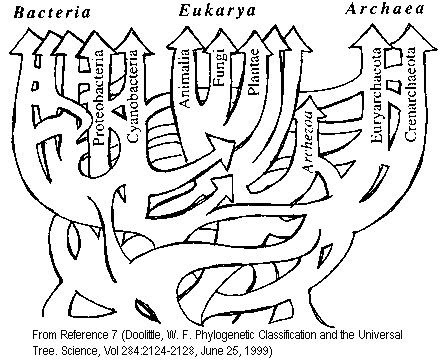
Perhaps phylogenies should not be considered trustworthy when based upon these non-junk DNA sequences.
biological function for one pseudogene challenges that popular belief.” Evolutionists have assumed that pseudogenes are non-functional because of predictions of evolution. The evolutionary prediction has discouraged what could be promising research into the biological role of pseudogenes. This “pseudogene” apparently regulates regulation of messenger-RNA on a different chromosome. Intelligent design, on the other hand, could predict that more functionality will be found for pseudogenes. The article ends with a profound question that both evolutionists and design theorists ought to take seriously: “Might the pseudogene copies of other functional genes be similarly useful?”
Back to the Main Origins News Page