
| The Short Answer: No. Darwinian evolution requires that a biological structure be functional along every small-step of its evolution. Irreducibly complex structures fail to perform any useful function if changed in any way, and thus cannot be built via the Darwinian mechanism. Thus, irreducibly complex structures are in principle unevolvable via Darwinian evolution. If a biological structure can be evolved (via co-optation of parts or otherwise), it is not irreducibly complex. Co-optation attempts to bridge the gap to irreducible complexity by “stealing” pre-existing parts which are complex, but do not fulfill a function related to the function of the irrneducibly complex structure. If two copies of those “co-opted” parts exist because a gene was duplicated, then one copy can fulfill the original function, and one copy can be “stolen” or “co-opted” to perform some new function. Most often the strongest evidence for “co-optation” that can be provided is mere sequence similarity (i.e. protein homology) between the part thought to have been co-opted and its original duplicate partner. Rarely (if ever) is detail given of how, or why, the part was able to be co-opted from its original function to fill its present function. Essentially, this mechanism is experimentally unverified and is at heart an appeal to a “miracle mutation.” It places Darwinian evolution in an unfalsifiable position and is an appeal to the extremely unlikely, and represents a good example of Thomas Kuhn’s “ad hoc modifications” used to save a theory in crisis. |
The Long Answer:
According to Michael Behe, irreducible complexity can be described as follows:
In The Origin of Species Darwin stated:
‘If it could be demonstrated that any complex organ existed which could not possibly have been formed by numerous, successive, slight modifications, my theory would absolutely break down.’
A system which meets Darwin’s criterion is one which exhibits irreducible complexity. By irreducible complexity I mean a single system which is composed of several interacting parts that contribute to the basic function, and where the removal of any one of the parts causes the system to effectively cease functioning.
(Michael Behe, from “Molecular Machines: Experimental Support for the Design Inference” available at
http://www.arn.org/docs/behe/mb_mm92496.htm)
Darwinists, such as the those who authored the National Academy of Sciences’ “Science and Creationism, A View from the National Academy of Sciences, 2nd ed.,” responded by proclaiming that irreducibly complex structures can be built via duplication and co-optation of parts:
“However, structures that are claimed to be “irreducibly” complex typically are not on closer inspection … Complex biochemical systems can be built up from simpler systems through natural selection … Natural selection can bring together parts of a system for one function at one time and then, at a later time, recombine those parts with other systems of components to produce a system that has a different function. Genes can be duplicated, altered, and then amplified through natural selection. The complex biochemical cascade resulting in blood clotting has been explained in this fashion.
(Science and Creationism, A View from the National Academy of Sciences, 2nd Ed. (1999, National Academy Press), emphasis added)
As Professor John Blamire explains, the advantage of this method is that when genes are duplicated, one part can perform the original function, and the duplicate copy is available for something else:
“So long as one of these copies remains unchanged and continues to perform its required function, the second duplicate copy can undergo random mutation without harming the cell.
Slowly, and by chance, this second gene may change enough to acquire a new function.”
(Evolution, The World of Darwin, Sources of variation: http://www.brooklyn.cuny.edu/bc/ahp/LAD/C20/C20_variation.html)
This relatively undetailed and simplistic explanation is from an undergraduate e-course. But what to do graduate students learn about this process of duplication – co-optation, and alteration?
In his book Darwin’s Black Box, one of Michael Behe’s examples of an unevolvable biochemical pathway was the blood clotting cascade. Behe critiques the work of world renowned blood clotting evolution expert Russell Doolittle, a biochemist at UC San Diego. In 2000, Russell Doolittle taught at a graduate seminar where the topic was for him to respond to Michael Behe’s claims in Darwin’s Black Box. The essence of Doolittle’s response was to proclaim nothing more than homology between various proteins in the blood clotting cascade:
Above we see 5 proteins involved in the blood clotting cascade, arranged in a tree simply according to their percent sequence similarity. This was the essence of Doolittle’s response to Behe: the blood clotting cascade proteins are similar (to varying degrees), therefore they must have evolved from one-another via duplication and co-optation. This mere sequence similarity, nothing less, and nothing more, formed the basis for Doolittle’s belief that the irreducibly complex blood clotting cascade could evolve. There was no discussion of intermediate stages showing how stepwise modifications in the current pathway could have been reversed back to a more simple stage. This is what graduate students were taught in a seminar directly intended to rebut the claims of Behe.
A similar defense of the evolution of irreducible complexity comes from Nicholas J. Matke’s recent “Evolution in (Brownian) space: a model for the origin of the bacterial flagellum.” Matzke attempts to answer the question of how a ‘primitive’ flagellum could have operated by asking, “[e]ven given the minimal costs and substantial selective benefits of crude motility, how could the sudden origin of the rotary motor complex be mutationally possible?” For two of the necessary proteins, he answers that question by appealing to pre-existing proteins which have sequence similarities to current proteins in a flagellum:
(Evolution in (Brownian) space: a model for the origin of the bacterial flagellum by Nicholas J. Matzke)
|
To account for the origin of a third crucial flagellar protein, Matzke finds the following:
No nonflagellar homologs of FliG have been discovered (except in type III virulence systems), perhaps not surprisingly given the peculiar function of this protein and the radical change it must have undergone, whatever its ancestral function.
(Evolution in (Brownian) space: a model for the origin of the bacterial flagellum by Nicholas J. Matzke)
If there were a FliG-like protein in biology today, Matzke would probably simply say, without any more detail, that FliG was co-opted from it. Lacking any such protein, Matzke proposes three hypotheses, each of which vaguely appeal to hypothetical proteins which did exactly what FliG currently does in some ancestral state. This is not a testable explanation for the origin of a Darwinian pathway.
Without getting into further detail, the main substance of the rest of Matzke’s explanation for the origin of the flagellum is to look at current flagellum parts, and find homology to other parts, and simply claim that they were duplicated and co-opted. The detail barely goes beyond these sorts of claims. Does citing two examples of homologous proteins and one example of an imaginary (and vague) protein that fulfilled the same job of a current protein show that “the sudden origin of the rotary motor complex … mutationally possible?” No.
The Gene Duplication Mechanism:
Duplicating a gene doesn’t help the evolution of complexity much, because once you duplicate a gene, you have a new piece of genetic information to play around with, but what good is that to you? If complex systems need specific parts, what sort of evidence is there that these duplicated genes will be the parts you need? Lynch and Conery found that the average gene duplicates about once every 100 million years (Lynch, M., Conery, J. S., “The Evolutionary Fate and Consequence of Duplicate Genes” Science 290:1151-1155 (Nov 10, 2000)) –that’s pretty rare. If the gene you need duplicates once every 100,000,000 generations, that doesn’t give you a very good chance of getting it when you need it. Furthermore, it has been found that, “the vast majority of gene duplicates are silenced within a few million years, with the few survivors subsequently experiencing strong purifying selection.” (Lynch and Conery, 2000) Another study showed that duplicated genes are not very free to mutate around at all, that there is strong selection pressure on them. (Huges, Austin L., “Adaptive Evolution of Genes and Genomes”. (see chapter 7, “Evolution of New Protein Function” pp 143-180. (Oxford University Press, New York, 1999)) This supports the statement by Conery and Lynch that the actual mechanisms by which gene duplication contributes to evolution are not very well understood:
“However, it is unclear how duplicate genes successfully navigate an evolutionary trajectory from an initial state of complete redundancy, wherein one copy is likely to be expendable, to a stable situation in which both copies are maintained by natural selection. Nor is it clear how often these events occur.” (Lynch and Conery, 2000).
The bottom line is that the gene duplication explanation still leaves the details to the dice, and this pathway definitely hasn’t been experimentally verified. All critics have found are protein homologies, and then inferred a vague ancestral pathway of gene creation. There is no explanation of how the parts could be co-opted, one mutational step at a time, to perform their current function. There is often a vague appeal to multiple mutations or instantaneous creation of new binding sites (apparently via multiple instantaneous complex mutational events), but this must happen all at once or the duplicated protein will fail to obtain a new function and become one of the “vast majority” of duplicated genes which gets silenced. Simply speaking, too many mutations are necessary for a protein to adopt a new function, and this explanation for the origin of real evolutionary novelty lacks a reliable mechanism and is little better than hand waving.
Michael Behe gives a very simple sketch of the problems with co-opting parts:
“Some Darwinists have proposed that a way around the problem of irreducible complexity could be found if the individual components of a system first had other functions in the cell. For example, consider a hypothetical example such as pictured here, where all of the parts are supposed to be necessary for the function of the system. Might the system have been put together from individual components that originally worked on their own, but then got together. Unfortunately this picture greatly oversimplifies the difficulty as I discussed in Darwin’s Black Box. Here analogies to mousetraps break down somewhat, because the parts of the system have to automatically find each other in the cell. They aren’t arranged by an intelligent agent as a mousetrap is. To find each other in the cell, interacting parts have to have their surfaces shaped so that they are very closely matched to each other. Originally, however, the individually acting components would not have had complementary surfaces. So all of the interacting surfaces, of all of the components, would first have to be adjusted, before they could function together, and only then would the new function of the composite system appear. Thus the problem of irreducibility remains, even if individual components separately had their own functions.”
(Michael Behe, Transcript of Intelligent Design Debate at: American Museum of Natural History April 23, 2002 at http://www.ncseweb.org/resources/articles/57_part_06_dr_michael_behe_10_31_2002.asp)
Some Darwinists have found more than just protein homology but complexes of similar proteins performing some unrelated function in the cell. Does this show co-optation is possible? William Dembski notes that the claim (popularized by Kenneth Miller) that a “Type III Secretory System” provides an intermediate stage in the supposed evolution of the flagellum, hardly accounts for the evolution of a structure:
“Van Till offers the type III secretory system as a possible precursor to the bacterial flagellum. This ignores that the current evidence points to the type III system as evolving from the flagellum and not vice versa (cf. Milt Saier’s recent work at UCSD). But beyond that, finding a component of a functional system that performs some other function is hardly an argument for the original system evolving from that other system. One might just as well say that because the motor in a motorcycle can be used as a blender, therefore the motor evolved into the motorcycle. Perhaps, but not without intelligent design. Even if it could be shown that the type III system predated the flagellum (contrary to Milt Saier’s work), it could at best represent one possible step in the indirect Darwinian evolution of the bacterial flagellum. But that still wouldn’t constitute a solution to the evolution of the bacterial flagellum. What’s needed is a complete evolutionary path and not merely a possible oasis along the way. To claim otherwise is like saying we can travel by foot from Los Angeles to Tokyo because we’ve discovered the Hawaiian Islands. Evolutionary biology needs to do better than that.”
Simply because we have an “island in the middle of the ocean” (i.e. a structure which uses some parts of the currently irreducibly complex structure), or “a few little seamounts” (i.e. individual proteins with similar sequences to the proteins in the irreducibly complex structure) does not mean that these parts could be duplicated and co-opted, remaining functional at every stage, to fulfill their current function in the irreducibly complex structure. The reason why so few duplicated parts are co-opted is probably because it is difficult for a part to pick up a brand new function within the cell. Essentially, for a randomly duplicated part to be co-opted, it must somehow mutate (for no apparent reason related to survival) to interact with some other parts in the cell. This is exceedingly unlikely, and not completely unlike the analogy in the diagram below:
In the picture above, a fitting lock and key must be derived from two ancestral parts which are vaguely similar. The hammer has a somewhat similar elongated shape to the key, and the vice has a somewhat similar shape to the lock. Somehow the hammer turns into a key, and the vice turns into a lock. Then somehow the lock and key can fit with one another. Can you imagine a scenario where this transformation can happen and yet the parts remain functional (relative to their form) at all stages? Though this analogy seems ridiculous, it is not entirely different from the co-optation argument used to account for the origin of irreducibly complex structures.
Thus, we have a revised definition of irreducible complexity from Michael Behe where he realizes that the essence of irreducible complexity is the fact that the “mutational gap” is too great to be bridged by Darwinian evolution:
“An irreducibly complex evolutionary pathway is one that contains one or more unselected steps (that is, one or more necessary-but-unselected mutations). The degree of irreducible complexity is the number of unselected steps in the pathway.”
(A Response to Critics of Darwin’s Black Box, by Michael Behe, PCID, Volume 1.1, January February March, 2002; iscid.org/)
There appear to be many necessary unselected mutations to evolve irreducible complexity in the cell. Are these many mutations possible? Well, they might be possible if we allow for extremely unlikely events going on in the history of life. Does the fact that Darwinists have a possible, though unlikely account for the origin of irreducible complexity force inferring intelligent design via irreducible complexity into an “argument from ignorance” or a “design-of-the-gaps” type argument? Has evolution been demonstrated sufficiently likely to justify us holding on to it as the explanation? William Dembski notes that possible, though highly unlikely, naturalistic explanations such as this do NOT block the design inference, in fact they warrant it:
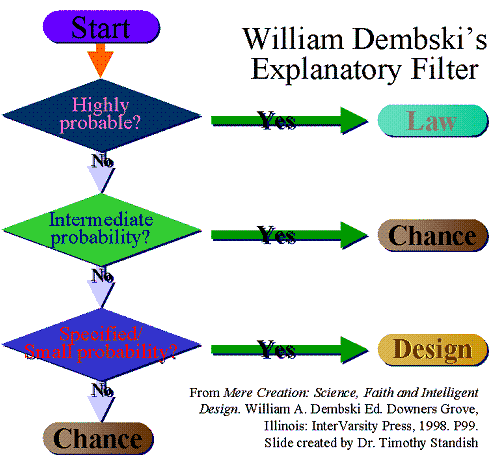
In the filter, when the likelihood of an event is exceedingly low, and yet it matches some clearly specified pattern, then we are justified in inferring design. Thus, intelligent design, which we already know tends to purposefully arrange parts in a complex manner to create new functions, may be the better explanation. Based off of our knowledge that intelligent agents can produce highly specified and complex structures, intelligent design best inferred to account for the origin of these highly specified irreducibly complex structures for which an evolution-by-duplication/co-optation-explanation is extremely unlikely. By proposing these unlikely “miracle mechanisms,” Darwinists have made evolution essentially unfalsifiable. Michael Behe offers some wise words on what to do when Darwinists propose highly unlikely explanations for the origin of irreducibly complex structures:
[O]ne needs to relax Darwin’s criterion from this:
“If it could be demonstrated that any complex organ existed which could not possibly have been formed by numerous, successive, slight modifications, my theory would absolutely break down.”
If a complex organ exists which seems very unlikely to have been produced by numerous, successive, slight modifications, and if no experiments have shown that it or comparable structures can be so produced, then maybe we are barking up the wrong tree. So, LET’S BREAK SOME RULES!
Of course people will differ on the point at which they decide to break rules. But at least with the realistic criterion there could be evidence against the unfalsifiable. At least then people like Doolittle and Miller would run a risk when they cite an experiment that shows the opposite of what they had thought. At least then science would have a way to escape from the rut of unfalsifiability and think new thoughts.
(“Answering Scientific Criticisms of Intelligent Design,” by Michael Behe, Science and Evidence for Design in the Universe, Proceedings of the Wethersfield Institute, Vol 9:146-147.)
Dembski would add that this sort of reasoning only confirms why the design inference is warranted in these situations.
Finally, it is possible that these highly unlikely scenarios and essential appeal to “miracle mutations” are like what Thomas Kuhn describes as “ad hoc modifications” used to save a theory in crisis:
“There is, in addition, a second reason for doubting that scientists reject paradigms because confronted with anomalies or counterinstances … By themselves they [anomalies in the currently reigning paradigm] cannot and will not falsify that philosophical theory, for its defenders will do what we have already seen scientists doing when confronted by anomaly. They will devise numerous articulations and ad hoc modifications of their theory in order to eliminate any apparent conflict.”
(Kuhn, T., The Structure of Scientific Revolutions, Chapter VIII, Response to Crisis, pg. 77-78, Univ. of Chicago Press, 2nd ed., 1970).
Thus, we have seen that evolving irreducible complexity via duplication and co-optation of parts is highly unlikely to have occurred, and yet this irreducible complexity is the very sort of complexity that tends to be produced by the action of an intelligent agent. This warrants the design inference.