
“Silly and misleading. Rather like Casey Luskin’s blather.”
–Edward Humes, in his apparently only comments in response to this extensive review of Monkey Girl
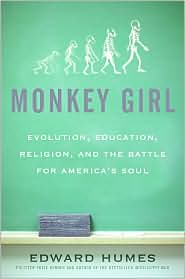 Any book with an icon of evolution on its cover — in this case, the fanciful diagram of ape-like skeletons transitioning into a human skeleton — is bound to be unfriendly towards intelligent design (ID). When I received my copy of Monkey Girl: Evolution, Education, Religion, and the Battle for America’s Soul (Harper Collins, 2007), Edward Humes’ book about the Kitzmiller v. Dover trial, I expected no less. Humes’ FAQ on evolution and ID on his website made the incredibly bold claim, “There is more scientific evidence … to support evolutionary theory than … gravitational theory.” What I did not expect to find in Humes’ book were dozens of inaccurate claims about the Kitzmiller v. Dover trial and extensive name-calling and ad hominem attacks against intelligent design proponents. This isn’t upsetting–just surprising given that it comes from a book that is being touted as an objective and accurate historical treatment of the Kitzimller v. Dover trial.
In early 2007, I wrote a three-part series of blog posts where I discussed how Humes misrepresented himself when trying to convince me to do an interview with him when he was writing Monkey Girl. (That series of prequels can be found at the following links: Part 1, Part 2, and Part 3.) When Humes first contacted me in 2006, he declared his commitment to non-partisan and objective journalism (he later refused to give me permission to quote directly from his original emails). Humes’ defensive posture immediately alerted me that something was awry, so I declined to do an interview. It turned out my instincts were correct: Edward Humes was not interested in non-partisan journalism regarding the evolution debate. He created a website about Monkey Girl, which had many inaccurate and highly partisan claims, like, “There is more scientific evidence, laboratory testing and direct observation to support evolutionary theory than virtually any other scientific theory, including gravitational theory,” calling ID a “form of creationism,” and saying ID “posits a supernatural process.” It would be hard to imagine a less-partisan treatment of evolution. At the end of that series of blog posts, before I received Humes’ book, I wrote the following:
At this point, I’ve recounted Humes’ glowing praise from only hardline Darwinists, his partisan and inaccurate FAQ, and the fact that he changed his FAQ in response to my emails and then did not disclose key changes while accusing me of misstating the FAQ. Yet Humes originally came to me soliciting an interview claiming to be fair and neutral.
Some readers may choose to believe that Humes developed his views while he wrote the book and was forthright towards me. Unsurprisingly, that is what Humes claims, and Humes’ Darwinist reviewers will certainly take that line in his defense. And if that’s the case, Humes could simply make his book proposal public, because that should reveal whether he really was non-partisan when he researched his book. That would certainly lay my suspicions to rest. But Humes continues to refuse to make his book proposal public. Other readers may wonder what Humes is hiding in the book proposal.
Regardless, there is no doubt that Humes is now a complete partisan (who believes evolution is better supported than gravity) and that he is promoting much false information about ID.
Because Discovery Institute was unable to obtain a review copy of Humes’ book, I had to order it off Amazon, and I have not yet received the book (somehow many Darwinist bloggers already have copies, as they’ve reviewed [it] for Humes on his blog). Perhaps after the book arrives, further commentary can be made about it. Meanwhile, I’m sure Edward Humes won’t complain too much about the free publicity we’re giving him. After all, you know what they say…
(Is Edward Humes, Monkey Girl Author, a Partisan? (Part III): Glowing Endorsements from Darwinists)
Soon after that posting, I received my copy of Monkey Girl from Amazon and started working on a fairly lengthy review of the book. Because the book had so many inaccurate statements, what started off as a review soon became a time-consuming rebuttal. Unfortunately, in the middle of working on that review/rebuttal of Monkey Girl, my hard drive severely crashed (an IT friend told me it was the worst hard drive meltdown he’d seen), and I also came down with a severe illness. For a while this project fell by the wayside. But recently I’ve had a couple people e-mailing me, citing Monkey Girl as a supposed objective, authoritative source of information on intelligent design. As a result, I decided to shorten my former review into this rebuttal.
People behave as if the fact that Edward Humes once won a Pulitzer prize (for a different work, mind you), that therefore Monkey Girl is an impartial and inerrant work. As someone who has been closely involved in the ID movement for years and who observed much of the Kitzmiller v. Dover trial in person, it would be a grave mistake to cite Monkey Girl as a non-partisan — or even accurate — source of information on ID or the Kitzmiller v. Dover case. In fact, at many points it simply parrots Darwinist talking points and retells many of their patently false urban legends about the Kitzmiller v. Dover case, leaving out crucial facts which contradict common Darwinist claims. Humes says in his book, “if the evolution wars are to continue, let the combatants be armed with facts, not fiction.” (pg. viii.) That sounds good to me. But Humes’ book comes off more like advocacy than an objective evaluation of the facts.
In response to some of these e-mails about Monkey Girl, I decided to dig up my prior review of Humes’ book, shorten it, and highlight some of the main points of my review. Because most of Humes’ inaccurate claims about ID have been answered in various other writings, my review of Monkey Girl will consist primarily of short descriptions of his false claims combined with links to articles that address his false statements. This response will come in six segments.
Part I: Inaccuraces In Monkey Girl Relating to Intelligent Design:
Part II: Inaccuracies in Monkey Girl Regarding Attacks upon Discovery Institute:
Part III: Edwards Humes’ One-Sided Attacks and Double-Standard Used against ID proponents Regarding Name-Calling:
Humes tries to paint the Darwinists as if they are the only ones who are victims of personal attacks in the debate over ID and evolution. Anyone who even remotely follows this issue on the internet realizes that namecalling can be a problem on both sides, but that Darwinists are the ones who overwhelmingly participate in personal attacks against ID proponents.
Humes quotes a couple ID proponents who apparently said nasty things about Darwinists, such as one legislator who apparently “offered a chilling comment likening anyone who thought differently to the murderous terrorists of 9/11.” (pg. 207) While it is terrible, to be sure, when anyone engages in such personal attacks, Humes fails to observe the fact that ID proponents are subjected to personal attacks that vastly outweigh those received by Darwinists. In fact, ID proponents are also regularly compared to terrorists, or the “Taliban,” by Darwinists who make such comparisons with a straight face. Such comparisons come not just from hyperbolic politicians with an agenda (like the example Humes gives) but from serious academics and journalists. Even a front page New York Times article in 2005 acknowledged that Discovery Institute “is also fending off attacks from the left, as critics liken it to… the Taliban.” The article had good reason for making that claim, because many ID critics compare ID proponents to terrorists or the Taliban:
Many of these examples come from PandasThumb, and it should be noted that on his Monkey Girl website, Humes recommends PandasThumb as “The leading evolution (and Intelligent Design criticism) blog.”
On a personal note, I am familiar with these kinds of attacks. In one single forum at Antievolution.org, created and owned by a former National Center for Science Education staff member, I have been called no less than “Bizarre ignoramus,” “retarded,” “suck-up,” “Pathetic Loser,” “attack mouse, gerbil, rat, or clockwork powered plush toy,” “an orc,” “Annoying,” “a miserable loser with no life,” “an idiot,” “dishonest,” “ignorant cheap poxied floozie,” “fanatic and lunatic,” “A proven liar,” “incompetent,” and many other far more colorful attacks which are probably best left unprinted here on Evolution News and Views.
I don’t list this example to complain — I happily forgive those who have attacked me, and in fact my main response to this behavior is sadness for how it brings the ID-evolution debate down into the gutter. Rather, I mention this example to point out that this example alone finds no counterpart anywhere in the ways that ID proponents have treated Darwinists. The internet Darwinist track record of name-calling against ID proponents speaks for itself, and Humes has portrayed the general nature of personal and ad hominem attacks in this issue exactly backwards from reality.
It is a travesty when anyone — whether a supporter of evolution or ID — is attacked in a mean-spirited fashion in this debate. Humes aims to shock his readers with how evolutionists are treated, while taking no interest in reporting how ID proponents are treated–which is dramatically worse than the treatment of Darwinists. This shows his partisan bias against ID proponents.
Hypocritically, Humes himself engages in much mud-slinging against ID proponents and Discovery Institute, calling them “combativ[e], “running scared,” “angry,” “cocky,” “co[y],” and “masters of anti-evolution spin.” In particular, Humes engages in name-calling in response to Traipsing Into Evolution, our rebuttal to the Kitzmiller v. Dover ruling, calling it the “rant of a sore loser” and claiming it was an “an adaptation of angry Internet postings” where we “just made [things] up” and engaged in “complete fabrication.” (He never identifies the “angry Internet postings,” so it’s hard to take this attack seriously, and it seems that he makes this claim to gloss over Traipsing‘s scholarly nature, with 50+ citations to legal cases, 30+ citations to pro-ID scientific references, 25+ citations to non-ID scientific references, and about 30 citations to transcripts and briefs related to Kitzmiller.) Another false claim was Humes’ statement that our book says that “[Judge] Jones has an oversize ego.” Where did we say this in our book? We made no such claim.
For a very small sampling of just some of the attacks we at Discovery Institute received post-Kitzmiller, see “For Many Darwinists, It’s Always Winter and Never Christmas.”
Part IV: Mistakes in Edward Humes’ Attacks in Monkey Girl on Traipsing Into Evolution:
The word “conflate” means “to bring together” — and that’s exactly what Judge Jones tried to do with respect to ID and fundamentalism. He did it for legal purposes so that supporting one could be seen as endorsing the other. Humes’ harsh attacks on Traipsing Into Evolution are extremely misguided, and it certainly cannot be fairly argued that our claim was a “complete fabrication.” Can that same charge be made against Humes’ false accusations against the book?
For a refutation of Judge Jones’ false history of ID, see Traipsing Into Evolution, “Intelligent Design will Survive Kitzmiller v. Dover,” or “ID Does Not Address Religious Claims About the Supernatural.”
Humes’ weak examples include: (1) Out-of-context quotations from Michael Behe where Humes tries to switch philosophical implications of ID with the actual scientific content of the theory; (2) Comments by Behe about the definition of science which had NOTHING to do with claiming ID was supernatural; (3) False claims that Scott Minnich said that the ground rules of science had to be changed for ID to be considered science; (4) Irrelevant comments by Steve Fuller and William Dembski attacking methodological naturalism, and (5) Irrelevant comments about Of Pandas and People (Pandas) that ignore what Pandas actually said. I’ll treat each one of these arguments separately:
1. Humes’ Out-of-context quotations from Michael Behe: Humes observes that Behe said that it is “implausible that the designer is a natural entity,” but this small snippet is a quotation that is taken grossly out-of-context. The citation is to where Behe is writing in a PHILOSOPHY journal about the philosophical implications of ID, where he is arguing that, on a philosophical level, there must be a regress back to some non-natural designer. Behe thinks such a regress can be made on a philosophical level, but he’s not making a scientific argument, nor is he discussing the actual scientific conclusions of ID. In fact, Humes ignores that Behe’s same article leaves open the possibility that, philosophically, humans were directly designed by a natural designer, as Behe states: “I should add that there is nothing in the previous reasoning to rule out the hypothesis that we terrestrials were designed by a natural designer which was itself designed by a supernatural designer, or that there was a series of designers between the supernatural one and us, or some variation of this. It simply means that at the beginning of the chain, input from beyond nature was required.”
In his response to Judge Jones’ ruling, Behe explained that the court blatantly misrepresented his views, and the theory of ID, because this quote was simply looking at the philosophical implications of ID:
“Again, repeatedly, the Court’s opinion ignores the distinction between an implication of a theory and the theory itself. If I think it is implausible that the cause of the Big Bang was natural, as I do, that does not make the Big Bang Theory a religious one, because the theory is based on physical, observable data and logical inferences. The same is true for ID.”
(Michael Behe, “Whether Intelligent Design is Science: A Response to the Opinion of the Court in Kitzmiller vs Dover Area School District”)
Additionally, Humes ignores the fact that Behe has clearly explained in multiple places that the scientific theory of intelligent design does not require the supernatural:
“The conclusion that something was designed can be made quite independently of knowledge of the designer. As a matter of procedure, the design must first be apprehended before there can be any further question about the designer. The inference to design can be held with all the firmness that is possible in this world, without knowing anything about the designer.” (Michael Behe, Darwin’s Black Box, pg. 197.)
“The most important difference [between modern intelligent design theory and Paley’s arguments] is that [intelligent design] is limited to design itself; I strongly emphasize that it is not an argument for the existence of a benevolent God, as Paley’s was. I hasten to add that I myself do believe in a benevolent God, and I recognize that philosophy and theology may be able to extend the argument. But a scientific argument for design in biology does not reach that far. Thus while I argue for design, the question of the identity of the designer is left open. Possible candidates for the role of designer include: the God of Christianity; an angel–fallen or not; Plato’s demi-urge; some mystical new age force; space aliens from Alpha Centauri; time travelers; or some utterly unknown intelligent being. Of course, some of these possibilities may seem more plausible than others based on information from fields other than science. Nonetheless, as regards the identity of the designer, modern ID theory happily echoes Isaac Newton’s phrase hypothesis non fingo.
(Michael Behe, “The Modern Intelligent Design Hypothesis,” Philosophia Christi, Series 2, Vol. 3, No. 1 (2001), pg. 165, emphasis added.)“most people (including myself) will attribute the design to God–based in part on other, non-scientific judgments they have made–I did not claim that the biochemical evidence leads ineluctably to a conclusion about who the designer is. In fact, I directly said that, from a scientific point of view, the question remains open. … The biochemical evidence strongly indicates design, but does not show who the designer was”
(Michael Behe, “Philosophical Objections to Intelligent Design: Response to Critics,” http://www.arn.org/docs/behe/mb_philosophicalobjectionsresponse.htm)
So Behe has been very clear that intelligent design itself does not require a supernatural designer. In fact, he gave clear and direct testimony at the trial, which Judge Jones ignored, explaining that ID does not require the supernatural:
Q. So is it accurate for people to claim or to represent that intelligent design holds that the designer was God? Behe: No, that is completely inaccurate.
Q. Well, people have asked you your opinion as to who you believe the designer is, is that correct?
Behe: That is right.
Q. Has science answered that question?
Behe: No, science has not done so.
Q. And I believe you have answered on occasion that you believe the designer is God, is that correct?
Behe: Yes, that’s correct.
Q. Are you making a scientific claim with that answer?
Behe: No, I conclude that based on theological and philosophical and historical factors.
(Behe, October 17 AM testimony, pgs. 94-95.)
Humes claims that we failed to address the evidence cited by Judge Jones, but I think it’s perfectly clear who is failing to address the arguments of the opposing side–it’s Edwards Humes. Thus, Judge Jones (and then Edward Humes) misconstrued the actual theory of ID — which Behe makes clear does not require the supernatural — with the philosophical implications that Behe has drawn from the theory.
2. Humes’ misconstrual of Behe’s definition of science: Humes’ comment about Behe’s definition of science (with respect to ID and astrology) is again grossly out-of-context because this segment of Behe’s testimony had absolutely nothing to do with whether ID required supernatural intervention. In fact, evolution fits under Behe’s definition of science, but that doesn’t mean that evolution requires the supernatural any more than it means that ID requires the supernatural.
3. Humes’ uncritical misconstruals of Scott Minnich’s testimony: Humes parrots Judge Jones (who copied and pasted from the ACLU) quoting pro-ID biochemist and Kitzmiller expert witness Scott Minnich out-of-context, stating that “Professor Minnich testified that for ID to be considered science, the ground rules of science have to be broadened so that supernatural forces can be considered.” No, Dr. Minnich NEVER said anything like that and in fact testified that ID does not require the supernatural. The citation is to page 97 of Minnich’s Nov. 4th AM testimony. I was in the courtroom when Minnich gave this testimony and I remember clearly what he said, and the context of the exchange. Here’s what Minnich actually said in the segment cited by Judge Jones, as it was recorded by the court reporter:
Q. Well, the answer to my question, and I understand you had a qualification, was true. For intelligent design to be considered science, the definition of science or the rules of science have to be broadened so that supernatural causes can be considered, correct?
A. Correct, if intelligent causes can be considered. I won’t necessarily — you know, you’re extrapolating to the supernatural. And that is one possibility.
Thus, Minnich’s comment about changing the definition of science (which they claimed was methodological naturalism) is conditional — science only has to be redefined if one defines mere intelligent causes to be supernatural. But Minnich isn’t saying ID necessarily postulates a supernatural cause because the supernatural is “one possibility” and, as he points out, the hostile attorney was “extrapolating to the supernatural,” but Minnich “won’t necessarily” do that. Minnich, however, made it clear that he was not “extrapolating to the supernatural,” as will be seen by looking at various excerpts from Minnich’s testimony:
Q. Do you have an opinion as to whether intelligent design requires the action of a supernatural creator?
A. I do.
Q. What is that opinion?
A. It does not.
(Minnich November 3 PM testimony, pgs. 45-46, 135.)Q. Is it — does intelligent design tell us how many designers there are? Is it just one or could it be more?
A. It could be more.
Q. So it could be a whole family of designers, right?
A. I suppose so.
Q. It could be competing designers? We could have one designer who’s designing good things and another designer who’s designing bad things, right?
A. I don’t — yeah, what’s your point?
Q. Well, does intelligent design tell us whether there could be –
A. No, no.
(Minnich, November 4th AM testimony, pg. 94.)Q. Now, the conclusion that something was designed, does that require knowledge of the designer?
A. No. Absolutely not.
Q. Why not?
A. Well, I mean, we can infer design, but the science isn’t going to tell us anything about the designer unless it’s, you know, signed on one of these components, and we haven’t found that yet.
Q. So is it accurate for people to claim or to represent that intelligent design holds that the designer is God?
A. No, absolutely not.
Q. Has science answered this question, the source of design —
A. No.
(Minnich, November 3 PM testimony, pg. 57.)
Again, during cross-examination, we see that Minnich says that ID permits a supernatural creator, but doesn’t require it:
Q. Would it be fair to say that intelligent design does not exclude the possibility of a supernatural cause as the designer?
A. It does not exclude.
Q. And, in fact, a designer could be a deity, correct?
A. It could be.
Q. And that would clearly be supernatural, right?
A. Right, but that’s — that would be a philosophical addition to that science isn’t going to take, isn’t going to tell us. I think I made that clear.
(Minnich, November 4 AM testimony, pgs. 95-96.)
Thus, Minnich makes it clear that the science of ID cannot tell you if the designer is natural or supernatural. Here, again, is exchange cited by Judge Jones (and thus, by Humes), which comes soon after this last quote given above:
Q. Well, the answer to my question, and I understand you had a qualification, was true. For intelligent design to be considered science, the definition of science or the rules of science have to be broadened so that supernatural causes can be considered, correct?
A. Correct, if intelligent causes can be considered. I won’t necessarily — you know, you’re extrapolating to the supernatural. And that is one possibility.
(Minnich, November 4 AM testimony, pg. 97.)
In his answer, Minnich makes it clear that methodological naturalism only excludes ID to the extent that it excludes “intelligent causes” by considering them to be “supernatural” — this is why he says “correct, if intelligent causes can be considered…” He attributed the extrapolation that ID requires a “supernatural cause” to the Darwinist attorney, Mr. Harvey, because Dr. Minnich had already made it clear that the science cannot tell you if the designer is natural or supernatural. It is “one possibility” that the designer is supernatural, but Minnich makes it clear that the scientific theory does not tell you that. The implication of Dr. Minnich’s logic is that if methodological naturalism does NOT exclude merely intelligent causes then, the Mr. Harvey’s answer is incorrect — if intelligent causes cannot be considered excluded.
Minnich also makes it clear that ID goes no further than inferring intelligence, stating, “So we’re looking at the empirical evidence. We find irreducible complex systems. When we find these in any other context they’re the product of intelligence, we infer by standard scientific inference or reasoning that these systems are also the product of intelligence, and we leave it at that.” (Minnich, Nov. 3rd Testimony, pgs. 49-50.) In one final exchange from his direct testimony, Minnich makes it clear that methodological naturalism doesn’t exclude ID because ID doesn’t require supernatural action:
Q. Does intelligent design require the action of a supernatural creator acting outside the laws of nature?
A. No.
[…]
Q. Does intelligent design rule out a natural explanation for design foundation?
A. It doesn’t.
Q. We heard quite a bit of testimony during the course of this trial about methodological naturalism, and I believe you indicated in your deposition you see that as placing limits on intelligent design, is that correct?
A. It does. It can. In the sense that it limits explanations it can be advanced, but it has the same kind of stricture on other avenues of scientific research as well.
Q. Does methodological naturalism necessarily exclude intelligent design from the realm of science?
A. No, it doesn’t.
Q. Why not?
A. Again, I mean, there could be a natural cause for the systems we’re trying to explain.
(Minnich, November 3 PM testimony, pgs. 135-137.)
Thus, Minnich once again makes it clear that methodological naturalism does not exclude design unless design is appealing to a supernatural creator. But he has made it clear that intelligent design is not an explanation to the supernatural, so it isn’t excluded by methodological naturalism. Dr. Minnich’s position should now be clear: he doesn’t think that methodological naturalism excludes ID unless you (a) wrongly extrapolate that ID requires a supernatural explanation, or (b) classify all intelligent causes as “supernatural” such that methodological naturalism would exclude any intelligent causes. This is because Minnich was clear that “we infer by standard scientific inference or reasoning that these systems are also the product of intelligence, and we leave it at that.” Humes, following Judge Jones, misrepresented Minnich’s testimony.
4. Humes cites irrelevant discussions from Steve Fuller and William Dembski: Humes quotes Steve Fuller and William Dembski bashing methodological naturalism, but we explain in our book (in a section that Humes apparently ignores) why, even if methodological naturalism is a correct criterion of science, that it does not disqualify ID from being science:
Whether methodological naturalism is really a foundational ground rule for the operation of science has been sharply disputed by historians and philosophers of science. Assuming ad arguendo that Judge Jones is correct [that science should be defined by methodological naturalism], his argument proves far less than he believes. Intelligent design, properly conceived, does not need to violate methodological naturalism, a point that expert witness Scott Minnich made clear at trial. To understand why this is the case, one needs to understand how a design inference is drawn. Intelligent design theory assumes that intelligence is a property which we can understand through general observation of intelligent agents in the natural world. An intelligent agent exhibits predictable modes of designing because it has the property of intelligence, regardless of whether or not the agent is ‘natural’ or ‘supernatural.’ Thus, the theory of intelligent design does not investigate whether the designing intelligent agent was natural or supernatural because it assumes that things designed by an intelligence may possess certain perceptible properties regardless of whether that intelligent agent is a natural entity, or in some way supernatural. Contrary to Judge Jones, intelligent design is clearly based upon an explanatory cause whose behavior is understandable and yields predictable evidence that it was at work. … Intelligent causes can be inferred through confirmable data. The types of information produced by intelligent causes can be observed and then measured. Scientists can use observations and experiments to base their conclusions of intelligent design upon empirical evidence. Intelligent design limits its claims to those which can be established through the data. In this way, intelligent design does not violate the mandates of predictability and reliability laid down for science by methodological naturalism (whatever the failings and limitations of methodological naturalism).
(Traipsing Into Evolution, pg. 37.)
5. Humes’ Misrepresentations of Pandas: Humes claims that the Pandas textbook shows that “ID is a supernatural, religious idea.” (pg. 344.) But Humes somehow misses that Pandas makes precisely the opposite claim — that the science of ID cannot determine whether the intelligence behind life is natural or supernatural, as these excepts from Pandas demonstrate:
“If science is based upon experience, then science tells us the message encoded in DNA must have originated from an intelligent cause. But what kind of intelligent agent was it? On its own, science cannot answer this question; it must leave it to religion and philosophy. But that should not prevent science from acknowledging evidences for an intelligent cause origin wherever they may exist. This is no different, really, than if we discovered life did result from natural causes. We still would not know, from science, if the natural cause was all that was involved, or if the ultimate explanation was beyond nature, and using the natural cause.”
(Of Pandas and People, pg. 7, emphasis added.)“Surely the intelligent design explanation has unanswered questions of its own. But unanswered questions, which exist on both sides, are an essential part of healthy science; they define the areas of needed research. Questions often expose hidden errors that have impeded the progress of science. For example, the place of intelligent design in science has been troubling for more than a century. That is because on the whole, scientists from within Western culture failed to distinguish between intelligence, which can be recognized by uniform sensory experience, and the supernatural, which cannot. Today we recognize that appeals to intelligent design may be considered in science, as illustrated by current NASA search for extraterrestrial intelligence (SETI). Archaeology has pioneered the development of methods for distinguishing the effects of natural and intelligent causes. We should recognize, however, that if we go further, and conclude that the intelligence responsible for biological origins is outside the universe (supernatural) or within it, we do so without the help of science.”
(Of Pandas and People, pgs. 126-127, emphasis added.)“The idea that life had an intelligent source is hardly unique to Christian fundamentalism. Advocates of design have included not only Christians and other religious theists, but pantheists, Greek and Enlightenment philosophers and now include many modern scientists who describe themselves as religiously agnostic. Moreover, the concept of design implies absolutely nothing about beliefs and normally associated with Christian fundamentalism, such as a young earth, a global flood, or even the existence of the Christian God. All it implies is that life had an intelligent source.”
(Of Pandas and People, pg. 161.)
Indeed, at one point, Pandas even seems to adopt methodological naturalism, stating that “intelligence . . . can be recognized by uniform sensory experience, and the supernatural . . . cannot.” (pg. 126.) Somehow Humes must have missed those passages where Pandas makes it clear that ID does not require the supernatural. For more details on Pandas, see “Response to ACLU ID FAQ: Part 1” and “Intelligent Design will Survive Kitzmiller v. Dover.”
Part V: Edward Humes’ Misconstruals of Religion and of Science in Monkey Girl:
In his Autobiography, Darwin took aim at belief in a personal God which he believed was superseded directly by his theory of natural selection, writing: “Although I did not think much about the existence of a personal God until a considerably later period of my life, I will here give the vague conclusions to which I have been driven. The old argument of design in nature, as given by Paley, which formerly seemed to me so conclusive, fails, now that the law of natural selection has been discovered. We can no longer argue that, for instance, the beautiful hinge of a bivalve shell must have been made by an intelligent being, like the hinge of a door by man. There seems to be no more design in the variability of organic beings and in the action of natural selection, than in the course which the wind blows. Everything in nature is the result of fixed laws.” Readers can decide for themselves if Humes is correct to state that it is only “critics of evolution” who claim that Darwin’s scientific research impacted his personal faith.
An evolutionary interpretation of the fossil data requires that many key features that allow birds to fly, including feathers, evolved for a purpose other than flight. Feathers supposedly evolved from scales, but pennaceous feathers are so well-suited for flight that it is difficult to imagine transitional stages between scales and fully functional flight feathers. According to much prevailing evolutionary wisdom, natural selection is not the powerful force driving the evolution of traits necessary for flight. Rather, bird flight has become a mere accident and lucky byproduct of a morphological coincidence. This does not make for a compelling evolutionary story.
“Intelligent human agents–in virtue of their rationality and consciousness–have demonstrated the power to produce information in the form of linear sequence-specific arrangements of characters. Indeed, experience affirms that information of this type routinely arises from the activity of intelligent agents. A computer user who traces the information on a screen back to its source invariably comes to a mind–that of a software engineer or programmer. The information in a book or inscriptions ultimately derives from a writer or scribe–from a mental, rather than a strictly material, cause. Our experience-based knowledge of information-flow confirms that systems with large amounts of specified complexity (especially codes and languages) invariably originate from an intelligent source from a mind or personal agent. As Quastler (1964) put it, the “creation of new information is habitually associated with conscious activity” (p. 16). Experience teaches this obvious truth.”
“For historical scientists, “the present is the key to the past” means that present experience-based knowledge of cause and effect relationships typically guides the assessment of the plausibility of proposed causes of past events. Yet it is precisely for this reason that current advocates of the design hypothesis want to reconsider design as an explanation for the origin of biological form and information. This review, and much of the literature it has surveyed, suggests that four of the most prominent models for explaining the origin of biological form fail to provide adequate causal explanations for the discontinuous increases of CSI that are required to produce novel morphologies. Yet, we have repeated experience of rational and conscious agents–in particular ourselves–generating or causing increases in complex specified information, both in the form of sequence-specific lines of code and in the form of hierarchically arranged systems of parts.”
“What natural selection lacks, intelligent selection–purposive or goal-directed design–provides. Rational agents can arrange both matter and symbols with distant goals in mind. In using language, the human mind routinely “finds” or generates highly improbable linguistic sequences to convey an intended or preconceived idea. In the process of thought, functional objectives precede and constrain the selection of words, sounds and symbols to generate functional (and indeed meaningful) sequences from among a vast ensemble of meaningless alternative combinations of sound or symbol (Denton 1986:309-311). Similarly, the construction of complex technological objects and products, such as bridges, circuit boards, engines and software, result from the application of goal-directed constraints (Polanyi 1967, 1968). Indeed, in all functionally integrated complex systems where the cause is known by experience or observation, design engineers or other intelligent agents applied boundary constraints to limit possibilities in order to produce improbable forms, sequences or structures. Rational agents have repeatedly demonstrated the capacity to constrain the possible to actualize improbable but initially unrealized future functions. Repeated experience affirms that intelligent agents (minds) uniquely possess such causal powers.”
“Intelligent agents have foresight. Such agents can select functional goals before they exist. They can devise or select material means to accomplish those ends from among an array of possibilities and then actualize those goals in accord with a preconceived design plan or set of functional requirements. Rational agents can constrain combinatorial space with distant outcomes in mind. The causal powers that natural selection lacks–almost by definition–are associated with the attributes of consciousness and rationality–with purposive intelligence. Thus, by invoking design to explain the origin of new biological information, contemporary design theorists are not positing an arbitrary explanatory element unmotivated by a consideration of the evidence. Instead, they are positing an entity possessing precisely the attributes and causal powers that the phenomenon in question requires as a condition of its production and explanation.”
Meyer’s article contains a strong positive argument for design and does not “equat[e] arguments against evolution with arguments for design.” Only by disregarding the bulk of what Meyer wrote in his PBSW paper can Humes, relying on Matzke, make that false claim.
Humes should have also scrutinized some of Matzke’s claims against Meyer, but instead relies on Matzke to claim that “recent discoveries had uncovered predecessor organisms in the fossil record that had previously been overlooked because of their fragility and small size.” (pg. 198.) Mike Gene did some fact-checking on Matzke, noting that Matzke’s claim that “Meyer repeats the claim that there are no transitional fossils for the Cambrian phyla” is false, because as Gene observes, “no where does [Meyer] actually claim ‘there are no transitional fossils for the Cambrian phyla.’”
Matzke attacks some of Meyer’s footnotes and citations, claiming that “of the two papers by Foote cited by Meyer, neither deals with the Cambrian/Precambrian records.” Yet Meyer cited two other studies besides those by Foote to bolster this point, neither of which Matzke refutes, and in fact one of Meyer’s citations to Foote does mention the Cambrian. Unfortunately, Humes repeats Matzke’s criticisms of Meyer without investigating them carefully.
In his description of Matzke’s argument, Humes insinutates that the Cambrian explosion is not a real event, but an artefact of poor preservation in the fossil record. But many experts and authority disagree with this view. Simon Conway Morris explains that “The ‘Cambrian explosion’ is a real evolutionary event, but its origins are obscure.” This corroborates with Meyer’s actual argument, which observes that “several recent discoveries and analyses suggest that these morphological gaps may not be merely an artifact of incomplete sampling of the fossil record … suggesting that the fossil record is at least approximately reliable.”
The alleged Precambrian fossils cited by Matzke comes from a paper by J. Y. Chen, the same scientist who stated that, “In China we can criticize Darwin but not the government. In America you can criticize the government but not Darwin.” Nonetheless, Matzke claims that Chen’s article documents “fossils of the long-hypothesized small, soft-bodied precambrian worm.” Yet Chen’s article does not contain the word “worm” and the word “small” is perhaps an understatement: the fossils are under 180 micrometers, smaller than the width of 4 human-hairs. Having read the paper, I’m not even sure if these microscopic features can be safely called fossils. More importantly, this fossil does not challenge Meyer’s argument: it was already known before this fossil was reported that a precambrian mollusk-like animal existed, Kimberella. Meyer easily dealt with such evidence in his paper, observing that “even on the most optimistic interpretation of these remains, Precambrian strata account for no more than four animal body plans,” and therefore “neither the peculiar Ediacaran fauna nor the Precambrian fossil record taken as a whole establishes the existence of the wide variety of transitional intermediates that neo-Darwinism and punctuated equilibrium require.” Adding the ambiguous microfossil that Matzke cites into the mix hardly changes the reality of the Cambrian explosion.
This same point is implied by Stephen Jay Gould, who wrote:
More importantly, paleontologists have documented a fairly rich record of [Precambrian] benthic tracks and trails (but no body fossils) that could not have been made by the sessile or planktonic Ediacaran organisms and have, by consensus of all experts, been regarded as bilaterian in origin. But-and here’s the rub these trackways are very small, measuring 5 mm in diameter at a maximum, with most only 1 mm. or so in width (see Valentine and Collins, 2000). Moreover, these tracks and trails do not extend deeply into Precambrian time. Hughes (2000, pg. 64) states: “Traces made by bilaterians extend back to about 550 million years at least, but earlier sediments are famous for their undisturbed sedimentary lamination. The rise of animals able to mine organic resources in sediments in complex ways officially defines the base of the Cambrian.” Thus, positive evidence indicates only a late Precambrian origin for bilaterians of any kind. The same data imply that all Precambrian bilaterians ranged in size from the microscopic to the barely visible, and that the Cambrian boundary marks a real and geologically sudden appearance of both large complex bilaterian body fossils, and a major change in the size and complexity of their tracks and trails…
Indeed, a recent discovery showed that Precambrian trail fossils do not necessarily indicate the presence of multi-cellular organisms. It seems that Humes’ mention newly discovered fossils does little to challenge Meyer’s argument, nor does it even clearly affect the number of Precambrian body plans that Meyer acknowledged scientists were aware of when he published his article.
For details on Meyer’s PBSW article and responses to critics, see “The Origin of Biological Information and the Higher Taxonomic Categories” or rebuttals to critics at http://www.discovery.org/a/2228 and http://www.discovery.org/a/2248, and see also Mike Gene’s article, “ID 102: Design and Creationism.”
Part VI: Incorrect Claims in Monkey Girl about Science Standards and Education Policy:
Conclusion
When trying to convince me to do an interview for Monkey Girl, author Edwards Humes told me he was non-partisan. But we have seen that his book unilaterally takes the side of the Darwinists, constantly portrays ID-proponents in a negative light, and often recapitulates common Darwinist talking points. In fact, Humes’ repeated uncritical recapitulation and endorsement of nearly everything Judge Jones and the Darwinists said in the Kitzmiller v. Dover trial makes Monkey Girl about as partisan as you can possibly get. But what would you expect from an author who said that evolution is better supported than gravity?
In his book Monkey Girl: Evolution, Education, Religion, and the Battle for America’s Soul, Edwards Humes says that, “if the evolution wars are to continue, let the combatants be armed with facts, not fiction.” (pg. viii.) Unfortunately, one will not find a balanced treatment of the facts in Monkey Girl, for it offers a strikingly false and inaccurate account of ID and the Kitzmiller case. Monkey Girl is worth reading if you want to understand the popular Darwinist perspective this debate. But if Monkey Girl is any indication, it’s a very one-sided perspective that is betrayed by many facts and filled with false caricatures and stereotypes.